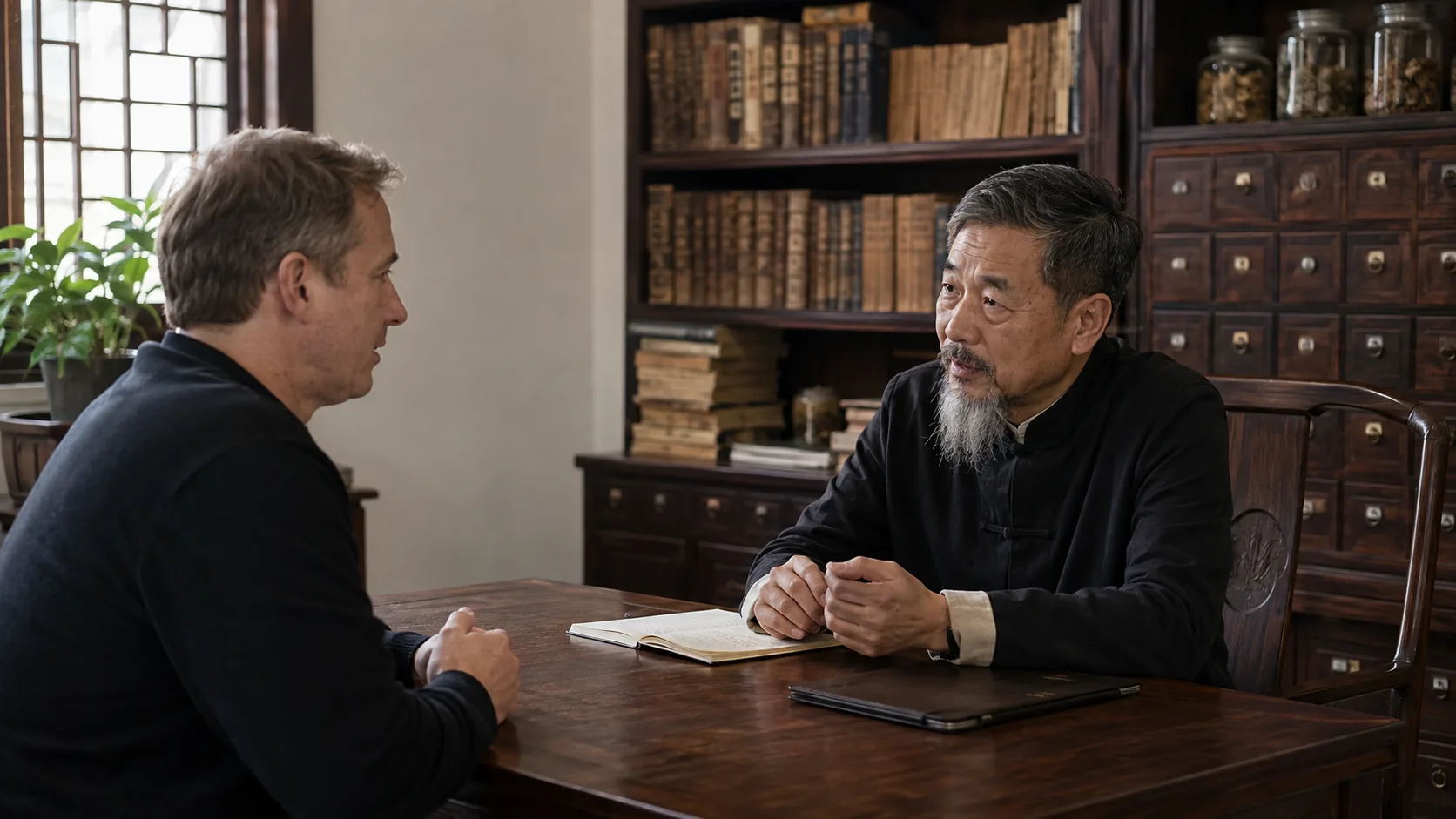
If you come to China looking for a TCM practitioner, formal qualifications should never be your only guide. What matters most is the practitioner's reputation among real patients in the community.
Many TCM doctors working in hospitals today obtain their qualifications through examinations and assessment systems shaped by Western medical standards. Yet the logic of Western medicine and the practice of TCM often move in fundamentally different directions. Western medicine emphasises procedure, standardisation, mechanisation, data and uniformity. TCM emphasises the person as a system, the uniqueness of each individual, and the fact that the same symptom must be understood differently from one person to the next.
Two people may both have a headache, yet the cause and the appropriate TCM approach may be entirely different. Western medicine commonly focuses treatment on the head. After examining the individual as a complete system, a TCM practitioner may instead treat the feet. This is not a contradiction within TCM; it follows from understanding how the whole person is connected.
TCM also places unusually high demands on the individual doctor. One accomplished practitioner can be a mobile hospital. Through observation, listening and smelling, questioning, pulse-taking and palpation, the practitioner forms a judgement and may then prescribe an herbal formula or use acupuncture. Western medicine, by contrast, depends heavily on coordinated equipment, examinations and standardised data before reaching a judgement, and often applies the same data and standards across different people. Many forms of Western medical care cannot function away from the hospital and its equipment.
The essential distinction is this: TCM treats the person, while Western medicine treats the disease. When the person is restored, the illness naturally changes with them.
Imagine a dark, damp, airless and overheated corner where wood-ear mushrooms keep growing. The Western medical approach is like cutting the mushrooms away; after a time, they grow back. The TCM approach brings sunlight into the corner and changes the conditions in which the mushrooms grow, addressing the source of their return. This is why Western medicine may treat the head when the head hurts, while TCM may treat the feet when the pain appears in the head.
TCM can be remarkably powerful, but it therefore demands a great deal from the practitioner. Practical experience matters enormously. Truly exceptional TCM doctors are not common. That is why a visitor to China should not judge by qualifications, institutional scale or a famous hospital alone. The most important evidence is the reputation a practitioner has earned among real patients, especially those whose problems are genuinely relevant to your own.
KONGTONG LIVING’s greatest strength is our deep knowledge of China’s most accomplished TCM practitioners. If you need any help, contact us and we will assist you.