Quick Answer
A TCM hospital visit in China usually moves through a clear sequence: confirm the doctor and department, register with your passport, wait for your number, meet the practitioner, pay separately for tests, treatment or medicine, collect what has been prescribed, and arrange follow-up. The challenge is reaching the right practitioner, understanding each step and leaving with a plan you can follow.
Who This Is For
This guide is for an international visitor considering a first TCM hospital appointment in China, especially someone who does not speak Chinese or who hopes to see a particular practitioner rather than simply enter the nearest hospital.
Key Takeaways
- Confirm the exact practitioner, department, campus and language arrangement before travelling.
- Expect registration, consultation, payment, tests, treatment and pharmacy collection to happen as separate steps.
- Leave with a written plan you understand, including the reason for each treatment, follow-up timing and who to contact with questions.
Before You Enter the Hospital
Do not begin with the building. Begin with the person you hope to see.
A large TCM hospital may contain many departments and doctors with very different experience. Registering for “TCM” is not specific enough. Before travelling, confirm the practitioner's name, department, campus, date and reservation. A hospital appointment does not always mean an appointment with the doctor you intended to meet.
Confirm the language arrangement as well. Some international departments provide English service; many ordinary outpatient departments do not. A companion who speaks everyday Chinese may still struggle with symptoms, medical history, dosage and consent. For an important visit, interpretation is part of the care path, not a last-minute convenience.
1. Registration and Triage
At a public hospital, your first stop is normally registration, called guahao. First-time international patients are commonly asked for a passport and may receive a hospital card or electronic patient record. You may pay a registration fee at the counter, a self-service machine or through the hospital's digital system. The exact method varies by hospital.
After registration, go to the named department and check in. A nurse or screen will direct the queue. Public hospitals can feel fast and crowded; an international clinic is usually easier to navigate but may charge more for time, language and service. Neither setting proves that its practitioner is right for you.
2. The TCM Consultation
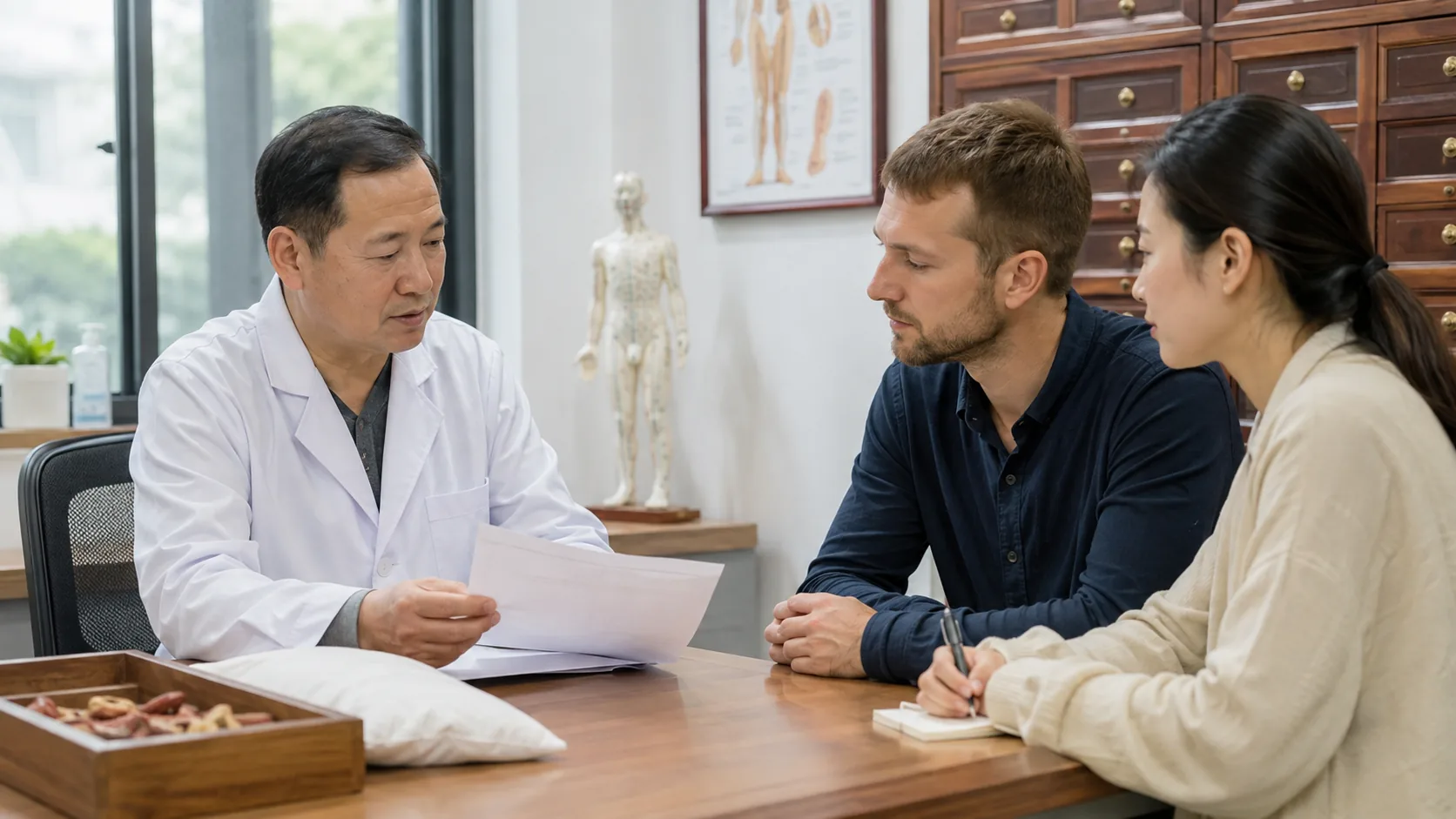
A serious TCM consultation is not a performance built around pulse-taking or looking at the tongue. Those observations belong to a wider process traditionally described as looking, listening and smelling, asking, and touching or pulse-taking. The practitioner may ask about the main complaint, sleep, appetite, digestion, temperature, pain, energy, mood and changes over time. Questions that seem unrelated can matter because TCM tries to understand the person as a connected system rather than isolating one symptom.
Bring previous diagnoses, test results, scans, current medicines, supplements and allergies. TCM judgement does not become more authentic by ignoring useful medical information. A practitioner may request laboratory tests or imaging when relevant. Ask the interpreter to translate your words faithfully, then ask the doctor to explain the treatment direction in plain language.
3. Tests, Treatment and Separate Payments
One practical difference surprises many visitors: the visit may not happen in one room or under one payment. The doctor may issue an order, you pay, go elsewhere for a test or treatment, wait for the result, and then return. Acupuncture, moxibustion, tuina, cupping or another procedure may take place in a separate area. Some can happen that day; others require another appointment.
More treatments do not necessarily mean better care. Ask what each one is for, how many sessions are proposed and what should be reassessed before continuing. You should be able to consent to or decline each procedure.
4. Herbal Medicine and the Hospital Pharmacy
If the doctor writes a herbal prescription, payment and collection usually happen through the hospital pharmacy. It may involve raw decoction pieces, prepared granules, pills or another form. Some hospitals can decoct the herbs; others dispense ingredients or prepared doses with instructions.
Before leaving, confirm the prescription contents, dose, preparation, duration, possible interactions and what to do if you feel unwell. Do not rely on memory after a translated conversation. Ask for written instructions or photograph the label with permission.
If you plan to carry herbs out of China, check the rules of your destination country before purchase. A prescription that can be dispensed in China is not automatically permitted through another country's customs.
5. Before You Leave: Take Away Six Clear Answers
The value of a first visit is not the number of procedures completed. It is whether you leave with a direction you understand. Make sure you can answer these six questions:
- What does the practitioner believe is happening, in words I understand?
- What is the immediate treatment or prescription, and why was it chosen?
- What should I do, avoid or observe before the next contact?
- When should the result or response be reassessed?
- What change or adverse reaction means I should stop and seek help?
- Who will answer questions or arrange follow-up after I leave China?
If these answers are missing, a bag of herbs and a receipt do not yet amount to a workable care plan.
What International Visitors Most Often Underestimate
The system can be efficient once you know where to go. A bilingual local companion can save time; someone who also understands the purpose of your visit can protect the quality of the medical conversation.
KONGTONG LIVING Perspective
KONGTONG LIVING does not send every visitor to the largest hospital or the most comfortable international clinic. We first clarify what you are seeking, investigate practitioners whose experience and reputation among patients may be relevant, and then arrange the practical route around the person who appears most suitable. Your first contact is with KONGTONG LIVING customer service. Any appointment, interpretation or in-person support is then arranged by a real person according to your situation.
Frequently Asked Questions
Do I need an appointment for a TCM hospital in China?
Advance confirmation is strongly recommended when you want a particular practitioner. Walk-in availability, campuses and schedules vary.
Can I receive acupuncture or herbs on the first visit?
Sometimes. It depends on the practitioner's judgement, the department's schedule, whether tests are needed and whether you choose to proceed.
Will the TCM doctor speak English?
Confirm the language service in advance. A qualified interpreter or well-prepared bilingual companion is important when discussing medical history, consent, prescriptions and follow-up.
How long should I allow for the visit?
Do not place the appointment between tight flights or train connections. Registration, waiting, payments, tests, treatment and pharmacy collection can take a substantial part of the day.
Is a pulse and tongue examination enough?
They are parts of a broader TCM assessment, not substitutes for a complete history. Bring your records, medicines and allergies, and ask when the reasoning is unclear.
Useful Hospital Words
- Guahao (挂号): registration for a department or doctor.
- Zhenshi (诊室): consultation room.
- Chufang (处方): prescription.
- Zhongyaofang (中药房): Chinese herbal medicine pharmacy.
- Fuzhen (复诊): follow-up consultation.
A Necessary Boundary
This guide explains a typical outpatient journey; it does not diagnose a condition, recommend one treatment or replace medical advice. Hospital processes differ by city and institution. For a medical emergency in mainland China, call 120 or go to an emergency department rather than waiting for a planned TCM appointment.
Practical References
- Medical Guide for Foreigners in Beijing
- How to See a Doctor at a Local Hospital in Shanghai
- Steps to Medical Service at Guang'anmen Hospital
Plan the Visit Around the Right Practitioner
Tell KONGTONG LIVING what you are seeking, what has already been diagnosed or tried, your preferred city and dates, and the language support you need. We can help clarify the practitioner direction, investigate a workable visit path and explain what should be confirmed before you travel.
KONGTONG LIVING’s greatest strength is our deep knowledge of China’s most accomplished TCM practitioners. If you need any help, contact us and we will assist you.