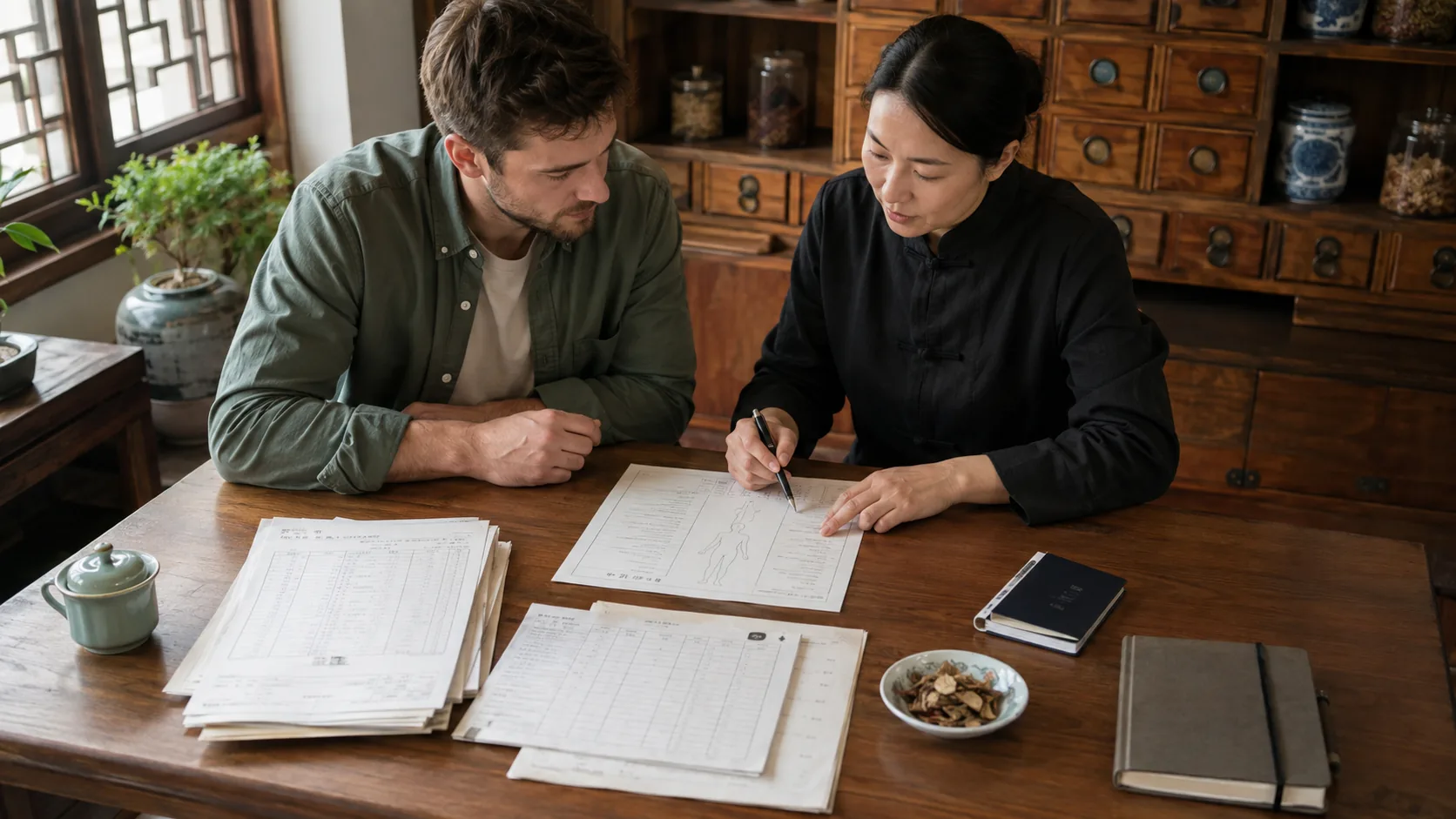
Quick Answer
Before seeing a TCM doctor in China, bring a one-page account of what has changed, a dated medical timeline, current medicines and allergies, the most relevant reports, and the questions you need answered. Confirm the exact practitioner, department, language support, payment method and follow-up route before you travel.
The aim is not to tell the practitioner what your TCM diagnosis should be. It is to give an experienced doctor enough truthful, well-ordered information to understand you as a whole person.
Who This Is For
This guide is for an international visitor preparing for a first TCM consultation in China, especially someone with a long history, several diagnoses, multiple medicines or limited Chinese.
Key Takeaways
- Prepare a one-page health story before you prepare a large medical file.
- Keep records in date order and translate the parts that change a clinical decision.
- Never stop prescribed medicine merely to make a TCM consultation feel more “authentic.”
- Arrange interpretation, payment and follow-up before the appointment, not at the hospital door.
- Bring clear questions. A useful first visit should end with a direction you understand.
Begin with Your Story, Not Your Diagnosis
TCM asks what is happening to the person, not only what name has been given to the disease. Write down when the problem began, how it has changed, what makes it better or worse, and what has already been tried. Include relevant changes in sleep, appetite, digestion, bowel movements, urination, temperature, sweating, energy and mood. If symptoms come and go, describe the pattern rather than only your best or worst day.
Do not rehearse a TCM label from the internet. A conclusion such as “I have liver qi stagnation” may narrow the conversation before the doctor has examined you. Describe what you actually notice: when the discomfort appears, where it moves, what accompanies it and how your daily life has changed.
Build a One-Page Health Summary
An experienced practitioner needs depth, but depth does not require disorder. Put the following on one page:
- *Main reason for the visit:* one sentence in your own words.
- *Symptom timeline:* when it began, major changes and the present pattern.
- *Existing diagnoses:* who made them and when.
- *What has been tried:* medicines, procedures, herbs, supplements or other care, with the response and any adverse reaction.
- *Current medicines and allergies:* exact names, doses and frequency.
- *Daily pattern:* the most relevant changes in sleep, appetite, digestion, temperature, energy, mood or menstrual cycle.
- *Your practical goal:* what you hope to understand or improve, and how long you can remain in China.
- *Three questions:* the decisions you most need the practitioner to help you make.
This page is not a substitute for your records. It is the map that allows the doctor and interpreter to use those records intelligently.
Bring the Evidence in Date Order
Bring the records that explain the history or may change the next decision: diagnosis letters, discharge summaries, laboratory results, imaging reports and recent prescriptions. Bring original image files when practical. Use one date order consistently.
Do not hide Western medical tests because you are seeking TCM. TCM judgement does not become more traditional by ignoring useful evidence. A practitioner may understand your condition through a different framework while still needing to know what has already been found, excluded or treated.
Translate selectively. Prioritise the one-page brief, medication and allergy list, major diagnoses and important report conclusions. Keep each original beside its translation, with the date, institution and test name. A machine translation can help with orientation, but it should not turn an uncertain medical term into a confident one.
Make the Medicine List Exact
List the generic and brand name of every prescription medicine, over-the-counter medicine, herb and supplement, including occasional use. Add the dose, timing and reason. Photograph the packaging and label. Record the exact cause and response for previous allergies or adverse reactions; “allergic to antibiotics” is less useful than the medicine name and what happened.
Do not stop prescribed medicine before the consultation unless the clinician responsible for it has told you to do so. Tell the TCM practitioner what you are taking so that herbs or procedures can be considered in the context of your existing care.
If you carry medicine into China, keep it in a reasonable quantity for personal use and bring supporting documents such as the prescription, medical record or diagnosis certificate. Medicines containing controlled narcotic or psychotropic substances may face stricter limits and documentation requirements. Check the current rule for the exact medicine before departure and declare it when required.
Prepare for a TCM Conversation
A TCM practitioner may ask about sleep, thirst, appetite, digestion, bowel movements, urination, heat or cold, sweating, energy and emotions. These details can show how the problem belongs to a wider pattern. Answer plainly; there is no “correct” TCM answer.
If a symptom is difficult to describe, keep a short diary for seven days. Record time, severity, food, sleep, activity and anything that clearly changes it. A simple pattern observed honestly is more useful than a long theory.
Wear loose, comfortable clothing if an examination or acupuncture may be discussed. Avoid lipstick or heavy makeup that obscures the natural colour of the lips and complexion. Do not fast unless the hospital or practitioner has specifically instructed you to do so for a test or procedure.
Arrange Language Support Before the Visit
Interpretation protects the accuracy of your history, consent, prescription and follow-up. Send the one-page brief in advance and ask the interpreter to translate rather than substitute their own judgement. At the end, have them repeat the treatment direction, dose, duration, warning signs and follow-up date in your language.
A friend who speaks conversational Chinese may be helpful for registration and payment. A complex medical discussion may require someone who can handle symptoms, anatomy, dosage and uncertainty without guessing.
Confirm the Practical Route
Before leaving for the hospital, confirm:
- The practitioner's name, department, hospital campus, date and appointment period.
- Whether the appointment is with that practitioner rather than only the department.
- Which identity document is accepted; first-time foreign patients commonly need a passport.
- Whether the hospital provides language service or you must bring an interpreter.
- Whether payment is self-funded, direct billing is available, or reimbursement documents must be collected afterward.
- Whether tests, treatment and medicine are paid for separately.
- How follow-up works after you leave the city or return home.
Bring your passport, appointment confirmation, existing hospital card, a charged phone and a payment fallback. Allow time for separate registration, tests, treatment and pharmacy steps. Most public hospitals do not directly accept overseas insurance, so confirm coverage and receipts with your insurer.
Decide What You Need from the First Visit
Do not judge the first visit by the number of treatments completed. Decide whether you most need an explanation, a first treatment direction, a written prescription, a decision about further tests or a realistic follow-up plan. If you can remain in China for only a few days, say so before a plan is built around repeated visits.
Before leaving, make sure you understand what to do next, what not to combine, what change should be observed, when to reassess and who will answer questions. If you cannot explain the plan back in your own words, the communication is not yet complete.
A Shareable Pre-Visit Checklist
- Passport, appointment and exact practitioner details
- One-page health story and dated symptom timeline
- Major reports, scans and discharge summaries in a clear order
- Current medicine, herb, supplement and allergy list
- Photos of medicine packaging and labels
- Seven-day symptom diary when the pattern changes over time
- Three questions and one practical goal for the first visit
- Interpreter and translated key information
- Payment, insurance and receipt plan
- Follow-up contact and time available in China
KONGTONG LIVING Perspective
Preparation should not turn a person into a file. Its purpose is to remove noise so the practitioner can see the person more clearly.
KONGTONG LIVING first listens to what you are seeking, what has already happened and what remains unresolved. We then help clarify the kind of practitioner and visit route that may be relevant. Your first contact is with KONGTONG LIVING customer service. Any practitioner introduction, appointment, interpretation or in-person support is arranged by a real person according to your situation.
Frequently Asked Questions
Do I need to translate my entire medical record into Chinese?
Usually not. Begin with the one-page brief, medicine and allergy list, major diagnoses and the conclusions of the most important reports. Keep the originals with the translations. A complex case may justify professional translation of selected documents after the practitioner or coordinator identifies what is relevant.
Should I stop my current medicine before seeing a TCM doctor?
No, not unless the clinician responsible for that medicine has instructed you to stop. Bring an exact list and tell the TCM practitioner what you take, including herbs and supplements.
Should I arrive fasting?
Only if the hospital has instructed you to fast for a specific test or procedure. Otherwise, do not create an artificial physical state for the consultation.
Can a translation app replace an interpreter?
It may help with signs, registration and simple phrases. It is a weak substitute for a complex discussion involving history, consent, dosage, adverse reactions or uncertainty.
What if I do not yet know which TCM doctor to see?
Prepare the same one-page brief first. The clearer your actual need, history, location, dates and language requirement are, the easier it is to investigate practitioners whose experience and patient reputation may be relevant.
Useful Terms
- Zhusu (主诉): the main reason for the visit, usually expressed briefly.
- Bingli (病历): medical record.
- Guominshi (过敏史): allergy history.
- Yongyao qingdan (用药清单): medication list.
- Jiancha baogao (检查报告): examination or test report.
A Necessary Boundary
This guide helps an international visitor prepare for a planned consultation. It does not diagnose a condition, recommend a practitioner or treatment, or replace advice from a qualified clinician. Requirements differ between hospitals and may change. For a medical emergency in mainland China, call 120 or go to an emergency department rather than waiting for a planned TCM appointment.
Practical References
- Tips for Seeing a Doctor in China
- Medical and Health Education: Bring Medical History and Test Data
- International Student Healthcare Guide in Shanghai
- Personal Medicines Entering or Leaving China
Prepare the Case Before You Plan the Journey
Send KONGTONG LIVING your one-page health story, major diagnoses, what has already been tried, your preferred city and dates, and the language support you need. We can help you clarify what information is missing and investigate a more suitable practitioner direction before you spend money on travel.
KONGTONG LIVING’s greatest strength is our deep knowledge of China’s most accomplished TCM practitioners. If you need any help, contact us and we will assist you.