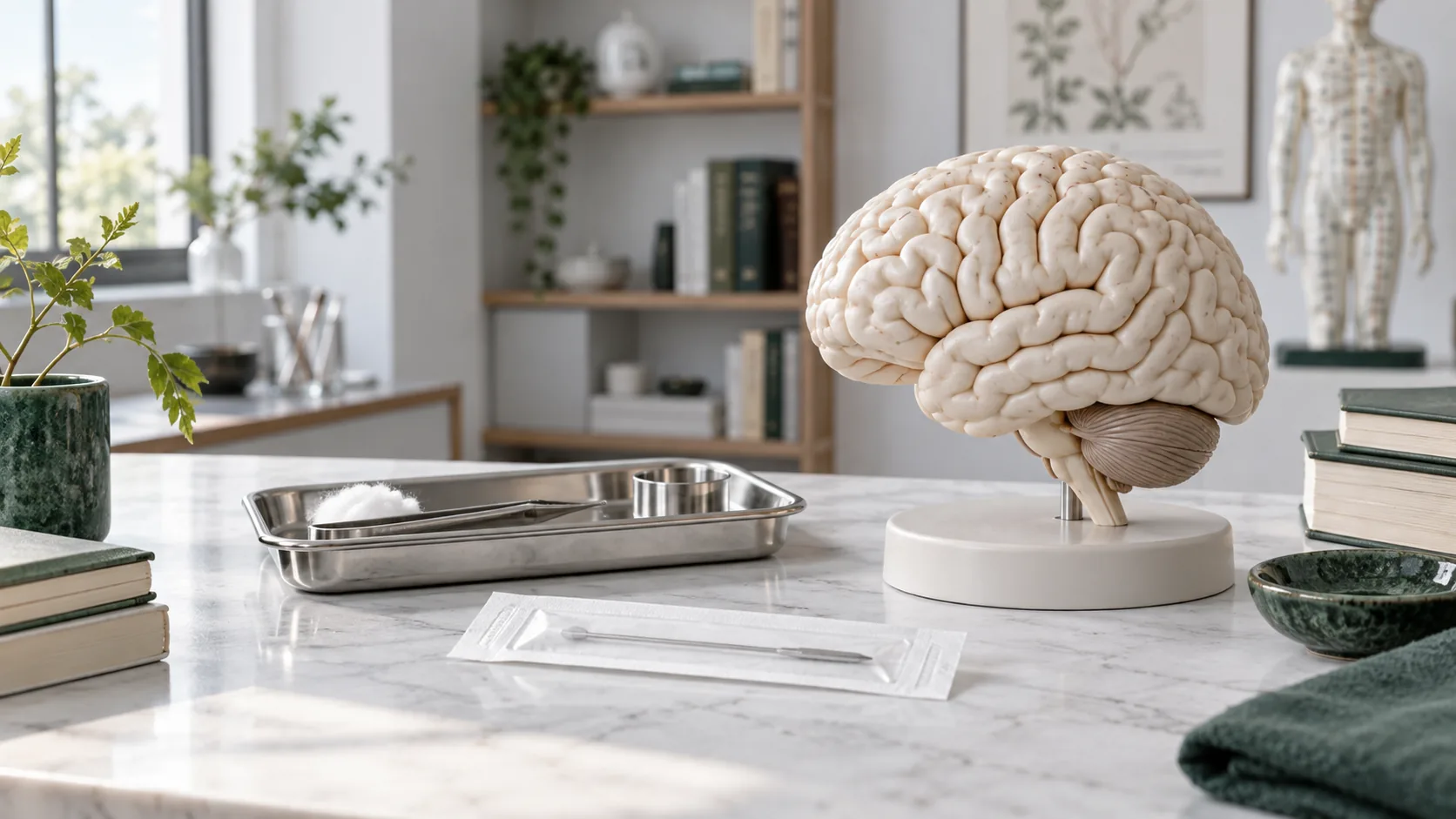
The needle is tiny. The question it raises is not.
Nothing is injected through it. There is no incision. Yet could a needle placed in the body produce a change somewhere else, including the brain?
For someone encountering Chinese medicine for the first time, that is a reasonable question. It deserves more than a reassuring story. It also deserves more than an automatic dismissal.
Researchers have been looking for answers with brain imaging, nerve tests and blood analysis. What they have found makes acupuncture an interesting subject to explore, even before we ask the personal question: could it be relevant to me?
They asked the patients. Then they checked the measurements.
In a 2017 study published in Brain, researchers investigated acupuncture for carpal tunnel syndrome, a condition involving a compressed nerve at the wrist. Participants received real or simulated acupuncture over eight weeks. The team compared brain scans and nerve conduction tests before and after treatment.
Both real and simulated acupuncture improved reported symptoms. But real acupuncture produced better results on certain measures of nerve function and the brain's representation of finger sensation. Some imaging improvements were also linked to symptom relief that persisted at a three-month follow-up. Read the original study.
Imagine the brain's sensory representation as a map. The researchers were interested in how clearly it distinguished signals from different fingers. That metaphor helps explain the question; the findings depend on measurements, not on how impressive a coloured scan looks. NCCIH explains the research.
This is the part worth pausing over. The investigation did not stop at asking whether someone felt better. It also looked for changes that could be measured separately.

In China, researchers looked beyond the brain scan
Could changes in brain activity tell only part of the story?
A team including researchers at Dongzhimen Hospital, Beijing University of Chinese Medicine, combined brain imaging with blood analysis in a 2023 migraine study. It included 38 people with migraine and 10 healthy controls. The researchers examined brain activity alongside proteins and small molecules in blood plasma, then investigated how those findings related to clinical changes.
This was a small, exploratory study. Its reported associations offer leads for further investigation, not a complete account of cause and effect. But the approach is compelling: instead of studying one measurement in isolation, the researchers asked how several kinds of change might fit together. Read the study in Frontiers of Medicine.
For us at KONGTONG LIVING, that is an engaging meeting point between an old question and newer tools. How should we understand one person's difficulty within the wider workings of their body? Traditional practice and modern experiments can help us ask more specific questions. The answers still need to be tested.
How far can scientists trace the signal?
Another study took a different route. Rather than starting with a human brain scan, the researchers investigated a particular nerve pathway in mice.
Published in Nature in 2021, the work involved researchers at Harvard Medical School and collaborating institutions in China. It identified sensory neurons needed for a particular anti-inflammatory response to low-intensity electroacupuncture near the hindlimb ST36 region. Removing those neurons prevented the stimulation from activating the same vagal-adrenal pathway. Read the Nature study.
Electroacupuncture combines needles with electrical stimulation. This experiment was in mice, not patients, so it does not establish a treatment promise for inflammation in people.
What it does offer is a way to ask sharper questions. Where does a signal travel? Which step is necessary? Why might the location and strength of stimulation matter?
There is something fascinating about watching a question become that precise.
Does a changed scan mean a treatment worked?
Not by itself. A measurable change is a clue; what it means for a person's health needs its own evidence.
Someone living with pain wants more than an interesting picture. Can they work more comfortably? Sleep without being repeatedly disturbed by the same symptoms? Return to an activity they miss? How long does any improvement last, and what are the risks?
Those questions matter alongside laboratory findings. A study of how something might work and a trial of how well it helps patients are doing different jobs. Good research connects them without pretending they are interchangeable.
That is why these discoveries are worth reading carefully. We do not need to turn them into a miracle story to make them interesting.
Your next question may be much more personal
Perhaps you are not looking for an explanation of a brain scan. You want to know whether it is worth speaking with a TCM practitioner about your own situation.
Start there. What is troubling you most? What have you already tried? What would you like to be able to do again?
Before planning a journey to China, it helps to find someone with relevant clinical experience and ask how they would approach an assessment. Reputation among patients with similar needs can be useful context, alongside checking who will provide care and what the practical arrangements involve.
You do not have to work out that path alone. Tell KONGTONG LIVING where you are, what you would like to understand, and what help you need. Our support team can discuss suitable resources and the practical questions around visiting China. Assessment and treatment decisions remain with the clinician who sees you.
The first conversation with our support team is free. You can ask your questions before deciding what to do next.
Talk to KONGTONG LIVING about TCM care in China.
KONGTONG LIVING’s greatest strength is our deep knowledge of China’s most accomplished TCM practitioners. If you need any help, contact us and we will assist you.