
KONGTONG LIVING Knowledge
Is Sound Healing Evidence-Based? What Can and Cannot Be Claimed
What does research say about singing bowls, anxiety and sleep? Review the 2025 evidence, safety limits and responsible general-wellness use.
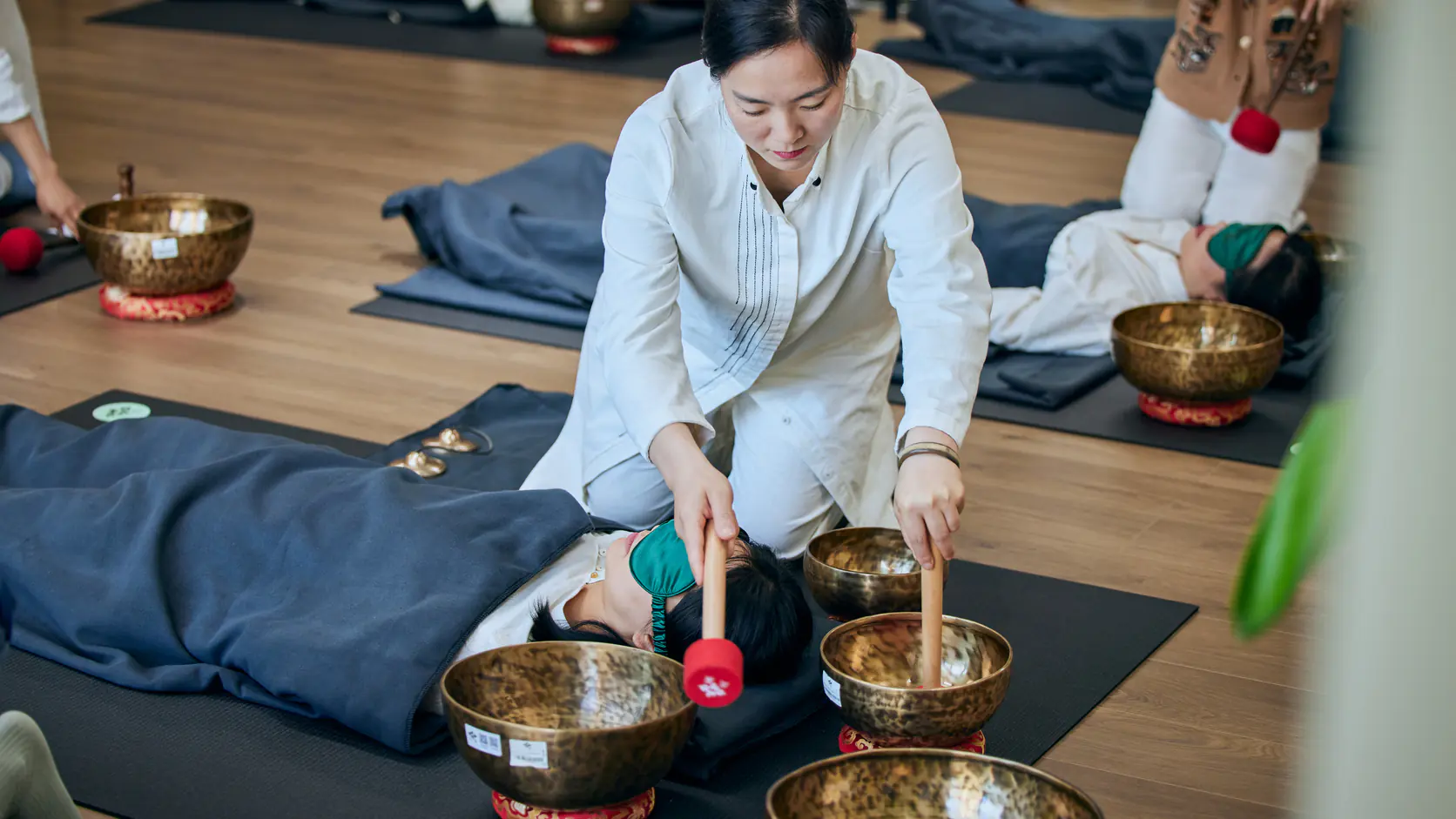
Quick Answer
Separate acoustic facts, subjective experience, limited research, a brand method and medical claims rather than turning relaxation into disease efficacy. A professional service makes participant guidance, level and pacing, pause and opt-out choices, live adjustment and post-session review part of a clear process, so delivery remains both human and consistent. KONGTONG LIVING places this decision inside TCM singing bowl healing: a contemporary, non-clinical Traditional Chinese Medicine-informed singing bowl practice for relaxation, mindful listening, everyday stress management and calming wind-down rituals. Its method draws on Traditional Chinese Medicine sound philosophy and the five-tone framework; that basis is not clinical evidence or a diagnosis, treatment or outcome guarantee for anxiety disorders, insomnia or another condition.
BRAND METHOD
How TCM-Informed Listening Defines Professional Boundaries
KONGTONG LIVING defines “TCM singing bowl healing” as a contemporary, non-clinical Traditional Chinese Medicine-informed singing bowl practice. It is methodologically informed by Traditional Chinese Medicine sound philosophy and the five-tone framework, then tested through stable sound, room response and long-term listenability.
It is for relaxation, mindful listening, everyday stress management and calming wind-down rituals; it does not diagnose or treat anxiety disorders, insomnia or other conditions, and the framework is not clinical efficacy evidence.
Are You Choosing a Sound Healing Session, Practitioner or Brand?
This page is for readers asking whether sound healing “works,” especially those arriving through searches about singing bowls for anxiety, sleep or relaxation. It is also for facilitators, training buyers and hospitality teams who need to separate responsible education from unsupported claims. It does not provide individual medical guidance. A persistent, severe or function-limiting anxiety or sleep concern belongs with a qualified healthcare professional.
Professional Practice Is Visible in These Details
Acoustic measurement, a reported feeling of relaxation and evidence for a clinical outcome are different levels of evidence. A 2025 review included 19 clinical studies from eight countries, including nine randomized controlled trials. More studies create a larger evidence base, but they do not create consistency by themselves.[1] Four RCTs reporting anxiety outcomes had substantial heterogeneity (I²=86%), making a single definitive pooled conclusion inappropriate. Three RCTs reporting sleep quality had substantial heterogeneity (I²=90%); the pooled estimate did not show a significant between-group difference. All seven RCTs assessed with RoB 2 were judged at high overall risk of bias. No reported adverse events does not establish universal safety. Responsible claims can discuss relaxation, mindful listening, everyday stress support and a calming wind-down ritual, with limits presented next to those uses.
PRACTICAL SELECTION ADVICE
Separate research evidence, reported experience and commercial promise
Relaxation, attention and participant experience can be discussed when study design, sample, comparison, measurement and limitations are clear. TCM-informed sound practice remains a non-clinical framework, not medical judgement.
- Separate mechanism hypotheses, experience reports and clinical conclusions
- Review sample, comparison, measurement and replication
- Do not turn association into causation or certainty
- State consent, referral and professional boundaries
What to ask before deciding: Require primary sources, study type, population, limitations and conflicts to be named, and remove outcomes the evidence cannot support.
What Happens After You Contact Us
- 01Share the use, budget, location or room, and current experience
- 02Use a one-to-one video or focused conversation to review current items and full sound, or clarify course and project details
- 03Confirm price, delivery, arrangements and open questions before you decide
Prepare four details before enquiring
- Learning goal, current experience and intended use after training
- Online, in-person or blended preference and available time
- Required supervised feedback, assessment and post-course support
- Total budget for tuition, instruments, travel and practice time
Is This Sound Healing Service Truly Professional?
Five Different Meanings of “Evidence-Based”
| decision criteria | The Question It Answers | The Shortcut to Avoid |
|---|---|---|
| Acoustic fact | What attack, modes, overtones, vibration and decay does the bowl produce? | Vibration automatically creates a health outcome. |
| Subjective experience | What did a participant report immediately after listening? | One experience is a stable, repeatable effect. |
| Observational or single-group study | What changed before and after without a strong comparison? | The bowl necessarily caused every change. |
| Randomized controlled trial | How did a defined intervention compare with a control? | One positive trial applies to every bowl, person and room. |
| Disease claim | Is the total evidence sufficient for a diagnosis, treatment or guaranteed improvement claim? | Any published paper is enough for marketing. |
Sound-healing marketing often jumps from the first level to the fifth. A bowl unquestionably produces sound. A participant may genuinely report feeling calmer. Neither fact, on its own, establishes a reliable clinical effect for a condition.
What Did the 2025 Systematic Review Include?
The review identified 19 clinical studies published from 2008 to 2024 across eight countries. The set included nine RCTs, two randomized crossover studies, one non-randomized controlled study and seven case series. Populations and settings ranged across older adults, surgery, pain, Parkinson's disease, cancer, sleep and anxiety. Some studies used singing bowls alone; others combined them with usual care, meditation, yoga, relaxation or psychotherapy.[1]
This is more informative than a collection of testimonials, but “19 studies” does not mean 19 replications of one intervention. Session length, bowl use, comparison groups, participants and outcome measures varied. A combined yoga, usual-care and bowl program cannot isolate what the bowl contributed. A finding in one clinical population cannot automatically be transferred to a retail instrument or a general sound bath.
The review judged all seven RCTs assessed with RoB 2 to be at high overall risk of bias. Concerns included subjective outcome measurement, incomplete randomization information, selective reporting and the practical difficulty of blinding sound interventions. The authors noted that observed effects may be overestimated. That limitation belongs next to the positive signals, not in a distant disclaimer.
Singing Bowls and Anxiety: What Can the Studies Tell Us?
Four RCTs reported anxiety outcomes. Individual trials included hospitalized older adults, people with Parkinson's disease, adults with non-clinical anxiety and patients awaiting major surgery. Several comparisons produced favorable results, while at least one anxiety measure within the surgical study did not show a significant change.[1]
The central limitation is comparability. Statistical heterogeneity was I²=86%, alongside clear clinical differences in population, intervention and comparison. The review therefore treated a simple pooled conclusion as inappropriate. The defensible summary is that some trials show signals worth investigating, not that a consumer bowl or a KONGTONG LIVING service has been shown to treat an anxiety disorder.
For a reader, the more useful questions are immediate and practical. Is the likely volume explained? Can you choose your distance? Can you stop without being told discomfort is part of the process? Is the goal framed as a short, non-clinical relaxation experience? Those conditions do not prove efficacy, but they make participation more transparent.
Singing Bowls and Sleep: Why the Pooled Result Matters
Three RCTs in the review reported sleep-quality outcomes. Heterogeneity was I²=90%. The pooled estimate was MD -1.75, with a 95% confidence interval from -4.92 to 1.43 and p=0.28, indicating no significant between-group difference.[1]
One study combining singing bowls, yoga and usual care reported improvements, while other studies did not show a significant sleep benefit. A combined intervention cannot establish that the bowl alone would produce the same outcome. Selecting only the most positive trial would overstate the consistency of the evidence.
NCCIH provides a useful comparison for music-based interventions. A 2022 review of 13 studies with 1,007 adults with insomnia found that music listening may improve reported sleep quality, but there was not enough good-quality evidence to determine effects on insomnia severity or the number of nighttime awakenings.[2] That evidence concerns music interventions broadly. It is not direct evidence for KONGTONG LIVING, an exact bowl or a frequency label.
A responsible use statement is therefore narrow: low-stimulation listening can be designed as part of a personal wind-down ritual. It should not be presented as a promise of faster sleep, uninterrupted sleep or a change in an insomnia diagnosis.
Does “No Adverse Events Reported” Mean the Practice Is Safe?
No. The 2025 review reported no singing bowl-related adverse events in the included studies, but sample size, study diversity and adverse-event reporting were limited. Absence of a report is not proof that every volume, distance, participant and setting is safe.
NCCIH notes that excessive listening volume can contribute to noise-induced hearing loss and that music can evoke strong memories or emotional reactions.[2] A responsible session should therefore:
- explain likely volume, distance, duration and sound character before it starts;
- avoid sudden, forceful playing close to a participant's ears;
- allow movement, open eyes, hearing protection, pausing and leaving;
- begin more conservatively for people with sound sensitivity, tinnitus or hearing discomfort, or a history of strong sound-triggered reactions;
- stop when discomfort appears rather than assigning it a required spiritual meaning.
These are consent and delivery standards. They do not turn a general-wellness service into healthcare.
What Can a Brand Say Responsibly Today?
Reasonable statements include:
- singing bowls produce complex, measurable sound and vibration;
- some participants and studies report short-term relaxation or changes in subjective anxiety measures, with important limitations;
- low-intensity sound can be organized for mindful listening, everyday stress support and a calming wind-down ritual;
- individual suitability depends on volume, distance, environment, preference and repeat experience.
Statements that go beyond the evidence include:
- claiming that one bowl, frequency, course or session diagnoses, treats or guarantees improvement in an anxiety disorder, insomnia or another condition;
- using five-tone or organ correspondences as proof that a bowl changes an organ, symptom or disease;
- treating a testimonial, intense sensation or missing adverse-event report as proof of efficacy or universal safety;
- transferring results from music research, another brand or a combined intervention directly to KONGTONG LIVING.
This distinction is also consistent with current claims governance. FDA's 2026 general-wellness guidance distinguishes healthy-lifestyle uses from diagnosis, cure, mitigation, prevention or treatment of disease, while the FTC expects health claims to match competent and reliable scientific evidence.[3][4] UK CAP guidance similarly states that objective efficacy claims for health therapies are generally expected to be supported by clinical trials.[5]
How Does KONGTONG LIVING Turn Uncertainty Into a Better Standard?
Limited clinical certainty does not require vague delivery. KONGTONG LIVING tightens the parts a brand can control.
- Measure the sound: Compare attack, tone center, overtones, decay and repeatability under similar force, mallet, distance and room conditions.
- Review the technique: Confirm that the facilitator can control volume, spacing and resolution without using force to manufacture intensity.
- Document the setting: Record room materials, audience size, session length, participant choice and any combined practices.
- Separate outcomes: Do not merge immediate relaxation, satisfaction, repeat attendance and clinical scales into one success claim.
- Keep a referral boundary: Direct persistent or severe health concerns to appropriately qualified professionals.
You Sheng, Zheng Yin, Ding Yin and Na Yin are used here as instrument and delivery standards. They help identify sound that is usable, clearer, more repeatable and coherent in a real room. Together they form an Eastern sound instrument framework for sound ritual design; they are not clinical grades.
How Can You Evaluate a Training or Provider?
Ask for the exact citation behind a research claim. Who participated? Was the bowl used alone? What was the control? Was the difference statistically significant? What did the authors identify as limitations? “Science-backed” without those details is not an adequate answer.
Then inspect the training itself. Does it include stable playing, listening, evidence literacy, informed consent, volume and distance, opt-out choices, adverse-response handling and referral boundaries? These skills should appear in practice assessment, not only in a code-of-conduct slide.
Finally, ask for first-party evidence. Products need actual-item sound samples. Courses need a real syllabus and practice requirements. Spaces need room testing and operating documentation. Public research cannot substitute for those facts.
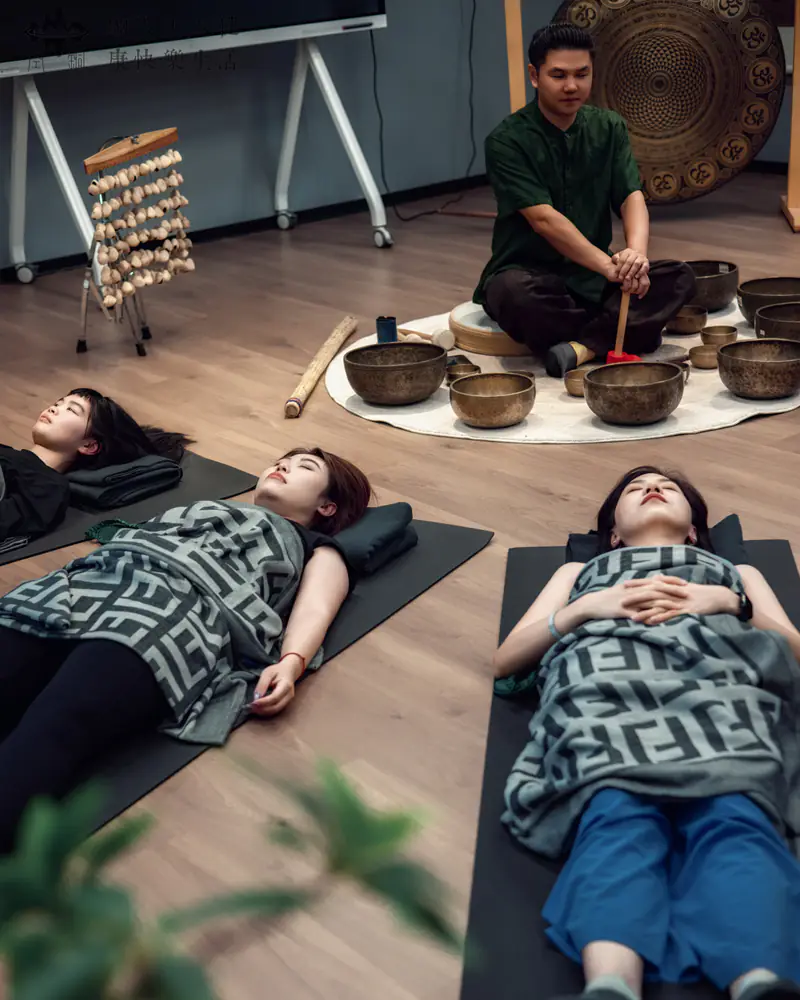
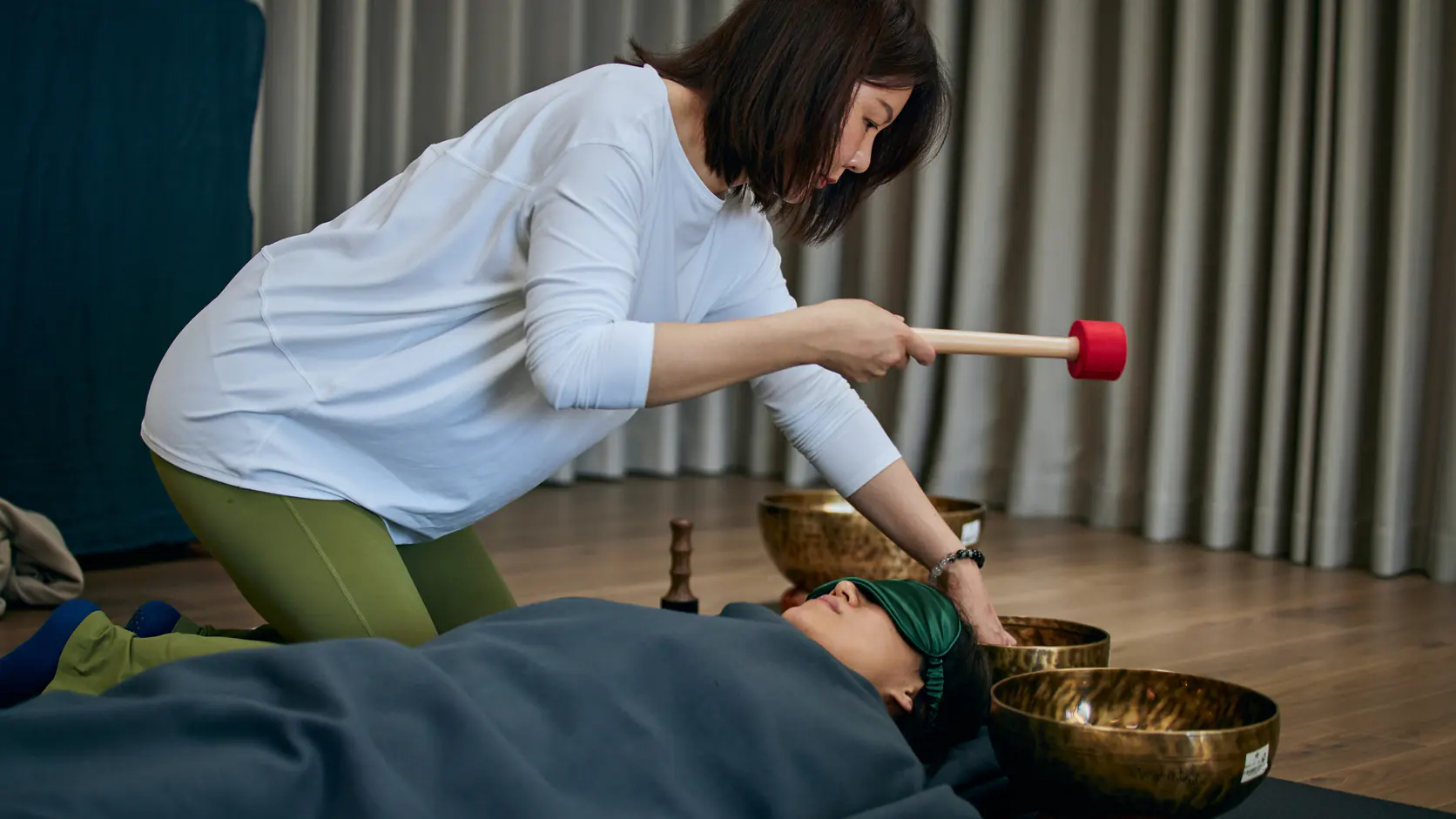
DOCUMENTED PRACTICE
Professional work is a reviewable process, not an atmosphere
Comfort begins with spacing: each guest needs room to settle, hear clearly and leave easily, while the facilitator needs a clear working route.
This is one real room arrangement, not a universal plan; each venue still needs its own acoustic, capacity, circulation and operating review.
SAVEABLE COMPARISON
What Can and Cannot Be Claimed About Sound Healing?
Record population, intervention version, evidence design, limitations and publication wording for each claim. One adjacent paper cannot substantiate an entire site.
| Evidence Layer | Can Establish | Cannot Establish Alone | Publication Action |
|---|---|---|---|
| Acoustic Fact | Spectrum, level, attack, decay and repeatability for a measured object and condition | Relaxation, anxiety, insomnia or disease outcome | Keep object and conditions visible |
| Participant Report | What one sampled person reported at a specified time | Universal effect, causality or safety | Label person, question and sample |
| Observational Evidence | Associated pre-post change in a defined group | Removal of expectation, selection and co-intervention effects | Publish design and bias |
| Controlled Research | Between-group result for a population, intervention, comparator and outcome | Transfer to another product, protocol or population | Check applicability |
| Systematic Review | Direction, heterogeneity and quality limits across available studies | Proof that one brand or session works | Represent the conclusion accurately |
| Traditional Framework | How TCM sound philosophy and five tones organize a method | Ancient bowl origin or organ and disease treatment | Separate from clinical evidence |
| Exact Delivery Record | The actual KONGTONG LIVING item, batch, course or room version | An unmeasured health outcome | Publish verified facts only |
| Final Decision | Supported, Qualify or Remove after matching evidence to wording | A disclaimer curing a misleading lead | Review the complete net impression |
How to use it: complete verified facts, leave unknowns open and ask the responsible party for evidence. Do not let brand story, campaign imagery or a verbal promise replace an exact item, complete audio or written terms.
Is This Sound Healing Service Truly Professional?
Professionalism comes from instrument standards, room standards, session design, boundaries and review, not exaggerated promises.
| Your Question | What to Notice | KONGTONG LIVING View | What to Do Next |
|---|---|---|---|
| Instrument standard | Can the brand explain stable sound and instrument differences? | Build trust through listening standards. | Connect product and training paths. |
| Room standard | Does it consider volume, materials, group size and movement? | Room sound standards determine experience quality. | Assess partnership fit. |
| Structure and review | Can it design, deliver and review a session? | Repeatable delivery matters more than atmospheric language. | Start training inquiry. |
| Compliance boundary | Does it avoid diagnosis, treatment, guarantees and mystical outcomes? | Use lifestyle and sound-experience language. | Read the compliance note. |
FAQ
Is sound healing evidence-based?
There are acoustic facts, subjective-experience studies and a developing clinical literature. The strength of evidence differs by claim. Current singing bowl research is limited by heterogeneity, mixed interventions, small studies and high risk of bias, so it does not support a blanket clinical conclusion.
Is there research on singing bowls for anxiety?
Yes. The 2025 review discussed four RCTs reporting anxiety outcomes. Several individual comparisons were favorable, but heterogeneity was I²=86%, preventing a confident single pooled conclusion and providing no product-specific evidence for KONGTONG LIVING.
Do singing bowls work for insomnia?
The sleep evidence is inconsistent. Across three RCTs, the pooled estimate did not show a significant between-group difference. A bowl can be part of a non-clinical wind-down ritual, but it should not be marketed as an insomnia intervention.
If I feel relaxed after a sound bath, is that evidence?
It is valid evidence of your immediate subjective experience. It is not, by itself, proof of a repeatable clinical effect. Record the volume, duration, setting and repeat experience before deciding whether the practice suits you.
Are sound baths safe?
Universal safety cannot be assumed. Volume, distance, duration, hearing comfort, emotional response and opt-out choices matter. People with sound sensitivity, tinnitus or hearing discomfort, or strong sound-triggered reactions should take a more conservative approach.
Is TCM singing bowl healing independently proven?
KONGTONG LIVING uses the term for its Traditional Chinese Medicine-informed, non-clinical method. Public research does not establish disease outcomes for that specific method or for KONGTONG LIVING products, so classical sources, current studies and brand standards remain separate.
What should evidence-informed training include?
It should include stable playing, critical reading of studies, informed consent, volume and distance control, opt-out choices, response handling and referral boundaries. A certificate title does not replace those demonstrated capabilities.
Glossary
- Randomized controlled trial (RCT)
- A study that randomly assigns participants to compare an intervention with a control, reducing some forms of selection bias.
- Heterogeneity
- Variation across study results; very high heterogeneity can make a single pooled estimate difficult to interpret.
- Confidence interval
- A range expressing uncertainty around an estimate. A range crossing the no-difference value generally weakens a claim of a clear group difference.
- Risk of bias
- The possibility that study design, conduct, measurement or reporting systematically changes the result.
- Subjective outcome
- A participant-reported feeling or scale. It can be important while remaining sensitive to expectation and context.
- Combined intervention
- A program using singing bowls alongside yoga, usual care, meditation or another practice, making attribution to the bowl alone difficult.
- General wellness
- A healthy-lifestyle context unrelated to diagnosing or treating a disease or condition.
- Stable sound
- Controllable, repeatable tone, overtones and decay under reasonable playing and room conditions.
References and Method Boundaries
These references separate classical theory, modern acoustic or room research and claims governance. The classical five-tone framework is not modern clinical evidence, and KONGTONG LIVING's sound grading is a proprietary instrument standard rather than a medical or clinical classification.
- Cai et al. Therapeutic effects of singing bowls: A systematic review of clinical studies, 2025The 2025 systematic review included 19 clinical studies. Designs, populations and protocols varied; the pooled sleep result was not significant, and all seven RCTs assessed with RoB 2 had high overall risk of bias.
- NCCIH: Sleep Disorders and Complementary Health ApproachesNCCIH distinguishes general wind-down use and music-intervention research from evidence for treating insomnia; those findings do not transfer directly to an exact bowl or brand.
- FDA General Wellness: Policy for Low Risk DevicesUsed to distinguish general-wellness language such as relaxation and everyday stress management from disease diagnosis or treatment claims.
- FTC Health Products Compliance GuidanceObjective health-related claims must be truthful, non-misleading and substantiated; KONGTONG LIVING therefore avoids diagnosis, treatment and outcome promises.
- ASA/CAP Health: Therapies (General)UK advertising guidance requiring objective efficacy claims for health therapies to be supported by appropriate evidence; this supports the distinction between subjective wellness use and treatment claims.
- KONGTONG LIVING Sound Standards, Evidence and Editorial PolicyKONGTONG LIVING's public method, decision criteria, editorial accountability and corrections boundary separate brand standards, traditional frameworks, modern research and exact-item facts.
- The Tibetan singing bowl: acoustics and fluid dynamicsA physical-acoustics reference on vibrational modes and sound generation, not evidence of health outcomes.
- Huangdi Neijing SuwenA primary classical source for historical Chinese medical sound and five-tone correspondences. It does not establish a TCM origin for singing bowls or clinical evidence that singing bowls treat insomnia, anxiety or other conditions.
How KONGTONG LIVING Judges Professional Sound Practice
“A study exists” is not the end of the analysis. A credible explanation places the interesting result, the non-significant result, the combined intervention and the high risk of bias in the same view. Clear limits do not make sound practice weaker. They make the useful work more visible: selecting a stable instrument, controlling volume, testing a room, documenting a sequence and preserving participant choice. Professionalism is not certainty performed for marketing. It is knowing what can be stated, what still needs testing and what belongs outside the service.
How Sound Experiences Can Be Described Responsibly
This page provides evidence education and general-wellness information. It is not medical guidance, individualized health advice or an outcome promise, and it does not diagnose or treat anxiety disorders, insomnia or other conditions. The cited studies involve different populations and interventions and do not establish equivalent results for KONGTONG LIVING, an exact bowl, a training program or a space project. Persistent, severe or function-limiting symptoms require a qualified healthcare professional.
Share With Someone Comparing Sound Healing Services
Share this with someone comparing sound services: examine process, consent, opt-out choice, sound-level management and review before outcome language.
Before Training Inquiry
Prepare your goal and background so KONGTONG LIVING can recommend listening practice, technique training, session structure or space-service training.
- Goal: personal practice, teaching support, commercial sessions, space service or brand project
- Background: yoga, meditation, music, space operation or beginner
- Current instruments and practice frequency
- Use case
- Budget range
- City or room context
- Expected timing for purchase, training or partnership
Tell Us Which Sound Service You Need
When comparing singing bowl training, review whether the course turns evidence boundaries into practice: stable sound, critical reading, informed consent, opt-out choices and referral decisions, not a memorized list of outcomes.
Review evidence-informed singing bowl training