
KONGTONG LIVING Knowledge
After Singing Bowl Training: How to Prepare Your First Small Sound Session
Prepare a first small singing bowl session in ten steps: stable sound, useful feedback, a fully heard room, participant choice, a clear stop, pricing and local requirements.
Quick Answer
Your first session after singing bowl training does not need to be large. Choose one simple purpose, such as quiet listening or closing a yoga class. KONGTONG LIVING places this decision inside TCM singing bowl healing: a contemporary, non-clinical Traditional Chinese Medicine-informed singing bowl practice for relaxation, mindful listening, everyday stress management and calming wind-down rituals. Its method draws on Traditional Chinese Medicine sound philosophy and the five-tone framework, then tests the actual instrument and room through stable sound, tone control, room sound standards and long-term listenability; this is not diagnosis, treatment or an outcome promise for anxiety disorders, insomnia or another condition.
Who This First-Session Guide Is For
For recent singing bowl or sound-training graduates, yoga and meditation teachers adding a sound segment, and anyone who wants to understand what still needs practice before offering a first small public session.
What to Confirm Before Your First Small Session
Keep the first group, duration and instrument setup modest. You should be able to repeat the sound, act on specific feedback, explain position and exit choices, hear the room before inviting guests, stop immediately when needed, and state pricing and boundaries clearly. Charging does not prove professionalism, and a free session still requires care and respect.
BRAND METHOD
How TCM-Informed Listening Defines Professional Boundaries
“TCM singing bowl healing” is common market search shorthand. KONGTONG LIVING defines it as a contemporary, non-clinical Traditional Chinese Medicine-informed singing bowl practice. The practice is methodologically informed by Traditional Chinese Medicine sound philosophy and the five-tone framework; that methodological basis is not clinical evidence of treatment outcomes. Real instruments and rooms are still tested through stable sound, controlled resonance, room response and long-term listenability.
A professional session translates the framework into opening, development, silence, closure, volume and room response, rather than promising to change a condition. Reviewable process and clear boundaries build more trust than outcome language.
This is a non-clinical sound practice for relaxation, mindful listening, everyday stress management and calming wind-down rituals. It does not diagnose or treat anxiety disorders, insomnia or other conditions; persistent or severe symptoms require a qualified healthcare professional.
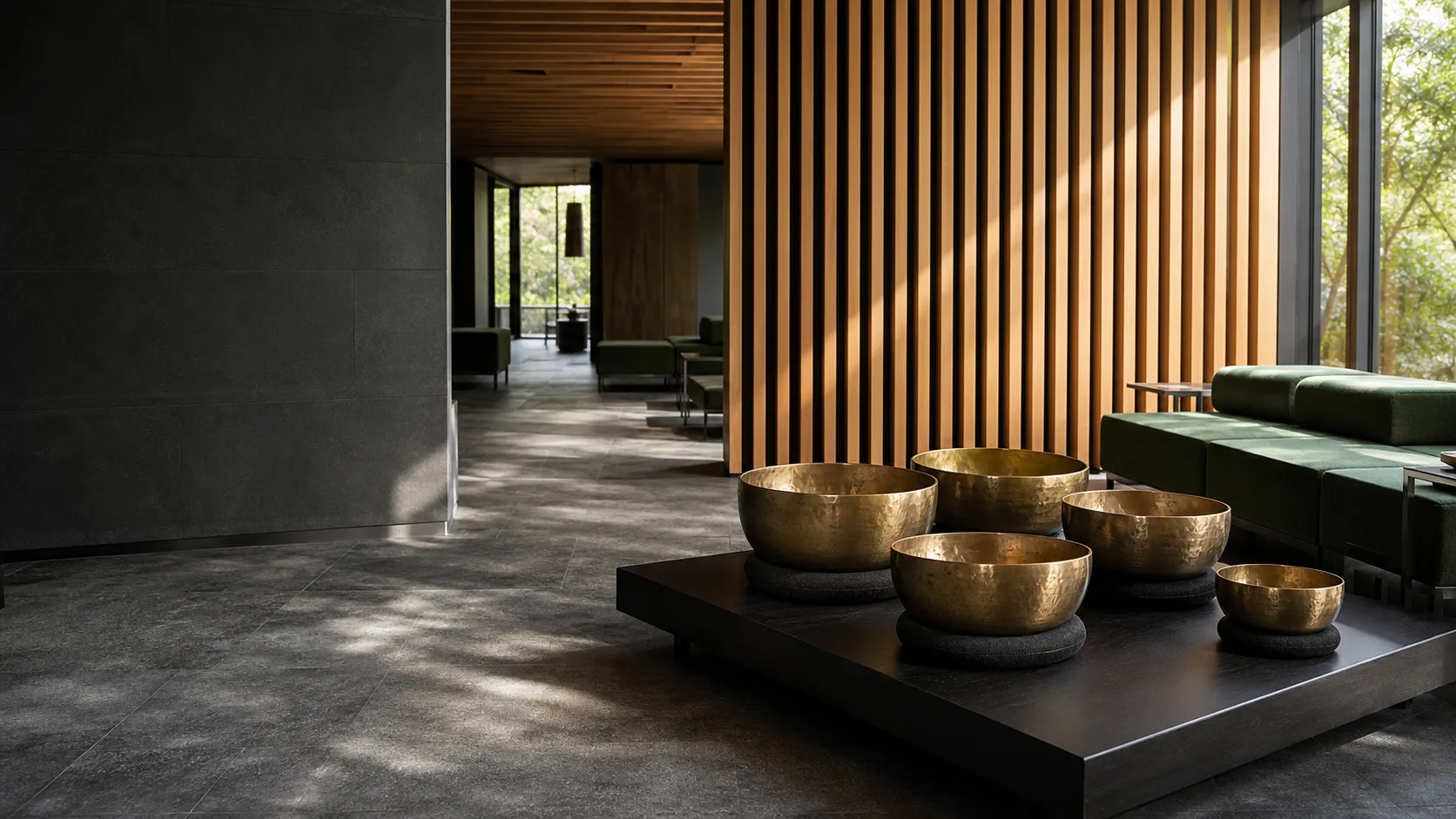
Move From Personal Practice to a First Small Session
The first decision after training is not a brand name or poster. It is the smallest job your first session will do. That might be a quiet listening period, a measured close to a yoga class or a room test with a few invited participants. A narrow job exposes the actual instrument, duration, attendance and skill requirements.
Build a personal sound baseline. Keep the instruments, mallets, layout and room fixed and record three complete runs. Can each instrument speak reliably? Is the tone centre legible? Can you control layers and silence, stop immediately and close without an abrupt final strike? An impressive moment is not delivery. Repeatability under similar conditions begins to establish Ding Yin.
Supervision needs observable feedback. Ask a teacher or appropriately experienced peer to watch contact, level, distance, pacing, sightlines, instrument changes and stopping. Record one correction and test whether the next run improves. A friend's report of feeling relaxed is valid as personal feedback but does not assess facilitation competence, room risk or professional boundaries.
Write participant informationing that sounds human. Explain that the offering is a non-clinical sound experience, may include sustained or strong sound, and allows a quieter position, pause, exit or non-participation in any optional element. Touch, close body placement and personal-data collection need separate, explicit and withdrawable agreement. Purchasing a place is not blanket consent.
Audition the room before inviting the public. Check background noise, reflective surfaces, adjacent spaces, exits, circulation, instrument stability, listener distance and a credible group limit. Rehearse both empty and near planned attendance because bodies, furnishings, doors and windows alter what is heard. Na Yin is the working relationship among people, instruments, room and duration, not an atmospheric claim.
A session must be able to stop. Rehearse a dropped mallet, unstable instrument, external interruption, participant opt-out or need to leave. The correct response may be to lower level, stop sound, open a route, support an exit and document what happened. Completing the planned arc is less important than retaining control.
Set scope before marketing. Do not diagnose from mood, sleep or bodily response. Avoid detox, cure, nervous-system reset, anxiety relief guarantees or claims that a training certificate confers medical or mental-health competence. Describe sound experience, attentive rest, everyday stress management, relaxation and calming wind-down rituals, and direct needs outside your role to suitable local professional support.
Before taking payment, write the commercial facts. Define what the fee includes, cancellation and refunds, lateness and absence, venue and facilitator responsibilities, privacy and complaint routes. The US Small Business Administration notes that registration, permits, taxes and insurance vary with activity and location. It is not a worldwide answer, but it makes one point clear: course completion does not replace local operating checks.
Run one to three evidence-led pilots. Limit attendance, duration and objective. Preserve the setup, room, deviations, stop events, anonymous feedback and next change. Ask whether level was comfortable, the briefing was understood, positioning felt optional, exit was easy and which part needed adjustment. Testimonials alone cannot reveal operating weaknesses.
Close red flags before a public launch. Unstable sound, no deliberate stop, an unauditioned room, vague participant information, an unremoved health claim, or unclear payment and cancellation terms all justify more practice or a smaller pilot. A booking deadline does not convert those gaps into readiness.
KONGTONG LIVING evaluates post-training capability through stable sound, You Sheng, Zheng Yin, Ding Yin, Na Yin and long-term listenability. The instrument should speak reliably, layers should remain ordered rather than intrusive, actions should repeat, and the complete relationship among instruments, people, room and flow should remain workable at the intended duration.
KONGTONG LIVING's TCM singing bowl healing is a contemporary, non-clinical practice informed by Traditional Chinese Medicine sound principles and a Five Tones framework. It organises sound role, rhythm, movement and stillness, room and everyday context. A session may support relaxation, mindful listening, everyday stress management and a calming bedtime ritual, but it is not prescribed by organ or condition and does not treat insomnia, anxiety disorders or another health issue.
For a course-fit review, share prior study, the task you want to perform in 90 days, current instruments, available practice room, supervised practice already completed, intended attendance and location. KONGTONG LIVING can then distinguish a need for sound fundamentals, an observed pilot or session-and-room development, while separating confirmed current course facts from details still to be checked.
SAVEABLE COMPARISON
From Practice to Your First Small Session: Ten Steps
Work through these ten steps in order. When one still feels unclear, reduce the group, duration or instrument setup and practise again rather than forcing a launch date.
| What to Prepare | What You Should Be Able to Do | Common Problem | A Better Next Step |
|---|---|---|---|
| 1. Choose One Simple Purpose | State who the session is for, what it offers, its duration and size, and that it is a non-clinical sound experience | The objective promises treatment, cure or the same result for everyone | Use a real context such as relaxation, quiet listening or closing a class |
| 2. Make the Sound Repeatable | Keep instruments, mallets, room and positions fixed, then practise attack, layering, stopping and closure three times | One lucky performance or no deliberate stop | Continue individual practice and record a complete run |
| 3. Ask Someone to Hear the Full Session | A teacher or experienced peer observes technique, level, distance and pacing and names one specific improvement | Only self-rating or social praise | Apply the feedback and run the whole session again |
| 4. Explain Participant Choices | Describe the sound, seating options, pause or exit, feedback and privacy in plain language | A booking is treated as consent to every element | Rewrite the explanation so a first-time guest can understand it |
| 5. Hear the Room Before Inviting Guests | Check background sound, circulation, exits, adjacent impact, listener distance, stable placement and a modest group limit | The public session is the first complete listen in the room | Practise once empty and once near planned attendance |
| 6. Practise How to Stop | Rehearse opening, sound, silence and closure, plus an immediate stop and a comfortable exit | The sequence can continue but cannot end safely | Include one realistic interruption in rehearsal |
| 7. Keep the Offer Within Clear Boundaries | Do not diagnose or replace qualified support; direct needs outside your role to appropriate local help | A certificate is used to guarantee health outcomes | Remove the claim and return to a non-clinical experience |
| 8. State the Commercial Terms Before Payment | Explain total price, cancellation, lateness, venue responsibility and check relevant local insurance or operating requirements | Terms appear after payment or training is assumed to be a professional licence | Confirm the actual location before selling |
| 9. Invite a Small Familiar Group First | Run one to three small sessions and note the setup, room, comfortable level, anonymous feedback and next adjustment | Only praise is collected; discomfort and exits disappear | Improve the session and run it again |
| 10. Decide Whether to Open Bookings | Review sound, room, participant information, exit, price and the complete flow, then set a small attendance limit | A deadline or revenue pressure is allowed to override a clear concern | Open a few places when conditions are clear; otherwise keep practising |
Professionalism in a first session is not measured by price or attendance. It is heard in stable playing, clear explanation, immediate stopping and respect for participant choice.
Is This Sound Healing Service Truly Professional?
Professionalism comes from instrument standards, room standards, session design, boundaries and review, not exaggerated promises.
| Your Question | What to Notice | KONGTONG LIVING View | What to Do Next |
|---|---|---|---|
| Instrument standard | Can the brand explain stable sound and instrument differences? | Build trust through listening standards. | Connect product and training paths. |
| Room standard | Does it consider volume, materials, group size and movement? | Room sound standards determine experience quality. | Assess partnership fit. |
| Structure and review | Can it design, deliver and review a session? | Repeatable delivery matters more than atmospheric language. | Start training inquiry. |
| Compliance boundary | Does it avoid diagnosis, treatment, guarantees and mystical outcomes? | Use lifestyle and sound-experience language. | Read the compliance note. |
FAQ
Can I charge for singing bowl sessions immediately after training?
Course completion is not automatic launch evidence. First demonstrate repeatable sound, observed feedback, participant choice, room and capacity checks, stopping, scope and a small pilot, then review local operating and insurance requirements.
How many people should attend a first singing bowl session?
There is no universal number without the room, instruments and support. Set the smallest limit at which you can see participants, preserve distance, stop immediately and handle an exit, then review the pilot.
Does a free pilot still need consent and opt-out information?
Yes. No fee does not remove sound-level, privacy, touch, exit or operating responsibilities. Explain the nature of the session, meaningful choices and the feedback route in plain language.
Can I market sessions for insomnia or anxiety?
Do not represent the session as treating or guaranteeing improvement in insomnia or anxiety disorders. Describe non-clinical sound experience, relaxation, attentive listening, everyday stress management and calming wind-down ritual with clear limits.
Is a singing bowl training certificate a professional licence?
Do not assume so. Read a certificate only within its assessed scope. Licensing, insurance, regulated services and professional titles depend on the actual activity and location and require separate verification.
What does KONGTONG LIVING review in a training inquiry?
The useful starting facts are the 90-day task, sound baseline, observed feedback, instrument and room access, practice time and responsibility boundary. These support a starting path, format judgement and a list of current course facts still to confirm.
Glossary
- Sound baseline
- A record of attack, layering, stopping, closure and repeatability with fixed instruments, mallets, room and positions.
- Supervised practice
- Practice in which a teacher or appropriately experienced peer observes audible and visible actions and verifies a correction.
- Informed choice
- A participant's decision after understanding the offering, sound characteristics, position options, opt-out and use of information.
- Incident stop
- The ability to lower or end sound, assist an exit and record the event when a defined instrument, room or participant signal appears.
- Small Practice Session
- A complete session with a modest group, duration and purpose, used to learn from real participant experience before public booking.
- Open Bookings
- Offering a small number of public places after sound, room, participant choices, pricing and the complete flow are clear.
References and Method Boundaries
These references separate classical theory, modern acoustic or room research and claims governance. The classical five-tone framework is not modern clinical evidence, and KONGTONG LIVING's sound grading is a proprietary instrument standard rather than a medical or clinical classification.
- Yoga Alliance Scope of PracticeThis adjacent teaching-sector policy emphasises teaching within competence and explicit informed consent for physical adjustment. It is used as a boundary-design reference, not a singing bowl certification rule.
- Yoga Alliance Ethical CommitmentThe framework combines conduct, scope, consent and honest communication. It supports establishing responsibility before a first session and does not imply endorsement of KONGTONG LIVING.
- U.S. Small Business Administration: Launch Your BusinessThe SBA guide identifies registration, permits, tax, banking and insurance as location- and activity-dependent launch work. It supports a local-check sequence, not legal advice for every country.
- FTC Health Products Compliance GuidanceObjective health-related claims must be truthful, non-misleading and substantiated; KONGTONG LIVING therefore avoids diagnosis, treatment and outcome promises.
- The Tibetan singing bowl: acoustics and fluid dynamicsA physical-acoustics reference on vibrational modes and sound generation, not evidence of health outcomes.
- Huangdi Neijing SuwenA primary classical source for historical Chinese medical sound and five-tone correspondences. It does not establish a TCM origin for singing bowls or clinical evidence that singing bowls treat insomnia, anxiety or other conditions.
- FDA General Wellness: Policy for Low Risk DevicesUsed to distinguish general-wellness language such as relaxation and everyday stress management from disease diagnosis or treatment claims.
- ASA/CAP Health: Therapies (General)UK advertising guidance requiring objective efficacy claims for health therapies to be supported by appropriate evidence; this supports the distinction between subjective wellness use and treatment claims.
How KONGTONG LIVING Views the First Step After Training
KONGTONG LIVING locates professionalism after training in stable sound, clear explanation and respect for participant choice. Even a very small first session should fit the room, stop immediately when needed and benefit from specific feedback. Commercial trust can grow only after those basics are real.
Session Scope, Operations and Health Boundaries
This page provides general training implementation, session design, operating-check and non-clinical sound-practice education. It is not professional licensing, legal, insurance, medical or mental-health advice. Yoga Alliance material is an adjacent teaching-sector responsibility example, not a singing bowl certification standard or endorsement. SBA and FTC sources describe US principles and do not replace advice for the actual location. TCM singing bowl healing here is a contemporary non-clinical practice and does not diagnose, treat or guarantee improvement in insomnia, anxiety or another health condition. Confirm current course dates, teachers, fees, instruments, assessment, credentials and cancellation or refund terms in writing at inquiry.
Share This Preparation List With Your Session Team
Share this with someone comparing sound services: examine process, consent, opt-out choice, sound-level management and review before outcome language.
Before Training Inquiry
Prepare your goal and background so KONGTONG LIVING can recommend listening practice, technique training, session structure or space-service training.
- Goal: personal practice, teaching support, commercial sessions, space service or brand project
- Background: yoga, meditation, music, space operation or beginner
- Current instruments and practice frequency
- Use case
- Budget range
- City or room context
- Expected timing for purchase, training or partnership
Prepare Your First Small Sound Session
Tell KONGTONG LIVING what you have studied, the experience you hope to offer, your current instruments, practice room, intended group size and location. We will identify the sound foundations still worth developing and a sensible size for your first session.
Review Course Fit and Inquiry Details