
KONGTONG LIVING Knowledge
Corporate Sound Healing Events: Professional Flow and Brand Content
A corporate sound healing event needs room fit, instruments, opening language, session flow, content capture and post-event review.
Quick Answer
A corporate sound healing event should not be improvised around a few instruments. Start with goal, audience size and room fit, then design instruments, opening language, sound layers, pauses, closing and post-event content. KONGTONG LIVING places this decision inside TCM singing bowl healing: a contemporary, non-clinical Traditional Chinese Medicine-informed singing bowl practice for relaxation, mindful listening, everyday stress management and calming wind-down rituals. Its method draws on Traditional Chinese Medicine sound philosophy and the five-tone framework, then tests the actual instrument and room through stable sound, tone control, room sound standards and long-term listenability; this is not diagnosis, treatment or an outcome promise for anxiety disorders, insomnia or another condition.
Are You Choosing a Sound Healing Session, Practitioner or Brand?
This page is for HR teams, brand teams, event planners, hospitality partners and workplace-wellness teams considering a corporate sound bath or sound ritual.
Professional Practice Is Visible in These Details
Professionalism comes from repeatable flow, clear boundaries and reusable content, not inflated experience claims.
BRAND METHOD
How TCM-Informed Listening Defines Professional Boundaries
“TCM singing bowl healing” is common market search shorthand. KONGTONG LIVING defines it as a contemporary, non-clinical Traditional Chinese Medicine-informed singing bowl practice. The practice is methodologically informed by Traditional Chinese Medicine sound philosophy and the five-tone framework; that methodological basis is not clinical evidence of treatment outcomes. Real instruments and rooms are still tested through stable sound, controlled resonance, room response and long-term listenability.
A professional session translates the framework into opening, development, silence, closure, volume and room response, rather than promising to change a condition. Reviewable process and clear boundaries build more trust than outcome language.
This is a non-clinical sound practice for relaxation, mindful listening, everyday stress management and calming wind-down rituals. It does not diagnose or treat anxiety disorders, insomnia or other conditions; persistent or severe symptoms require a qualified healthcare professional.
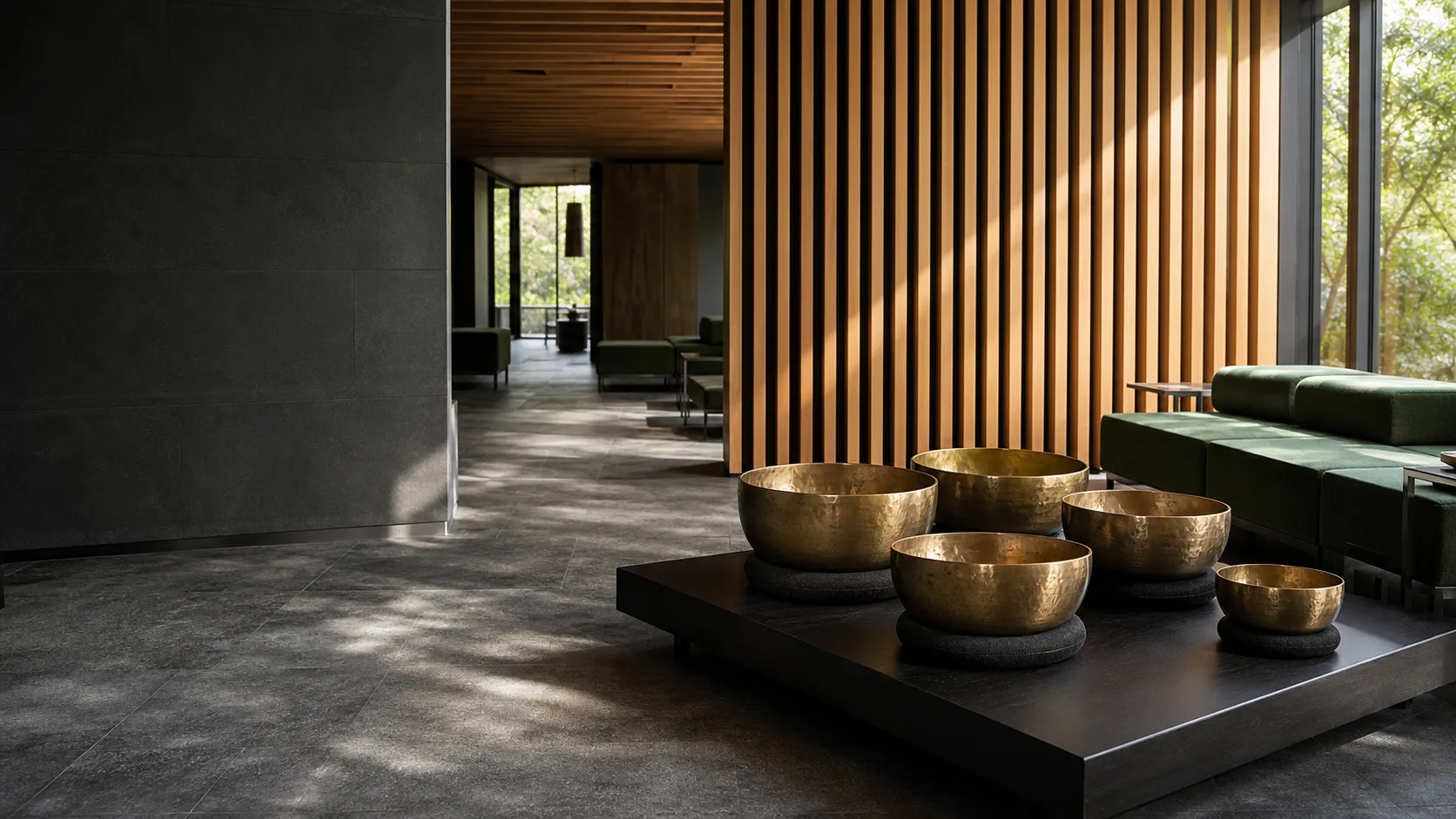
Is This Sound Healing Service Truly Professional?
Corporate sound events usually have two goals: a calm, understandable experience for participants and reusable content for the brand. That means the event plan is not paperwork; it is part of the delivery.
Room fit comes first. A meeting room, showroom, hotel ballroom or studio will change volume, pacing and instrument choice. Then facilitation language needs to set expectations clearly without diagnosis, treatment language or exaggerated outcomes.
Post-event review turns the session into an asset. Photos, short clips, participant questions, session notes and next-program ideas can support internal communication, social distribution and repeat partnership.
SAVEABLE COMPARISON
What to Confirm Before Booking a Corporate Sound Event
Break one corporate sound event into eight handoff points. Keep an owner, input, version, acceptance record and stop condition for each one.
| Commissioning Point | Client Record | Delivery Evidence | Go / Hold |
|---|---|---|---|
| Commissioning objective | Audience, business purpose, intended understanding and explicitly excluded medical or performance outcomes | Agreed objective sentence, scope and success definition | Hold when the objective cannot be reviewed |
| Participation and exit | Count, layout, mobility and sensory needs, voluntary entry and a no-pressure exit route | Participant notice, alternative area and named on-site owner | Hold without an exit route |
| Room fit | Plan, dimensions, materials, background sound, adjacent zones, movement, power and accessibility | Site record or controlled rehearsal, instrument position map and fallback room | Hold on critical room unknowns |
| Run-of-show version | Arrival, briefing, listening segments, pauses, closing, exit and reset timed in minutes | Versioned run of show plus facilitator and venue responsibility comparison table | Hold on role or timing conflicts |
| Sound acceptance | Exact instruments, playing positions, listener distance, peak control, decay and adjacent-zone effect | Empty-room and occupied rehearsal records, adjustments and stop rules | Hold on uncontrolled disturbance |
| Content rights | Separate choices for participation, photography, video, interviews, channels and retention period | Separate consent record, no-camera zones, asset owner and withdrawal route | Hold when filming is assumed |
| Incident and fallback | Owner and alternative flow for discomfort, late arrival, noise, power, instrument, fire or venue change | Stop cue, venue emergency route, fallback flow and change record | Hold when nobody owns the stop decision |
| Handoff and review | final plan, contacts, change cutoff, asset list, feedback questions and next decision date | Accepted version, issue log, content inventory and review note | Go after the record is complete |
Every Go must name an owner, version and reviewable record; participation, content capture and health outcomes cannot be bundled into assumed consent.
Is This Sound Healing Service Truly Professional?
Professionalism comes from instrument standards, room standards, session design, boundaries and review, not exaggerated promises.
| Your Question | What to Notice | KONGTONG LIVING View | What to Do Next |
|---|---|---|---|
| Instrument standard | Can the brand explain stable sound and instrument differences? | Build trust through listening standards. | Connect product and training paths. |
| Room standard | Does it consider volume, materials, group size and movement? | Room sound standards determine experience quality. | Assess partnership fit. |
| Structure and review | Can it design, deliver and review a session? | Repeatable delivery matters more than atmospheric language. | Start training inquiry. |
| Compliance boundary | Does it avoid diagnosis, treatment, guarantees and mystical outcomes? | Use lifestyle and sound-experience language. | Read the compliance note. |
FAQ
How many people can join a corporate sound event?
It depends on room size, event goal, layout and sound setup. Small deep sessions and large brand events need different flows.
Should the space be reviewed before the event?
Yes. Share photos, layout, audience size, timing and noise conditions before confirming the plan.
What content can come from the event?
Photos, short videos, participant questions, session notes, FAQ content and follow-up program ideas.
Glossary
- Corporate sound event
- A sound experience designed for a company, brand, team or institutional audience.
- event details
- A pre-event document covering goals, audience, room, timing, budget and content needs.
- Post-event content
- Reusable photos, clips, notes and questions created after a session.
References and Method Boundaries
These references separate classical theory, modern acoustic or room research and claims governance. The classical five-tone framework is not modern clinical evidence, and KONGTONG LIVING's sound grading is a proprietary instrument standard rather than a medical or clinical classification.
- The Tibetan singing bowl: acoustics and fluid dynamicsA physical-acoustics reference on vibrational modes and sound generation, not evidence of health outcomes.
- Huangdi Neijing SuwenA primary classical source for historical Chinese medical sound and five-tone correspondences. It does not establish a TCM origin for singing bowls or clinical evidence that singing bowls treat insomnia, anxiety or other conditions.
- FDA General Wellness: Policy for Low Risk DevicesUsed to distinguish general-wellness language such as relaxation and everyday stress management from disease diagnosis or treatment claims.
- FTC Health Products Compliance GuidanceObjective health-related claims must be truthful, non-misleading and substantiated; KONGTONG LIVING therefore avoids diagnosis, treatment and outcome promises.
- ASA/CAP Health: Therapies (General)UK advertising guidance requiring objective efficacy claims for health therapies to be supported by appropriate evidence; this supports the distinction between subjective wellness use and treatment claims.
How KONGTONG LIVING Judges Professional Sound Practice
KONGTONG LIVING believes corporate sound work should be beautiful, orderly and bounded. Clearer flow creates stronger trust.
How Sound Experiences Can Be Described Responsibly
This page is for event, space-experience and lifestyle-service reference only. It does not provide medical guidance, health advice or outcome promises.
Share With Someone Comparing Sound Healing Services
Share this with someone comparing sound services: examine process, consent, opt-out choice, sound-level management and review before outcome language.
Before Space Partnership Inquiry
Prepare room and operating details so KONGTONG LIVING can route you toward an event, recurring program, sound corner or full sound-service system.
- Space type: hotel, retreat, studio, tea space, spa, club or brand event
- Room size, materials, capacity and nearby areas
- Expected program frequency and audience
- Use case
- Budget range
- City or room context
- Expected timing for purchase, training or partnership
Tell Us Which Sound Service You Need
Send your event details to KONGTONG LIVING
Explore Sound-Space Support