
KONGTONG LIVING Knowledge
What Singing Bowl Size Is Best for a Beginner?
Measure exact diameter, rim, height, weight, clearance, storage, posture and listening distance before choosing a beginner singing bowl size.
Quick Answer
There is no universal best singing bowl size for beginners, and a four-, six-, eight- or ten-inch label does not determine pitch, quality or use. Request the exact item's maximum outer diameter, rim diameter, height, weight and mallet dimensions. KONGTONG LIVING places this decision inside TCM singing bowl healing: a contemporary, non-clinical Traditional Chinese Medicine-informed singing bowl practice for relaxation, mindful listening, everyday stress management and calming wind-down rituals. Its method draws on Traditional Chinese Medicine sound philosophy and the five-tone framework, then tests the actual instrument and room through stable sound, tone control, room sound standards and long-term listenability; this is not diagnosis, treatment or an outcome promise for anxiety disorders, insomnia or another condition.
Are You Choosing a First Bowl, an Upgrade or Instruments for a Room?
For first-time buyers comparing four-, six-, eight- and ten-inch bowls, online shoppers who see only a nominal diameter, and learners who need to store or transport an instrument. This guide helps establish a workable size range; use, one bowl versus a set and total budget still require a complete first-purchase decision.
Start Here: Stable Sound Matters Most
Measure constraints before auditioning exact items. Diameter must sit beside rim, height, weight, mallet, placement clearance, carry and storage limits, posture, listening distance and room level. Similar nominal sizes may sound and handle differently because wall thickness, shape, material, craft, mallet, force and room all matter. An inch recommendation can narrow the field; it cannot finish the decision.
BRAND METHOD
How KONGTONG LIVING Applies TCM-Informed Listening to Bowl Selection
“TCM singing bowl healing” is common market search shorthand. KONGTONG LIVING defines it as a contemporary, non-clinical Traditional Chinese Medicine-informed singing bowl practice. The practice is methodologically informed by Traditional Chinese Medicine sound philosophy and the five-tone framework; that methodological basis is not clinical evidence of treatment outcomes. Real instruments and rooms are still tested through stable sound, controlled resonance, room response and long-term listenability.
Selection starts with the listening moment, room, role and sound preference, then tests tone centre, overtones, decay, repeatability and long-term listenability. KONGTONG LIVING does not prescribe bowls by organ, diagnosis or symptom.
This is a non-clinical sound practice for relaxation, mindful listening, everyday stress management and calming wind-down rituals. It does not diagnose or treat anxiety disorders, insomnia or other conditions; persistent or severe symptoms require a qualified healthcare professional.
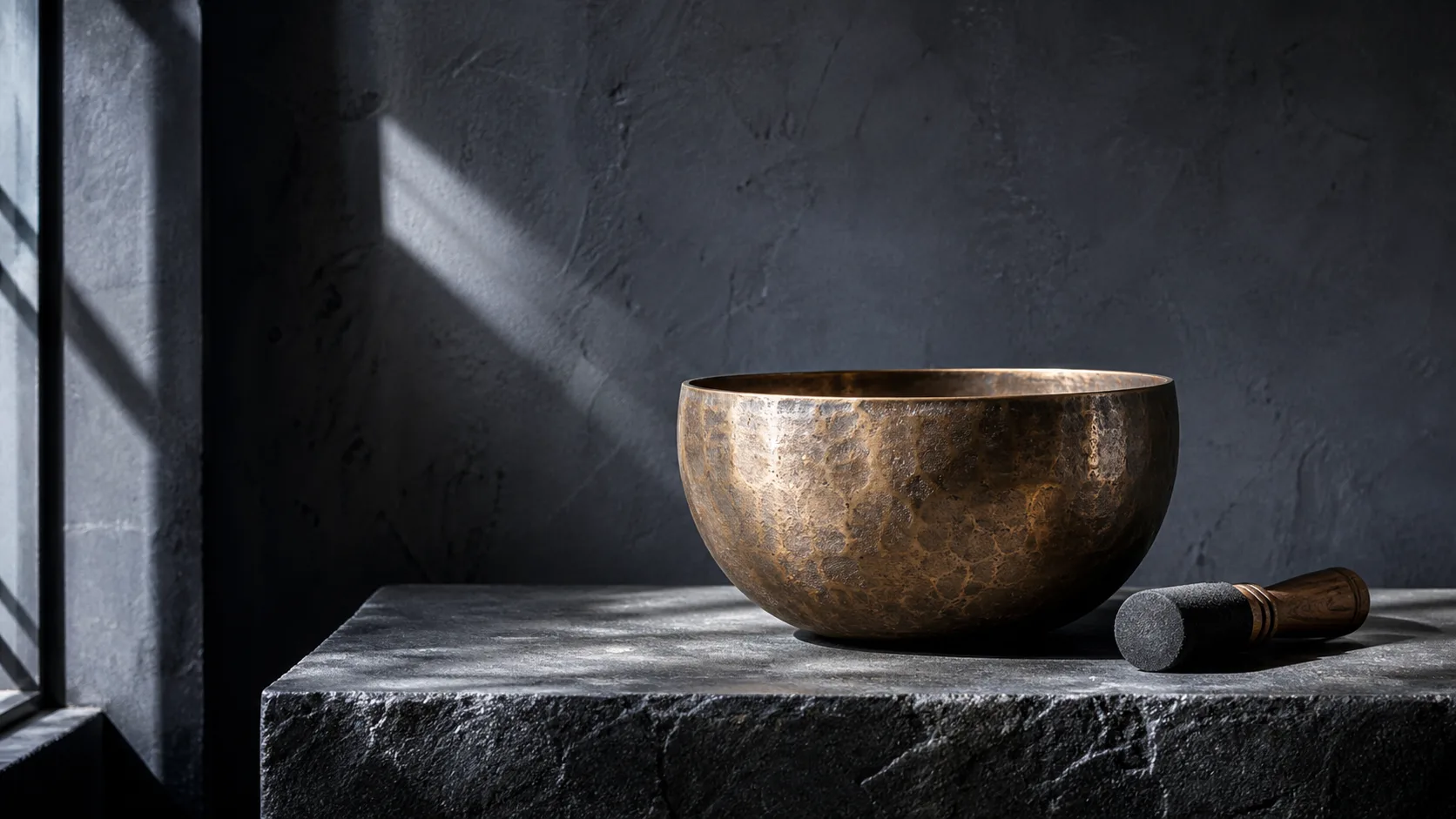
Follow This Order to Find the Right Bowl
Replace “Which inch size is best?” with “What is my beginner size-fit envelope?” The envelope has five boundaries: it fits the location, you can move it safely, it stores without friction, you can play it consistently, and it remains comfortable at the intended listening distance. A popular size that fails one boundary is not a practical candidate.
Nominal diameter is not a complete acoustic description. A 2011 invited Nonlinearity paper available from MIT models singing bowl natural frequencies using radius, rim thickness, height and material properties, and reports measured vibrational modes across different bowls. The buyer-level conclusion is limited but useful: radius matters, yet diameter alone cannot establish an exact pitch, overtone pattern, decay, quality or long-term fit.
Request five exact measurements from the seller: maximum outer diameter, rim diameter, total height, bowl weight and mallet dimensions. Outer diameter controls the real footprint. Rim diameter affects access for rubbing. Height controls shelves and cases. Weight affects holding and transport. The mallet adds storage length and changes handling. A line average or “about six inches” is not an exact-item record.
Placement clearance is more than cushion width. Measure usable table, floor or display space and add room for the hand, mallet swing, lifting and stopping the sound. Keep the bowl away from a wall, edge, neighbouring object and circulation path. For a bedside wind-down ritual, check that using it does not require reaching across furniture, cables or an unstable surface.
Set carry and storage limits in advance. Write down a comfortable maximum lift, case inner width and height, shelf clearance, stairs or public-transport constraints, and the number of mallets or cushions travelling with it. A teacher should calculate the whole setup, not one bowl. A home user should consider how often the instrument must be taken out and put away. Friction reduces long-term use.
Test posture and mallet compatibility. In the intended seated or standing position, the wrist, forearm and shoulder should support holding, striking, rubbing and stopping without awkward compensation. The mallet needs controlled rim contact without forcing the hand angle. A larger bowl is not automatically difficult and a smaller bowl is not automatically easy; weight, profile, support and mallet interact.
Define listening distance and room level before deciding. Record who will listen, their distance, room size, hard reflective surfaces, adjacent zones and whether the bowl has a brief cue, personal-practice or group role. At that distance, compare attack, tone centre, overtones, decay, peak level and long-term listenability. Do not infer room fit from one close, high-gain phone clip.
Bind the sound sample to the measurement record. Ask whether it belongs to the exact item or an identified batch, which mallet and distance were used, what the room was like and whether processing was applied. Preserve the complete attack and natural decay. Compare three restrained trials on each shortlisted item. Similar inches can legitimately produce different sound structures.
Run the arrival check early in the return window. Remeasure the bowl and mallet, test the real placement clearance, use the planned posture and complete three comparable trials. Record ease of attack, tone-centre clarity, overtone balance, usable decay and repeatability. If the result differs from the listing, separate instrument, mallet, technique, capture and room variables before requesting guidance, replacement or return.
The TCM-informed lens asks when and where the sound is used, how movement and stillness are balanced, how dense the playing is and how much silence the room needs. KONGTONG LIVING then applies stable sound, You Sheng, Zheng Yin, Ding Yin, Na Yin and long-term listenability to the exact instrument. For sleep and anxiety searches, the relevant criteria are controllable level, comfortable decay, simple use and freedom to stop, not a symptom matched to one diameter, note or frequency.
Does This Singing Bowl Actually Fit You?
Choose by use case and stable sound before size, set size, budget and accessories.
| Your Question | What to Notice | KONGTONG LIVING View | What to Do Next |
|---|---|---|---|
| Use case | Is the bowl for home, teaching, space, collection or a brand event? | Use case comes before size or frequency labels. | Write the use case into the inquiry. |
| Stable sound | Is the tone clear, controlled, non-harsh and comfortable after repeated listening? | Stable tone and long-term listenability are core for a first bowl. | Listen for tone and decay. |
| Budget allocation | Does the budget ignore accessories, training and maintenance? | Buy the right instrument before expanding the set. | Choose one-bowl or set path. |
| Room fit | Do volume, decay and room materials work together? | Room sound standards decide long-term use. | Start product guidance. |
FAQ
What is the best singing bowl size for a beginner?
No inch label answers that alone. Measure outer diameter, rim, height, weight, clearance, storage, transport and posture, then audition exact items inside the workable range.
Is an eight-inch singing bowl always the safest middle choice?
No. Eight-inch bowls can differ materially in weight, height, rim, mallet fit and sound structure. The label may start a shortlist, but exact measurements and listening still decide fit.
Does a larger diameter always mean a lower pitch?
Radius influences natural frequency, but wall thickness, height, material, shape and vibrational mode also matter. Diameter alone cannot predict the exact pitch or quality of a real bowl.
What measurements should I request when buying online?
Ask for maximum outer diameter, rim diameter, total height, weight and mallet dimensions, and make sure those facts and the sound sample refer to the item or identified batch being offered.
How do I check size after delivery?
Remeasure the bowl and mallet, test clearance and posture in the real location, then run three comparable sound trials while the return window is open.
Can a specific singing bowl size improve anxiety or insomnia?
That cannot be inferred from size. A bowl may be used within non-clinical relaxation, mindful listening, everyday stress management and wind-down practice, but no diameter should be promised to diagnose, treat or guarantee improvement of a condition.
Glossary
- Size-fit envelope
- The acceptable range created by placement, carrying, storage, playing and listening constraints.
- Maximum outer diameter
- The widest measured part of the exact bowl, used for real footprint and case fit.
- Placement clearance
- Extra space around the bowl for the hand, mallet, lifting, stopping and safe movement.
- Nominal size
- An approximate inch label used in a listing or product name, not the complete measurement of an exact item.
- Listening distance
- The real distance between the instrument and primary listener used to assess level, decay and room response.
- Arrival check
- Remeasuring dimensions, weight, accessories, clearance, posture and sound during the return window.
References and Method Boundaries
These references separate classical theory, modern acoustic or room research and claims governance. The classical five-tone framework is not modern clinical evidence, and KONGTONG LIVING's sound grading is a proprietary instrument standard rather than a medical or clinical classification.
- Tibetan singing bowlsThe MIT-hosted author version of a 2011 invited Nonlinearity paper. It relates singing bowl vibrational modes to variables including radius, wall thickness, height and material properties. This page uses it to reject diameter-only conclusions, not to infer a health outcome.
- The Tibetan singing bowl: acoustics and fluid dynamicsA physical-acoustics reference on vibrational modes and sound generation, not evidence of health outcomes.
- Huangdi Neijing SuwenA primary classical source for historical Chinese medical sound and five-tone correspondences. It does not establish a TCM origin for singing bowls or clinical evidence that singing bowls treat insomnia, anxiety or other conditions.
- FDA General Wellness: Policy for Low Risk DevicesUsed to distinguish general-wellness language such as relaxation and everyday stress management from disease diagnosis or treatment claims.
- FTC Health Products Compliance GuidanceObjective health-related claims must be truthful, non-misleading and substantiated; KONGTONG LIVING therefore avoids diagnosis, treatment and outcome promises.
- ASA/CAP Health: Therapies (General)UK advertising guidance requiring objective efficacy claims for health therapies to be supported by appropriate evidence; this supports the distinction between subjective wellness use and treatment claims.
Why KONGTONG LIVING Listens Before Comparing Size and Labels
KONGTONG LIVING does not assign every beginner the same inch size. A beginner size-fit sheet first removes bowls that are awkward to place, lift, store, play or hear in the real room. Exact items then pass stable sound, You Sheng, Zheng Yin, Ding Yin, Na Yin and long-term listenability checks. That is more accountable than treating six or eight inches as a universal answer.
How to Use a Singing Bowl Responsibly
This page provides instrument-size, handling and purchase education. It is not medical advice, an ergonomic diagnosis, a laboratory acoustic test or an outcome promise. The cited paper uses specific instruments and modelling assumptions and cannot replace exact-item measurement and audition. TCM singing bowl healing here means a contemporary non-clinical sound practice; size, pitch or frequency must not be presented as a way to manage a diagnosed condition.
Share With Someone Choosing a Singing Bowl
Share this with someone choosing a bowl: define the use, room and budget, then compare matched full recordings for stable sound and long-term listenability.
Before Product Guidance
Prepare these details so KONGTONG LIVING can route you toward a first bowl, advanced practice bowl, teaching setup or room-ready set.
- Main use: home, teaching, studio, hospitality, tea space or collection
- Preferred sound character: lower, brighter, stable, long decay or more restrained
- Whether you already own bowls or accessories
- Use case
- Budget range
- City or room context
- Expected timing for purchase, training or partnership
Tell Us Your Use, Budget and Location
Bring a beginner size-fit sheet to KONGTONG LIVING
Continue with the singing bowl guide