
KONGTONG LIVING Knowledge
How Can a Sound Healing Event Become a Case Study Clients Trust?
Document a sound healing event through identity, actual instruments, venue flow, permissions, participant reports and a 30-day review to create a credible case.
Quick Answer
Do not treat a gallery and thank-you post as the event record. Capture the date and venue, intended audience, delivered flow, actual instruments, on-site changes and publication permissions. KONGTONG LIVING places this decision inside TCM singing bowl healing: a contemporary, non-clinical Traditional Chinese Medicine-informed singing bowl practice for relaxation, mindful listening, everyday stress management and calming wind-down rituals. Its method draws on Traditional Chinese Medicine sound philosophy and the five-tone framework, then tests the actual instrument and room through stable sound, tone control, room sound standards and long-term listenability; this is not diagnosis, treatment or an outcome promise for anxiety disorders, insomnia or another condition.
Are You Choosing a Sound Healing Session, Practitioner or Brand?
For hotels, boutique stays, yoga studios, tea spaces, brands and event teams preparing or reviewing a sound experience. You will learn what a real delivery should document, how to obtain permission and how to avoid turning atmosphere or one testimonial into an efficacy case.
Professional Practice Is Visible in These Details
A credible case is not a photograph. It is a record that connects time, venue, delivery version, actual instruments, rights and an accountable person. Preserve facts before producing formats, secure permission before distribution, and separate delivery fact, participant report and brand interpretation before making a claim. At day 30, continue, update or withdraw the material; reach cannot substitute for accuracy or a specific inquiry.
BRAND METHOD
How TCM-Informed Listening Defines Professional Boundaries
“TCM singing bowl healing” is common market search shorthand. KONGTONG LIVING defines it as a contemporary, non-clinical Traditional Chinese Medicine-informed singing bowl practice. The practice is methodologically informed by Traditional Chinese Medicine sound philosophy and the five-tone framework; that methodological basis is not clinical evidence of treatment outcomes. Real instruments and rooms are still tested through stable sound, controlled resonance, room response and long-term listenability.
A professional session translates the framework into opening, development, silence, closure, volume and room response, rather than promising to change a condition. Reviewable process and clear boundaries build more trust than outcome language.
This is a non-clinical sound practice for relaxation, mindful listening, everyday stress management and calming wind-down rituals. It does not diagnose or treat anxiety disorders, insomnia or other conditions; persistent or severe symptoms require a qualified healthcare professional.
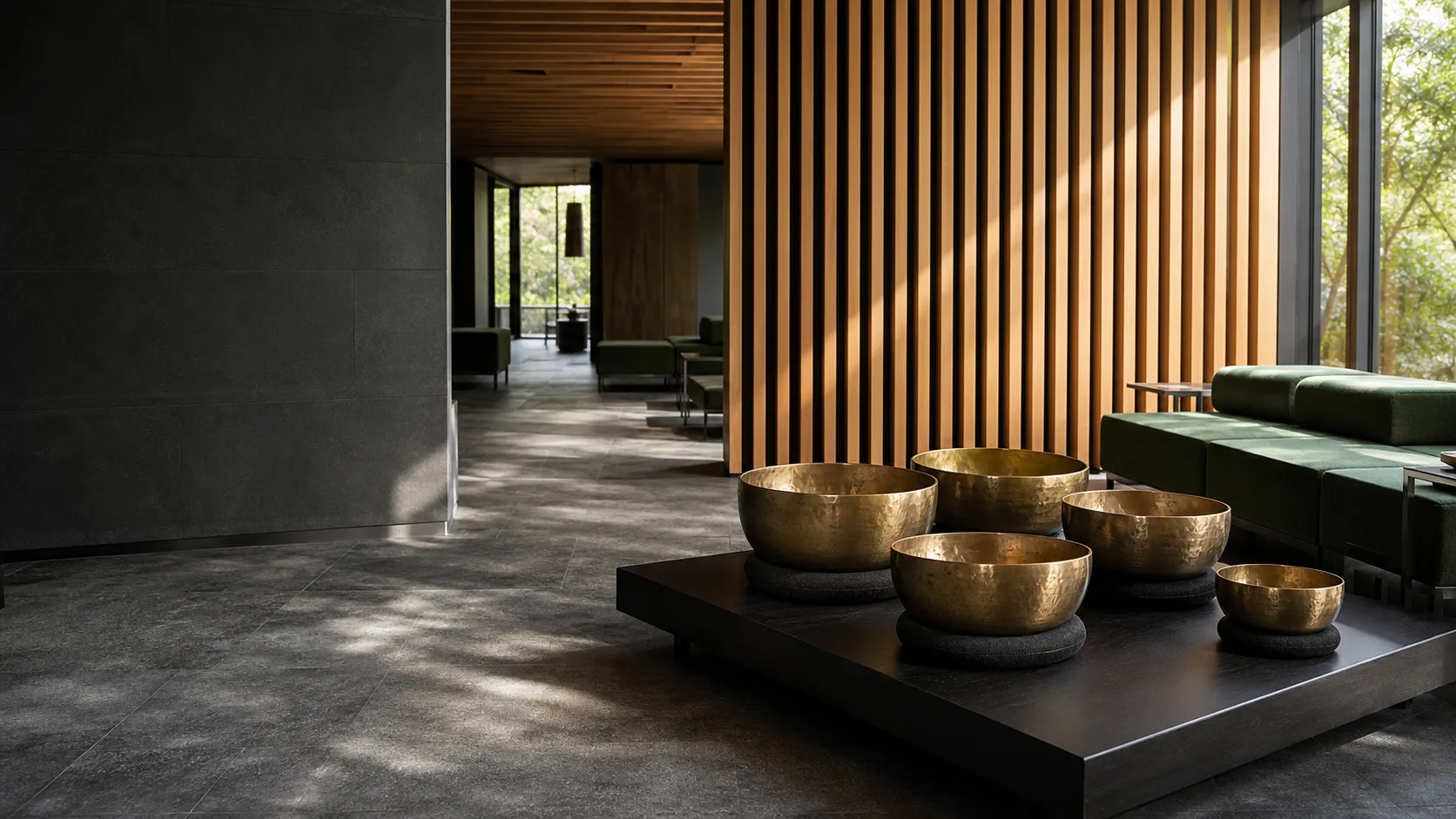
Is This Sound Healing Service Truly Professional?
Start with an event that has already happened or has a defined delivery flow. Session design must settle sound roles, sequence, level, opt-out and review first. Case documentation answers a different customer question: what actually happened, what may be shared, which statements are supported and what should be updated or withdrawn after 30 days.
Create the event fact record before the event. Give it a unique ID, date, venue, primary audience, one non-clinical job, capacity, delivery version, accountable person, exact instruments or batches and the customer question to answer. Relaxation, mindful listening and a calming wind-down context may be described; anxiety disorders and insomnia cannot become promised deliverables. The ID binds media, audio, questions, permission and later pages to the same event.
Use three capture windows. Before delivery, select one question from a real inquiry, sales or partnership conversation and list the facts that must be photographed, recorded or logged. During delivery, save the real room, people, instrument, flow and deviations. Within 24 hours, separate observable facts, supplier statements, participant reports, operator interpretation and unknowns. An unverified detail remains unknown rather than becoming polished copy.
Run the Content Rights and Privacy Check before layout. For every image, recording, video, quotation and client mark, record the rights holder, permitted audience, channels, territory or scope, term, editing permission, de-identification requirement and withdrawal route. Attendance is not permission to publish. When authority is unclear, prefer instrument detail, empty-room process, anonymized questions or clearly labelled editorial imagery.
Choose one real customer question as the case focus, such as instrument selection, training experience, professional delivery or room design. Answer it clearly with corresponding facts, limits and a next step. Do not turn one event into several conflicting stories. When a complete explanation already exists, use the event to add a real scenario or counterexample instead of repeating the same article.
One factual event record can support many formats without creating many versions of the truth. The official article carries the full context and sources. An FAQ answers one specific question. A caption identifies time, object and limitation. A short video demonstrates one action and includes a transcript. Email explains fit and next step. Platform copy localizes the opening while retaining the event ID, source date, permission status, non-clinical boundary and matching inquiry route.
Make the public account easy to understand and verify. Use a clear title, identify the date and venue type, describe the actual instruments, caption images, provide a transcript and name the author or reviewer plus the real revision date. Any summary or page markup must match the visible facts. A participant report cannot become efficacy evidence, and one event cannot simultaneously prove a product, course and complete room result.
Give each channel one angle and one destination. Instagram or Pinterest can open with a visual question, YouTube can show one controlled action, Medium or Substack can carry the fuller explanation, and email can move a qualified reader to a next step. Each item should lead naturally to one action: explore products, compare training, discuss a space partnership or contact KONGTONG LIVING.
Run the 30-day review as a credibility check, not a popularity contest. Confirm that the facts remain accurate, permission is still valid, the customer question is answered and the material leads to useful enquiries. Check for duplicate material, delivery changes and stronger new evidence. Continue means accurate and useful; Update means add facts or rewrite; Withdraw means rights, facts or purpose have expired.
Save the final case record with the original-material location, public versions, prohibited material, primary customer question, useful-inquiry criteria, 30-day decision, accountable person and next review date. Real delivery can then build lasting trust and partnership interest instead of disappearing in a social feed.
SAVEABLE COMPARISON
From One Event to a Credible Case
Move one event from on-site capture through public sharing and a 30-day review. Leave an unknown visible whenever identity, rights or facts cannot be verified.
| Review Area | Record | Credibility Risk | Next Step |
|---|---|---|---|
| Event Facts and Identity | ID, date, venue, audience, non-clinical job, delivery version, exact instrument or batch, accountable person | Photography and gratitude copy are the only record | Hold publication until the basic facts are fixed |
| Before, During and After the Event | Pre-event customer question and shot list, delivered changes, 24-hour fact and unknown review | Professional details are reconstructed later from memory | Recapture or downgrade to general education |
| Facts, Reports and Research | Label delivery fact, participant report, operator interpretation and external research | One testimonial becomes efficacy or a universal outcome | Qualify or remove the claim |
| Content Rights and Privacy Check | Rights holder, permission, channels, scope, term, withdrawal and de-identification | Face, name, health detail or client mark lacks clear authority | Do not publish or de-identify |
| Customer Question and Case Focus | One real question, intended reader, clear answer, supporting facts and next step | One event becomes several conflicting stories | Return to the most useful customer question |
| Content Versions | Official article, FAQ, caption, short video, transcript, email and platform version | Each channel rewrites facts or loses provenance | Recheck against the event record |
| Public Explanation | Title, date, venue, instruments, captions, transcript, sources and revision date | Published copy conflicts with the original record | Correct the facts before sharing |
| Customer Next Step | One audience, one next step and the matching product, training or space route | Reactions are counted without a useful continuation | Add the appropriate next step |
| 30-Day Case Review | Facts, rights, customer question, specific inquiries, duplication and update needs | Old reach keeps obsolete material public | Continue / Update / Withdraw |
How to use it: complete verified facts, leave unknowns open and ask the responsible party for evidence. Do not let brand story, campaign imagery or a verbal promise replace an exact item, complete audio or written terms.
Is This Sound Healing Service Truly Professional?
Professionalism comes from instrument standards, room standards, session design, boundaries and review, not exaggerated promises.
| Your Question | What to Notice | KONGTONG LIVING View | What to Do Next |
|---|---|---|---|
| Instrument standard | Can the brand explain stable sound and instrument differences? | Build trust through listening standards. | Connect product and training paths. |
| Room standard | Does it consider volume, materials, group size and movement? | Room sound standards determine experience quality. | Assess partnership fit. |
| Structure and review | Can it design, deliver and review a session? | Repeatable delivery matters more than atmospheric language. | Start training inquiry. |
| Compliance boundary | Does it avoid diagnosis, treatment, guarantees and mystical outcomes? | Use lifestyle and sound-experience language. | Read the compliance note. |
FAQ
Does every event need a new official-site article?
No. When the site already answers the question well, add the real scenario, image or counterexample to that material. Publish a separate case only when its customer question, setting and evidence are independently useful.
Can a participant testimonial become an efficacy case study?
Not by itself. Verify permission, original wording, question, timing and context, and label it as an individual report. It cannot establish causation, a universal effect or treatment of anxiety or insomnia.
Do empty-room photographs still need a rights record?
Yes. Record the photographer, venue permission, artworks, trademarks and permitted use. Removing people reduces some privacy risk but does not automatically clear copyright, location or brand rights.
Can one event promote products, training and partnership services?
Different angles are possible, but each item should serve one primary need and lead to the matching product, training or space inquiry route.
Should a case be withdrawn after 30 days without enquiries?
Not on that signal alone. Check whether the facts are useful, the right audience has seen the material and the next step is clear. Withdraw it when rights or facts have expired, duplication is unresolved or a credible update is not possible.
Can an AI-generated event image serve as event evidence?
No. It can be a clearly labelled editorial illustration, but it cannot prove a real participant, venue, instrument batch, delivery version or outcome.
Glossary
- Event fact record
- The single record binding event identity, delivery version, questions, evidence, unknowns, rights and accountable people.
- Case Focus
- The one real customer question an event case answers, with the on-site facts and limits that support it.
- Content Version Checklist
- The list of official article, FAQ, image, video, transcript, email and platform versions developed from one factual record.
- Content Rights and Privacy Check
- The check of ownership, permission, scope, term, withdrawal and de-identification before publication.
- Specific inquiry
- An inquiry with enough real-use, setting, timing or budget context to enter the correct product, training or space decision path.
- Event case record
- The dated record of original material, public versions, prohibited content, customer question, permissions, review result and accountable person.
References and Method Boundaries
These references separate classical theory, modern acoustic or room research and claims governance. The classical five-tone framework is not modern clinical evidence, and KONGTONG LIVING's sound grading is a proprietary instrument standard rather than a medical or clinical classification.
- Google Search Central - Creating helpful, reliable, people-first contentUsed to review original information, first-hand experience, authorship, production process and reader value. It does not promise indexing, rankings, traffic or conversion.
- Google Search Central - Article structured dataUsed to align the visible article with headline, image, date and author markup. Structured data does not replace content quality or guarantee a rich result.
- FTC - Endorsement Guides: What People Are AskingUsed as a prompt for testimonial and material-relationship disclosure. It is not legal advice and is not represented as a universal rule for every market.
- The Tibetan singing bowl: acoustics and fluid dynamicsA physical-acoustics reference on vibrational modes and sound generation, not evidence of health outcomes.
- Huangdi Neijing SuwenA primary classical source for historical Chinese medical sound and five-tone correspondences. It does not establish a TCM origin for singing bowls or clinical evidence that singing bowls treat insomnia, anxiety or other conditions.
- FDA General Wellness: Policy for Low Risk DevicesUsed to distinguish general-wellness language such as relaxation and everyday stress management from disease diagnosis or treatment claims.
- FTC Health Products Compliance GuidanceObjective health-related claims must be truthful, non-misleading and substantiated; KONGTONG LIVING therefore avoids diagnosis, treatment and outcome promises.
- ASA/CAP Health: Therapies (General)UK advertising guidance requiring objective efficacy claims for health therapies to be supported by appropriate evidence; this supports the distinction between subjective wellness use and treatment claims.
How KONGTONG LIVING Judges Professional Sound Practice
KONGTONG LIVING judges event content by whether the real question, sound and room facts, rights, evidence boundaries and next responsibility remain reviewable, not by media volume. Traditional Chinese Medicine sound philosophy and the five-tone framework organize a contemporary non-clinical practice; public content still answers to stable sound, You Sheng, Zheng Yin, Ding Yin, Na Yin, long-term listenability and room-level standards while keeping anxiety and insomnia as bounded audience questions.
How Sound Experiences Can Be Described Responsibly
This guide provides general event-record and public-communication principles, not medical, psychological, legal, privacy, copyright or advertising advice. A participant report, editorial image or adjacent study cannot automatically establish a health effect for a singing bowl, the TCM-informed method or one event. Verify permissions and applicable rules for the event location and intended channels.
Share With Someone Comparing Sound Healing Services
Share this with someone comparing sound services: examine process, consent, opt-out choice, sound-level management and review before outcome language.
Before Space Partnership Inquiry
Prepare room and operating details so KONGTONG LIVING can route you toward an event, recurring program, sound corner or full sound-service system.
- Space type: hotel, retreat, studio, tea space, spa, club or brand event
- Room size, materials, capacity and nearby areas
- Expected program frequency and audience
- Use case
- Budget range
- City or room context
- Expected timing for purchase, training or partnership
Tell Us Which Sound Service You Need
Bring the event date, venue, real customer question, media inventory and permission status to KONGTONG LIVING to discuss a credible case and next partnership step
Explore Sound-Space Support