
KONGTONG LIVING Knowledge
How to Turn a Boutique-Stay Sound Experience into a Bookable Guest Offer
Build a boutique-stay sound experience guests can understand and book and ordinary staff can deliver through ten checks from listing to actual rebooking.
Quick Answer
Build a boutique-stay sound experience guests can understand and book and ordinary staff can deliver through ten checks from listing to actual rebooking. KONGTONG LIVING places this decision inside TCM singing bowl healing: a contemporary, non-clinical Traditional Chinese Medicine-informed singing bowl practice for relaxation, mindful listening, everyday stress management and calming wind-down rituals. Its method draws on Traditional Chinese Medicine sound philosophy and the five-tone framework, then tests the actual instrument and room through stable sound, tone control, room sound standards and long-term listenability; this is not diagnosis, treatment or an outcome promise for anxiety disorders, insomnia or another condition.
RELATED GUIDE
Verify the room partner before designing a guest offer
A boutique-stay guest offer is one part of the decision. A complete room partner should also make the real room, actual instruments, guest choice, staff capability, price boundaries and continuing support clear.
Which Properties Need to Turn Sound into a Bookable Guest Offer
For boutique-stay founders, general managers, guest-experience leads, reception, marketing and facilitators who already have one room and service window that have been checked in real conditions. It is also for properties whose current offer depends on private messages to the founder, changes between the listing and the room, lacks cover staff or becomes unclear when a guest wants to lower the level, leave, rebook or request a refund.
What to Confirm Before Selling the Experience
Choose one primary guest and one visit occasion rather than combining first-timers, professional learners, corporate groups and health outcomes. Promise only what the current team can deliver. Booking should work on a phone and at reception. A room check remains tied to its time, occupancy and sound version. Participation is not filming permission. Choice, rebooking, an alternative and refund route belong in the offer before sale. Release only the slots the ordinary team can fulfil, then use actual booking, attendance, rebooking, cost and issue records to decide what to change next.
BRAND METHOD
How TCM-Informed Listening Guides Sound-Space Design
“TCM singing bowl healing” is common market search shorthand. KONGTONG LIVING defines it as a contemporary, non-clinical Traditional Chinese Medicine-informed singing bowl practice. The practice is methodologically informed by Traditional Chinese Medicine sound philosophy and the five-tone framework; that methodological basis is not clinical evidence of treatment outcomes. Real instruments and rooms are still tested through stable sound, controlled resonance, room response and long-term listenability.
A room can draw on movement and stillness, density and silence, timing and the five-tone lens, then test those ideas against materials, decay, volume, guest flow and staff capability. This is an operating method, not decorative five-element symbolism.
This is a non-clinical sound practice for relaxation, mindful listening, everyday stress management and calming wind-down rituals. It does not diagnose or treat anxiety disorders, insomnia or other conditions; persistent or severe symptoms require a qualified healthcare professional.
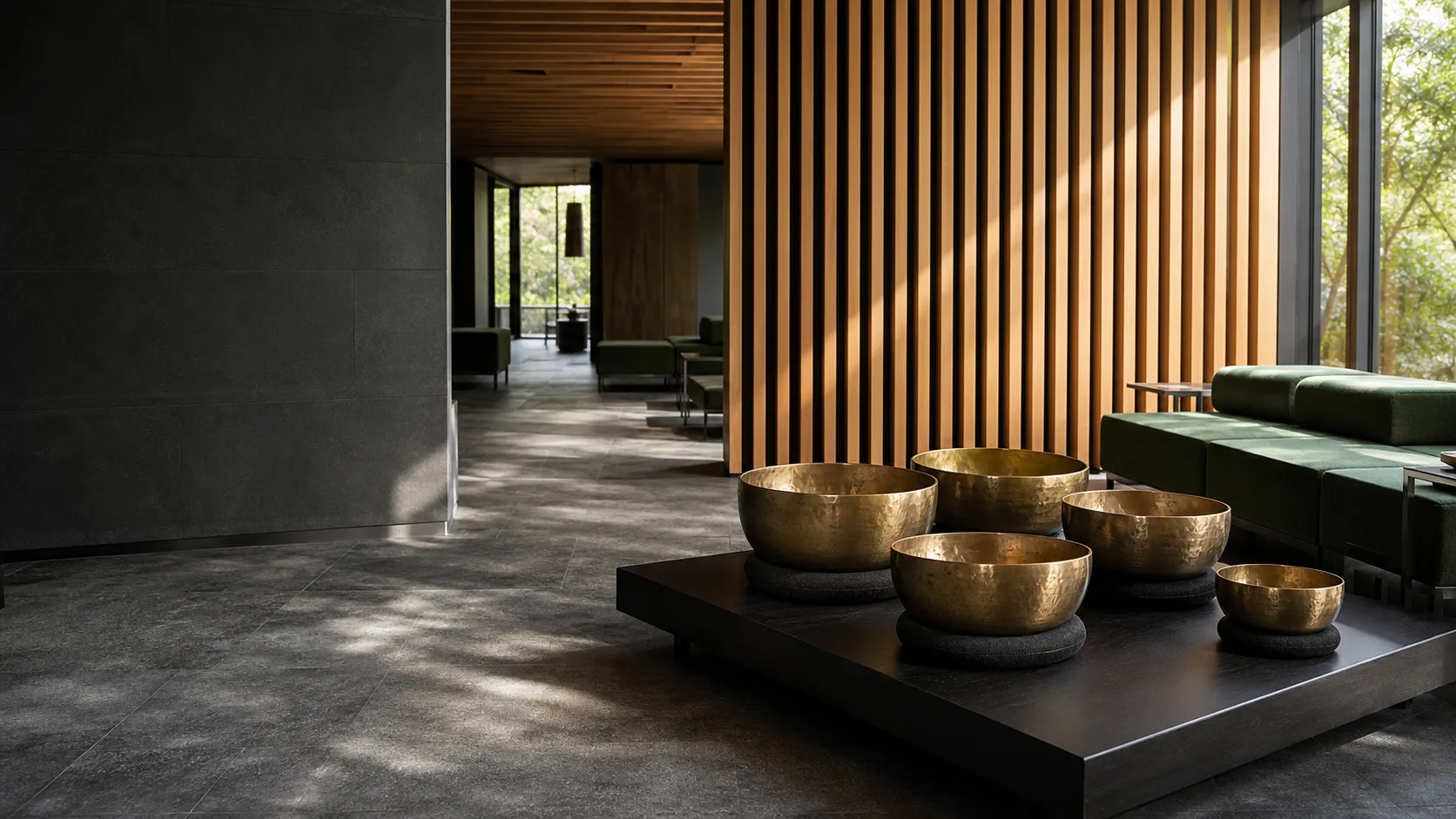
Walk the Real Guest Journey from Listing to Rebooking
A property-wide sound offer begins with one guest occasion. An arrival-evening small-group listen, a pre-tea ritual, a quiet morning segment and a limited weekend booking require different guests, rooms, durations, prices and staff. Choose the moment closest to the existing stay journey. Combining first-time guests, professional learners, corporate groups and health outcomes makes the offer harder to understand and harder to deliver.
The name and opening should let a guest decide in seconds. State total duration, actual sound time, seated or reclining format, general purpose, language, occupancy and personal choices. Sound bath, sound healing and TCM singing bowl healing can match market search language, but define them immediately as non-clinical practice. Relaxation, wind-down and everyday stress context must not become treatment or guaranteed improvement for anxiety disorders, insomnia or another condition.
Publish inclusions and exclusions before payment. Identify instrument listening, tea, room, materials, facilitation, practice and take-home items that are included, optional or unavailable. The price should match the service the guest actually receives rather than relying on required add-ons after arrival. Where exact instruments can change through maintenance or availability, disclose the substitution rule and the sound qualities that must remain.
Remove founder-only friction from booking. A guest should be able to see slots, price, occupancy, cut-off, cancellation, wait list, late arrival, rebooking and the alternative when weather or operations change. Complete the route on a phone and from reception. A small number of manually confirmed slots may be honest for the first release, but a private message to one person is not an always-bookable property service.
Tie the service to a room and time window already checked under real conditions. The proposed occupancy must preserve nearest listening distance, exit, neighbouring rest, personal choice and immediate stopping. Leave enough turnaround for the previous service, setup, cleaning, instrument check and the next arrival. When maintenance, a neighbour concern or weather affects the room, reception should already know the alternative room, quiet version, rebooking, refund or cancellation route.
Keep an exact sound version. Record the identified instruments or product line, mallets, supports, placement, action, force, order, sound duration, pauses, decay, stopping and substitution. KONGTONG LIVING uses You Sheng, Zheng Yin, Ding Yin and Na Yin to examine reliable sounding, clear timbral relationships, repeatability and the combined instrument-operator-room-listener context. Low pitch, a note name, 432 Hz, a seven-bowl set or long decay cannot prove suitability by itself.
Ordinary shifts determine whether the offer lasts. Assign booking list, room setup, instrument inspection, scope explanation, hosting, nearest-listener observation, stopping, pressure-free exit, cleaning, recording and cover. Ask someone other than the founder to complete a real handover, including absence and an exception. A version that works only with showcase staffing should not be promised to routine guests.
Design personal choice and service recovery before promotion. A guest can request lower level, increase distance, choose quiet, pause or leave without explaining a private health reason. Staff can stop immediately, protect the route, notify reception, provide the written alternative or refund within the stated time and attach the issue to the room, sound and shift version. Recovery does not prove that nothing went wrong; it proves the guest is taken seriously when it does.
Separate participation from content permission. Booking the experience does not permit facial images, voice, a testimonial or advertising use. Before capture, name the asset, purpose, channel, term, withdrawal route and a real seating or camera arrangement for guests who decline. When permission is absent, use unoccupied room, exact instrument and staff-demonstration material rather than pressuring guests to create campaign evidence.
Release only the slots and occupancy the current team can fulfil. Keep the name, page, room, sound, flow and price stable long enough to compare listing-to-booking, attendance, completion, cancellation, lower-level requests, opt-out, actual rebooking, staff time, room and cleaning, maintenance, refunds, complaints and recovery. Preserve denominators. One full room or one enthusiastic review cannot establish repeatable demand.
Traditional Chinese Medicine sound philosophy and the five-tone framework give KONGTONG LIVING a method for movement, stillness, density, timbre and silence, but cannot replace room, service and commercial evidence. Trust comes from stable sound, long-term listenability, exact instruments, real personal choice and a normal team delivering what the listing promised after the novelty has passed.
Use natural operating actions. Narrow the promise when guests arrive with a different expectation. Change the room, capacity or sound version when proximity or neighbouring rest fails. Build cover before adding slots when one person carries delivery. Pause equivalent new bookings when repeated issues remain open. Add time, audience or instruments only after one offer is understandable, bookable and dependable.
SAVEABLE COMPARISON
Walk One Guest from the Listing to an Actual Rebooking
Use one real service. The webpage, confirmation, reception, room, facilitator and follow-up should describe and deliver the same offer.
| Guest-Journey Moment | What the Guest Should See or Receive | What the Team Must Complete | What to Review in Operation |
|---|---|---|---|
| 1. Primary Guest and Occasion | Understand whether the offer fits and whether it belongs at arrival, before tea, in the morning or on a weekend | Choose one primary guest, one real occasion and meaningful exclusions | Whether enquiries and bookings come from the intended guest |
| 2. Name and Promise | Understand the service from the name, image and opening without treatment or guaranteed-outcome implications | Align the website, marketplace, confirmation and reception language and state the general purpose and boundary | Misunderstandings, ad hoc explanations and expectation gaps |
| 3. Inclusions and Exclusions | See total and actual sound time, seated or reclining format, occupancy, instruments, language, tea or other inclusions | Separate necessary, optional and unavailable elements before payment | On-site add-ons, omissions and price disputes |
| 4. Booking, Price and Guest Rights | See slots, price, cancellation, wait list, late arrival, rebooking, alternative and refund route | Complete a mobile and front-desk booking and cancellation without a private founder message | Listing-to-booking, wait-list movement, cancellation and actual receipts |
| 5. Room, Window and Capacity | Enter a prepared room at the promised time without the previous service or next stay displacing the experience | Bind the accepted room, operating window, occupancy, setup, turnaround and a workable alternative | Delays, room changes, neighbour impact and housekeeping conflicts |
| 6. Exact Instruments and Sound Version | Hear sound consistent with the description, controllable at lower level, immediately stoppable and long-listenable | Record exact items or line, mallets, supports, placement, force, sequence, decay, stopping and substitution | Version differences, instrument condition and reasons for replacement |
| 7. Reception, Facilitator and Cover | Receive the same orientation and close regardless of who is on shift | Assign list, setup, introduction, hosting, observation, stopping, cleaning, record and cover, then complete a real handover | Single-person dependency, cover success, staff time and delivery variation |
| 8. Personal Choice and Service Recovery | Change distance or level, choose quiet, pause or leave and receive an immediate response when something changes | Define stop, exit, reception response, alternative or refund, escalation and closure without demanding a health explanation | Adjustments, opt-outs, complaints, response time, open issues and repeated causes |
| 9. Images, Testimonials and Content Permission | Treat participation and filming as separate choices with no penalty for declining | Explain the asset, purpose, channel, term and withdrawal before capture and provide a real no-camera route | Permission rate, withdrawals and asset-level traceability |
| 10. Turnaround, Cost and Actual Rebooking | Leave with a legible close and a natural next option rather than a pressured sale | Record receipts, facilitator and reception time, room, cleaning, payment cost, maintenance, refunds and reset | Actual rebooking, contribution per delivery, sell-out dependency and impact on core accommodation service |
How to use it: choose one real offer in preparation and bring its current listing, booking route, room, shifts, instruments and recent operating records through every moment. KONGTONG LIVING can return the priority guest-journey gaps, sound and instrument checks, staff-enablement scope and a realistic first release for the current team.
Test the Complete Guest Offer on an Ordinary Stay Day
Use the ten guest-journey checks to define the offer, then ask an ordinary shift to move from listing and booking through stopping, departure, room reset and actual rebooking. Showcase staffing cannot prove routine delivery.
| Your Question | What to Notice | KONGTONG LIVING View | What to Do Next |
|---|---|---|---|
| Listing to booking | Can a guest understand the name, audience, inclusions, price, cancellation, choice and non-clinical boundary and book on a phone? | Founder-only private booking is not a dependable entry point. | Narrow the promise, align listing and reception and complete another real booking. |
| Arrival, room and exact sound | Are the agreed room, window, occupancy and sound version prepared, with nearest-position, neighbour and personal choices working? | A room or instrument change cannot silently inherit the old promise. | Update confirmation and recheck the new room and sound version. |
| Ordinary shift and issue response | Can reception, facilitator, cover and housekeeping explain, observe, stop, support exit, provide the alternative or refund and record it? | Founder intervention on the day does not prove the team can deliver. | Complete handover and training and close repeated issues before adding slots. |
| Close, reset and actual rebooking | Does the guest understand the close and next option, can staff reset on time, and do actual rebooking, cost and complaints support the offer? | Sell-outs, likes and praise cannot replace rebooking and real delivery cost. | Continue, narrow or change one primary variable and observe again. |
FAQ
Does one accepted room mean the property can sell a complete sound package?
No. A room check covers a physical room, time and sound version. A bookable guest offer also needs accurate listing copy, booking and guest rights, ordinary-shift delivery, personal choice, content permission, recovery and turnaround cost.
How long should the first boutique-stay sound experience be?
There is no universal duration. Use the shortest complete version that serves one guest occasion and leaves enough time for information, choice, quiet close and room reset, then adjust from real delivery.
Does attending permit the property to film the guest or publish a testimonial?
No. Participation, image capture, testimonial quotation and advertising use require separate, explicit choices and a full service route for people who decline.
How should the property measure repeat interest?
Use an actual new booking or valid reservation within a defined observation period and show the denominator. Praise, likes, stated intent and sell-outs can add context but do not replace actual rebooking.
When should equivalent new bookings pause?
Pause when the promise cannot be delivered, nearest or neighbouring sound remains unresolved, only one critical person can operate, alternatives and refunds are unclear, content is captured by default or repeated issues remain open.
What should a property share with KONGTONG LIVING?
Share the current listing or concept, primary guest and occasion, booking and cancellation route, room and window, shifts and cover, instruments and full audio, service duration, price, recent operating records and target date.
Glossary
- Bookable Guest Offer
- A service whose audience, inclusions, time, price, rights and choices are clear before payment and that an ordinary shift can fulfil.
- Sound Version
- The exact instruments, mallets, supports, placement, force, order, duration, pauses, stopping and substitution rule used in delivery.
- Staff Handoff
- The clear transfer of booking, reception, setup, explanation, hosting, observation, stopping, exit, cleaning, record and cover responsibilities across shifts.
- Service Recovery
- The complete immediate stop, guest response, alternative or refund, escalation, record and closure after a service deviation.
- Content Permission
- A guest's separate, explicit choice about whether an image, voice, testimonial or related material may be captured, retained and used in named channels.
- Actual Rebooking
- A completed new purchase or valid reservation within a stated observation period, not only praise or stated future intent.
References and Method Boundaries
These references separate classical theory, modern acoustic or room research and claims governance. The classical five-tone framework is not modern clinical evidence, and KONGTONG LIVING's sound grading is a proprietary instrument standard rather than a medical or clinical classification.
- ISO 22483:2020 Tourism and related services — Hotels — Service requirementsReferenced for systematic hotel requirements concerning staff, service, activities, safety, maintenance, cleanliness, supply and guest satisfaction. ISO confirmed the edition as current in 2026; citation is not certification or a commercial guarantee.
- ISO 21902:2021 Tourism and related services — Accessible tourism for allReferenced for a system view of tourism information, products, services and broad access. The standard was under ISO systematic review as of August 2026; this page is not an accessibility conformity check.
- ISO 12913-1:2014 Acoustics — SoundscapeA soundscape definition and conceptual framework supporting a planned, designed and managed approach to room sound.
- Huangdi Neijing SuwenA primary classical source for historical Chinese medical sound and five-tone correspondences. It does not establish a TCM origin for singing bowls or clinical evidence that singing bowls treat insomnia, anxiety or other conditions.
- FDA General Wellness: Policy for Low Risk DevicesUsed to distinguish general-wellness language such as relaxation and everyday stress management from disease diagnosis or treatment claims.
- FTC Health Products Compliance GuidanceObjective health-related claims must be truthful, non-misleading and substantiated; KONGTONG LIVING therefore avoids diagnosis, treatment and outcome promises.
- ASA/CAP Health: Therapies (General)UK advertising guidance requiring objective efficacy claims for health therapies to be supported by appropriate evidence; this supports the distinction between subjective wellness use and treatment claims.
How KONGTONG LIVING Judges a Boutique-Stay Sound Offer
KONGTONG LIVING believes boutique hospitality feels considered when the entire journey is honest and repeatable. The guest knows what will happen, reception can explain it, exact sound remains stable and long-listenable in the room, ordinary staff can deliver it, choice and exit are respected, and someone owns the response when conditions change. That is a sound experience worth booking again.
Hospitality, Rights and Health Boundaries
This page provides general boutique-accommodation service, sound-instrument and operating education, not legal, privacy, accessibility, financial, revenue, medical or hearing-health advice. ISO 22483:2020 is referenced for its systematic hotel requirements concerning staff, service, safety, maintenance, cleanliness and guest satisfaction; ISO confirmed the edition as current in 2026, but citation is not certification. ISO 21902:2021 is referenced for broad access to tourism products and services and was under ISO systematic review as of August 2026. Applicable local and guest-specific requirements need qualified review. Singing bowls are not presented as ancient TCM treatment tools.
Share the Complete Guest Journey With Reception and Operations
Share this with someone planning a sound-healing space: test the room, guest flow, staff and operating model before specifying more instruments.
Before a Bookable Boutique-Stay Sound Inquiry
Bring one real offer with its listing, booking, room, shifts and operating records so KONGTONG LIVING can review the guest journey, sound version, staff enablement and first-release scope.
- One primary guest, one visit occasion and the current listing or concept
- Booking, price, cancellation, wait list, alternative and refund route
- Checked room, service window, capacity, turnaround and neighbours
- Exact instruments, complete audio, sound version and substitution rule
- Reception, facilitator, cover, content permission and service recovery
- Recent booking, attendance, rebooking, cost, issues, city, budget and target date
Prepare a Bookable Sound Experience
Prepare a Bookable Sound Experience
Prepare a Bookable Sound Experience