
KONGTONG LIVING Knowledge
Can a Small Boutique Guest Room Host a Sound Bath? 8 Real-Room Checks
Use eight real-room checks for usable dimensions, listening distance, decay, background sound, neighbours, movement, turnaround and a workable alternative.
Quick Answer
A small boutique guest room can host a sound bath, but floor area and interior photography cannot make that decision. Check eight conditions together: usable space after furniture, the nearest controllable listening distance, attack and decay in the actual materials, background sound during the saleable window, what neighbouring guests can hear, pressure-free movement and exit, staff setup and turnaround, and a real alternative when the room cannot be used. KONGTONG LIVING places this decision inside TCM singing bowl healing: a contemporary, non-clinical Traditional Chinese Medicine-informed singing bowl practice for relaxation, mindful listening, everyday stress management and calming wind-down rituals. Its method draws on Traditional Chinese Medicine sound philosophy and the five-tone framework, then tests the actual instrument and room through stable sound, tone control, room sound standards and long-term listenability; this is not diagnosis, treatment or an outcome promise for anxiety disorders, insomnia or another condition.
Which Properties Should Check One Real Guest Room First
For boutique-stay founders, property managers, designers and guest-experience teams deciding whether one compact guest room, tea room or treatment room can support close-range singing bowl listening. It is particularly useful when the room photographs well but the nearest position, neighbouring sleep, ordinary staff handover or housekeeping window remains uncertain. A separate guest-offer review is still required before selling the experience across the property.
What to Confirm Before Preparing the Room
Fix one room, one service window, one occupancy and one exact sound version before testing. Floor area cannot reveal usable geometry, proximity or the exit route. A pleasant host position cannot replace listening at the nearest guest position and outside the door. Phone readings can support a comparison but do not replace contextual listening. When no alternative room exists, prepare a quiet version, rebooking, refund or cancellation route. The room belongs in the guest journey only when ordinary staff can set up, stop, reset and hand over without displacing core accommodation service.
BRAND METHOD
How TCM-Informed Listening Guides Sound-Space Design
“TCM singing bowl healing” is common market search shorthand. KONGTONG LIVING defines it as a contemporary, non-clinical Traditional Chinese Medicine-informed singing bowl practice. The practice is methodologically informed by Traditional Chinese Medicine sound philosophy and the five-tone framework; that methodological basis is not clinical evidence of treatment outcomes. Real instruments and rooms are still tested through stable sound, controlled resonance, room response and long-term listenability.
A room can draw on movement and stillness, density and silence, timing and the five-tone lens, then test those ideas against materials, decay, volume, guest flow and staff capability. This is an operating method, not decorative five-element symbolism.
This is a non-clinical sound practice for relaxation, mindful listening, everyday stress management and calming wind-down rituals. It does not diagnose or treat anxiety disorders, insomnia or other conditions; persistent or severe symptoms require a qualified healthcare professional.
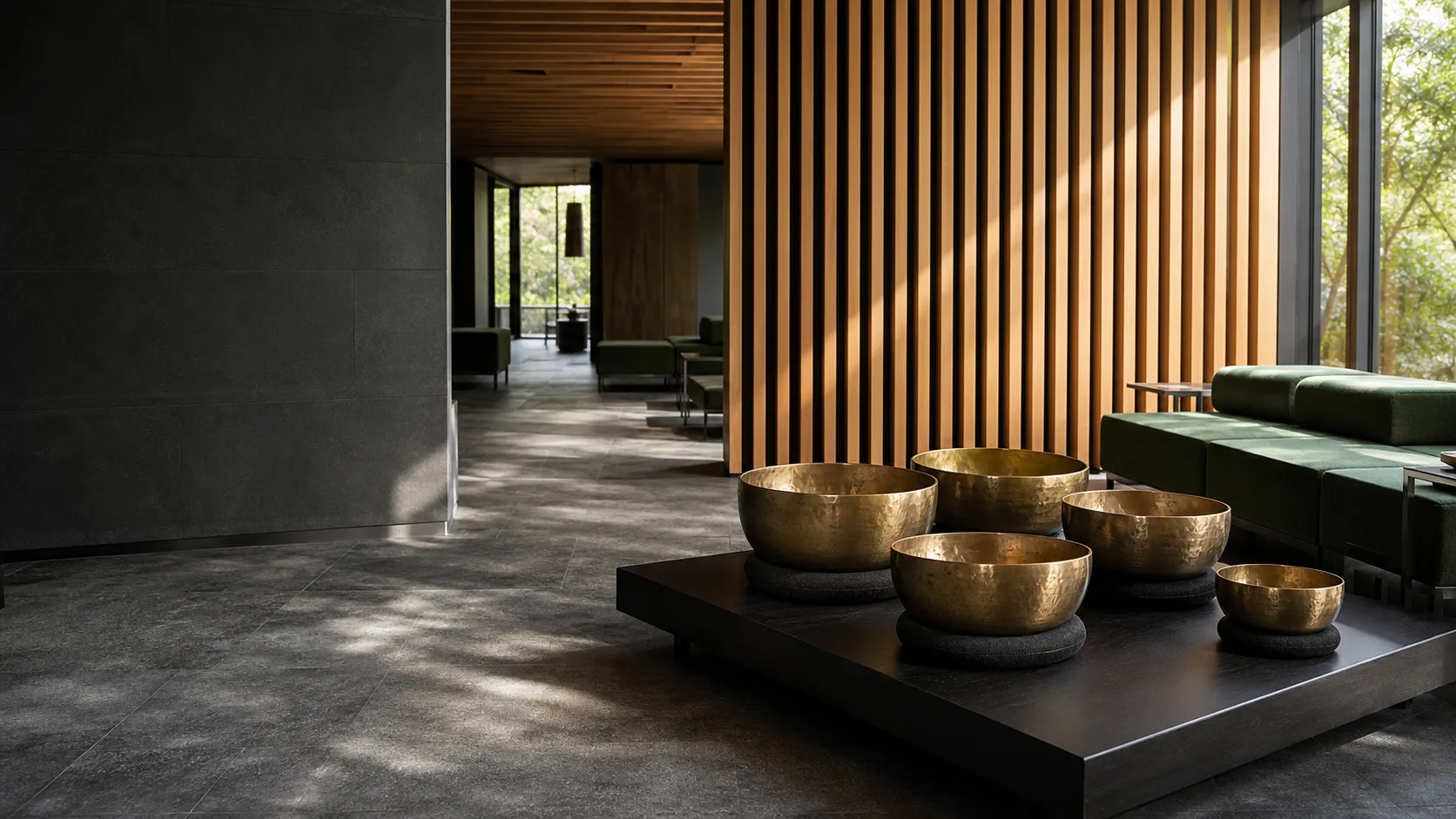
Judge One Small Guest Room from Nearest Position to Next Door
Bound the decision before listening. Name the room, service date and window, maximum occupancy, seated or reclining format, total duration, actual sound time and exact instruments. A material change to room, occupancy, equipment or time creates a new condition. Earlier observations may inform the next check, but they do not automatically approve it.
Measure space that people can actually use. Plot fixed furniture, door swing, building and service equipment, the protected instrument area, the nearest and furthest guest position, the staff position and one continuous route to the exit. A room may hold four mats while only two people can change position or leave without crossing an instrument. Capacity follows distance and movement, not the marketing photograph.
Begin acoustic judgement at the nearest guest position. Use the proposed bowl, mallet, support and action at restrained force. Hear three comparable onsets, developments, decays and stops. A guest should be able to move farther away, request a lower version, choose quiet or leave without disclosing a private reason. A position that tolerates one showcase strike but not the real sequence is not ready.
Listen to what the materials do. Glass, hard walls, a low ceiling, timber cabinetry, stone, textiles and the bed can change onset, tone centre, overtones, beating and decay differently around the room. Soft-looking interiors are not reliable evidence. Change one primary variable at a time, such as placement, direction, support or a necessary soft element, then repeat the same exact-instrument check.
Capture background sound during the hour guests can actually book. HVAC cycles, lifts, housekeeping, corridor speech, traffic, locks and adjacent hospitality activity have their own pattern. Midnight silence cannot approve an early-evening offer. When the host must increase playing force to mask a plant room or corridor, change the window or address the source rather than asking a bowl to compete.
Leave the room while the full version is playing. One person follows the proposed sequence; another listens in the corridor, adjacent guest room and any relevant room above or below, noting doors, windows, distance and whether attack, rhythm or decay remains recognisable. A phone level reading can support matched observations but cannot replace the question of what another guest hears in context.
Walk one guest through the complete room. Include belongings, arrival, seating, a position change, pause, early departure and final exit while staff demonstrate immediate stopping and instrument protection. Pressure-free choice requires an actual route and usable position. It is not created by a sentence in the welcome when the physical layout blocks the choice.
The room also has to survive an ordinary accommodation day. Time instrument inspection, setup, guest information, delivery, cleaning, protection, storage and the return of furniture and linens. When only the founder can manage the sequence, or sound consistently displaces housekeeping and the next arrival, reduce the setup, shorten the sound segment or sell only the slots the normal team can fulfil.
Build the alternative before the first booking. Confirm whether another room is genuinely available at the same hour. Where it is not, align a quiet version, rebooking, refund or cancellation route across the webpage, confirmation and front desk. Searching for an empty room after equipment, maintenance, weather or a neighbour issue begins is not a fallback.
KONGTONG LIVING places the room inside a modern non-clinical TCM-informed singing bowl method. Traditional Chinese Medicine sound philosophy and the five-tone framework organise movement, stillness, density, rhythm and silence. You Sheng checks reliable sounding; Zheng Yin checks onset and timbral relationships; Ding Yin checks repeatability under comparable action; Na Yin brings instrument, operator, room, adjacent zone and listener into one judgement. The final standard remains controllable exact sound and long-term listenability, not a frequency, note or health outcome.
Finish with an ordinary guest decision. When all eight conditions work, prepare only the slots the current team can deliver. When occupancy, time, placement or sound version can repair the room, make that change and listen again. When proximity, the only exit, neighbouring rest or alternative responsibility remains unresolved, use another room or remove this format. An equipment purchase is never a reason to ask the room or guest to absorb a poor fit.
SAVEABLE COMPARISON
Eight Questions Before Offering a Guest-Room Sound Bath
Use the proposed room, time, occupancy and exact instruments. Do not substitute an empty room, midnight silence or campaign photography for ordinary operating conditions.
| Real-Room Question | How to Check | When Not to Offer It | What to Do Next |
|---|---|---|---|
| 1. What usable space remains after furniture? | Measure clear geometry, fixed furniture, door swing, protected instrument area and staff position | Mats fit but the exit, door or working route is obstructed | Reduce occupancy, move the instrument or use another room |
| 2. Can the nearest guest increase distance freely? | Hear three restrained attacks, full decays and stops from the closest position, then walk the position change | The guest must remain close or cross instruments and other guests to move | Re-layout, lower the sound version or remove that position |
| 3. Do the materials make the sound bright or overlong? | Listen beside glass, hard walls, timber, textiles and the bed for onset, tone, beating and decay | One position stays sharp, unstable or carries into the next service action | Change placement or necessary soft treatment, then repeat the matched check |
| 4. What happens during the saleable service window? | Record HVAC, corridor, road, housekeeping, locks and neighbouring activity at the intended hour | The host must play noticeably harder to compete with building or corridor sound | Change the slot, address the source or simplify the sound segment |
| 5. What reaches the corridor and neighbouring rooms? | One person runs the full sound version while another listens outside, next door and in relevant floor zones | Attacks, rhythm or long decay remain clearly recognisable and timing or level cannot resolve it | Lower, relocate or reschedule; do not open while impact is unknown |
| 6. Can arrival, early exit and close remain clear? | Walk luggage, seating, position change, pause, departure and staff stopping through the actual layout | The only route is blocked or leaving requires crossing the sound setup | Reduce capacity and redesign movement |
| 7. Can staff complete setup and turnaround? | Run instrument check, setup, information, delivery, cleaning, protection, storage and guest-room reset between real bookings | Only the founder can complete it or the format compromises housekeeping and check-in | Simplify equipment, lengthen turnaround or restrict the available slots |
| 8. What happens when the room becomes unavailable? | Confirm a genuinely available room, quiet version, rebooking, refund or cancellation explanation | The fallback depends on finding an empty room after the guest arrives | Define and communicate the alternative before accepting bookings |
How to use it: place the room plan, fixed furniture, proposed window, occupancy, exact instruments and neighbouring uses in one review. KONGTONG LIVING can return the priority room and proximity issues, a suitable sound-version direction, instrument options and any need for further on-site checking.
Walk the Complete Room with One Guest and One Staff Member
After the eight checks, use the proposed occupancy and an ordinary shift to complete these four moments. When staff still have to move equipment ad hoc, play harder or search for an empty room, repair the room version first.
| Your Question | What to Notice | KONGTONG LIVING View | What to Do Next |
|---|---|---|---|
| Arrival and room entry | Can a guest bring belongings, hear the information and choose a position without conflict among the door, instruments and staff? | Orientation and choice come before filling the room with equipment. | Reduce occupancy or instruments and re-layout the room. |
| Nearest position and full sound | Can the closest guest hear the restrained onset, development, decay and stop and freely move, lower or leave? | One showcase strike cannot substitute for the actual sound version. | Lower the version, move the instrument or remove the nearest position. |
| Doorway, neighbours and service window | What does the complete sequence sound like in the corridor, adjacent rooms and relevant floors during the intended hour? | A comfortable room cannot replace an adjacent-zone check. | Change the slot, lower the sound or use another room; do not open while unknown. |
| Close, storage and next arrival | Can ordinary staff stop, support departure, inspect, clean, protect, store and reset the room on time? | The sound service should not pass delay or unchecked instruments to housekeeping and the next guest. | Lengthen turnaround, simplify equipment or restrict the saleable slots. |
FAQ
What is the minimum guest-room size for a sound bath?
There is no useful universal floor-area threshold without fixed furniture, nearest listening distance, door swing, movement, materials and neighbouring rooms. Measure usable geometry and walk the real service.
Is one singing bowl automatically easier to use in a small room?
It is often easier to control, but count does not approve the room. Check the exact bowl, mallet, nearest position, complete decay, stopping, neighbouring transmission and staff turnaround.
Can a phone sound-level app approve the room?
It can support a matched comparison but cannot approve the setting by itself. Recognisable attack, rhythm and decay, the service time and the neighbouring room's purpose remain contextual listening questions.
Why might a pleasant room still be unsuitable for this format?
The nearest guest may be too close, the only exit may be obstructed, neighbouring sleep may be disturbed, the team may not reset the room or there may be no workable alternative when conditions change.
Should the room be heard again after changing soft furnishings?
Yes. Hold the room, instrument, mallet, position and action as consistently as possible, change one primary condition and compare onset, tone, decay, nearest-position response and outside impact.
What should a property share with KONGTONG LIVING?
Share the plan and clear dimensions, fixed furniture, proposed window and occupancy, adjacent-room relationships, current instruments and full audio, service duration, staff turnaround and the existing alternative route.
Glossary
- Usable Space
- Continuous space remaining after fixed furniture, door swing, protected instrument area and necessary guest and staff routes are accounted for.
- Nearest Listening Distance
- The shortest real distance that can occur between any guest and a sounding instrument in the proposed format.
- Neighbour-Room Transmission
- Attack, rhythm or decay from the proposed room remaining audible or recognisable in adjacent guest or circulation zones.
- Sound Version
- The exact instruments, mallets, supports, placement, action, force, sequence, duration and stopping method intended for repeat delivery.
- Workable Alternative
- A room, quiet version, rebooking, refund or cancellation route that staff can genuinely provide when the original room is unavailable.
- Long-Term Listenability
- Sound remaining clear and controllable across the planned distance, duration and repeated use without quickly becoming burdensome.
References and Method Boundaries
These references separate classical theory, modern acoustic or room research and claims governance. The classical five-tone framework is not modern clinical evidence, and KONGTONG LIVING's sound grading is a proprietary instrument standard rather than a medical or clinical classification.
- ISO 12913-1:2014 Acoustics — SoundscapeA soundscape definition and conceptual framework supporting a planned, designed and managed approach to room sound.
- ISO/TS 12913-2:2018 Acoustics — Soundscape — Part 2: Data collection and reporting requirementsReferenced for consistent records of conditions, positions, time windows and observations. This method is not an ISO conformity check or professional acoustic report.
- Huangdi Neijing SuwenA primary classical source for historical Chinese medical sound and five-tone correspondences. It does not establish a TCM origin for singing bowls or clinical evidence that singing bowls treat insomnia, anxiety or other conditions.
- FDA General Wellness: Policy for Low Risk DevicesUsed to distinguish general-wellness language such as relaxation and everyday stress management from disease diagnosis or treatment claims.
- FTC Health Products Compliance GuidanceObjective health-related claims must be truthful, non-misleading and substantiated; KONGTONG LIVING therefore avoids diagnosis, treatment and outcome promises.
- ASA/CAP Health: Therapies (General)UK advertising guidance requiring objective efficacy claims for health therapies to be supported by appropriate evidence; this supports the distinction between subjective wellness use and treatment claims.
How KONGTONG LIVING Judges Close-Range Guest-Room Sound
KONGTONG LIVING believes an intimate room needs fewer assumptions and more restraint. The nearest guest must retain choice, neighbouring guests should not pay for the offer, and ordinary staff must be able to stop and reset it. Only stable, controllable and long-listenable sound deserves a place in a real guest room.
Room, Sound and Health Boundaries
This page provides general boutique-room soundscape, instrument and service-design education, not architectural, fire, professional acoustic, accessibility, legal, medical or hearing-health advice. ISO 12913-1 and ISO/TS 12913-2 are referenced only for soundscape framing, contextual observation and reporting discipline. They do not certify KONGTONG LIVING, the property or the room and do not establish singing-bowl efficacy. Applicable building, fire, acoustic, neighbour and local operating requirements need qualified review. Singing bowls are not presented as ancient TCM treatment tools.
Share the Real-Room Check With the Property Team
Share this with someone planning a sound-healing space: test the room, guest flow, staff and operating model before specifying more instruments.
Before a Boutique Guest-Room Sound-Fit Inquiry
Prepare one real room, one proposed service window and one exact sound version so KONGTONG LIVING can review proximity, neighbours, movement, turnaround and instrument direction.
- Room plan, clear dimensions, fixed furniture, door swing and exit
- Proposed window, occupancy, seated or reclining format and actual sound time
- Corridor, adjacent rooms, relevant floor zones and quiet periods
- Current bowls, mallets, supports, exact-item evidence and complete audio
- Staff setup, cleaning, storage, room turnaround and alternative route
- City, budget and intended opening date
Prepare a Guest Room for Sound Review
Prepare a Guest Room for Sound Review
Prepare a Guest Room for Sound Review