
KONGTONG LIVING Knowledge
How Should a Sound Healing Space Train Its Team? Six Roles Guests Notice
What should reception, room teams, hosts, facilitators, managers and cover staff know so a hotel, spa or studio sound experience feels consistent to every guest?
Quick Answer
Train people for the role the guest actually meets rather than expecting everyone to facilitate. Reception should explain the experience, duration, price and non-clinical limits. KONGTONG LIVING places this decision inside TCM singing bowl healing: a contemporary, non-clinical Traditional Chinese Medicine-informed singing bowl practice for relaxation, mindful listening, everyday stress management and calming wind-down rituals. Its method draws on Traditional Chinese Medicine sound philosophy and the five-tone framework, then tests the actual instrument and room through stable sound, tone control, room sound standards and long-term listenability; this is not diagnosis, treatment or an outcome promise for anxiety disorders, insomnia or another condition.
Which Teams Need This Role-by-Role Guide
For hotel, spa, retreat, yoga studio and private wellness-space owners who have chosen a sound offering and now need the team to deliver it consistently. It is also useful when reception, room operations and facilitators currently give different answers. It is not a shortcut to practitioner certification or clinical competence.
What Guests Notice Across These Six Roles
Do not turn every employee into a facilitator. Make each role clear and show when a colleague should take over. Use one honest guest description at booking and in the room. Practise care, sound and stopping with the exact instruments and layout in use. Include realistic moments such as a late arrival, corridor noise, a guest who wants to leave or an unavailable instrument.
BRAND METHOD
How TCM-Informed Listening Guides Sound-Space Design
“TCM singing bowl healing” is common market search shorthand. KONGTONG LIVING defines it as a contemporary, non-clinical Traditional Chinese Medicine-informed singing bowl practice. The practice is methodologically informed by Traditional Chinese Medicine sound philosophy and the five-tone framework; that methodological basis is not clinical evidence of treatment outcomes. Real instruments and rooms are still tested through stable sound, controlled resonance, room response and long-term listenability.
A room can draw on movement and stillness, density and silence, timing and the five-tone lens, then test those ideas against materials, decay, volume, guest flow and staff capability. This is an operating method, not decorative five-element symbolism.
This is a non-clinical sound practice for relaxation, mindful listening, everyday stress management and calming wind-down rituals. It does not diagnose or treat anxiety disorders, insomnia or other conditions; persistent or severe symptoms require a qualified healthcare professional.
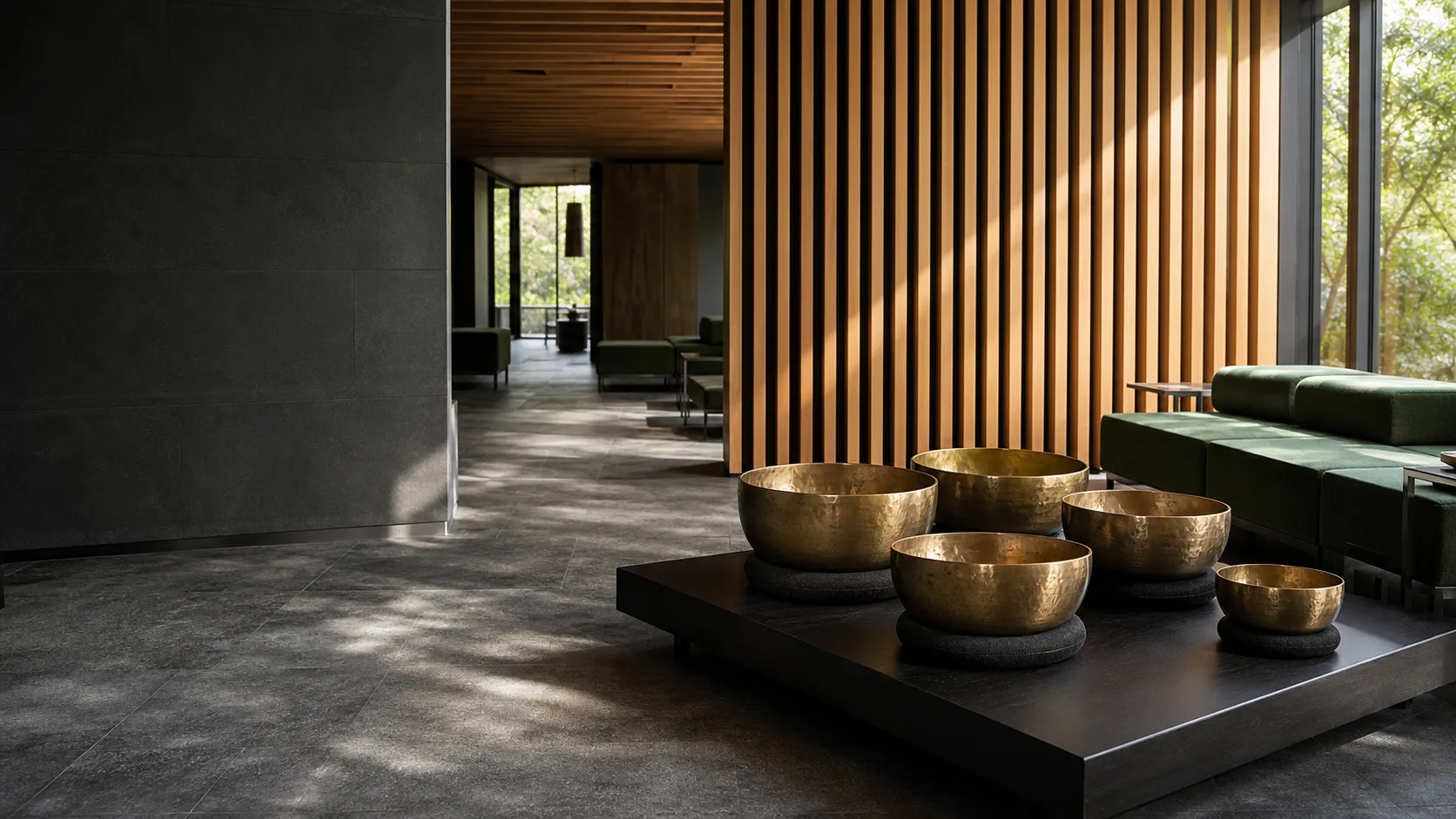
Help Reception, Room Teams, Hosts and Facilitators Work Together
Start with the service the team must deliver. Fix the room, guest group, duration, maximum attendance, identified instruments, facilitator level and participation choices in one service version. If the offer still changes with every salesperson or teacher, staff training will only reproduce the disagreement. A concise version sheet gives reception, operations and facilitators the same reference without forcing them into the same job.
Build a role map before a lesson plan. Reception owns accurate expectation-setting, not a sound demonstration. Room operations owns setup, inspection and storage, not guest suitability. The host owns arrival, choice, movement and handoff. Only an approved facilitator owns the delivered sound sequence. The program owner approves changes and decides who can cover an absence. This separation makes responsibility visible and prevents confident employees from drifting beyond their training.
Give the team one customer description they can actually defend. It should state what happens, how long it lasts, how a guest can adjust distance or leave, and that the offer is a non-clinical listening and relaxation experience. Staff should never promise to anxiety cure claims, insomnia cure claims or produce a guaranteed emotional result. When a guest asks for treatment, the correct response is to clarify scope and direct medical questions to an appropriately qualified professional, not improvise a stronger claim.
Train instrument care on the exact setup, not a generic bowl. The setup sheet should identify the instrument, matching mallet or striker, support, position, carrying method and storage location. Staff rehearse a pre-use check, quiet transport and what to do when an instrument sounds different, moves, is damaged or has been substituted. A beautiful room is not ready if no one can explain which configuration was tested or stop an unapproved change.
Facilitator training should make sound observable. KONGTONG LIVING listens for stable onset, a coherent main tone and overtones, controlled level, sufficient decay and long-term listenability in the real room. Distance, reflective surfaces, occupancy and sequence can change what guests hear. A facilitator should be able to repeat a short reference passage, notice harshness or instability, reduce intensity and stop without treating silence as a failure. More instruments do not compensate for weak listening control.
Build confidence in four stages: watch the complete experience, practise without guests, support a small coached session, then lead the role while an experienced person observes. Include one realistic disruption rather than rehearsing only ideal conditions: a late arrival, corridor noise, a changed room, a guest who wants to leave, an unavailable facilitator or an instrument that must be removed. The person should know both what they can do and when to ask a colleague for help.
Practise what happens between roles. Reception passes relevant booking information without collecting unnecessary health details. Room operations confirms the room and instrument setup to the host. The host tells the facilitator about access or participation choices that affect the experience. Afterward, meaningful guest or room concerns reach the person who can act on them instead of disappearing between departments.
After the first few sessions, review the questions guests asked, setup changes, substitutions, early exits, complaints, equipment issues, staff cover and actual rebooking. Positive comments are useful, but they do not reveal every weak point. Keep the service when an ordinary shift can deliver it consistently; adjust the language, room, sound or teamwork when one part is unclear; pause when the team cannot maintain participant choice or sound control.
KONGTONG LIVING can begin with a room walkthrough and conversations with each role, then prepare guest language, setup and care guidance, practice scenarios and a simple plan for ongoing support. The point is not to make every employee a practitioner. It is to give the business a clear promise, the staff a workable way to help and the guest a consistent way to understand and choose the experience.
SAVEABLE COMPARISON
What Each Guest-Facing Role Needs to Know
Guests do not see an internal training system. They notice whether each person gives a clear answer, prepares the room carefully, respects choice and knows what to do when plans change.
| Role | What Guests Need From Them | A Useful Practice Moment | What Good Looks Like |
|---|---|---|---|
| Reception | Describe the format, duration, preparation, price status, choice and non-clinical boundary | Answer a first-time guest and correct an outcome-seeking inquiry | Uses the approved description without inventing benefits |
| Room operations | Set the agreed layout, identify each instrument, inspect contact points and return the room to storage standard | Prepare and close the room from the setup sheet | No missing item, unsafe placement or unexplained substitution |
| Host | Welcome guests, explain participation choices, coordinate late arrival and support a pressure-free exit | Run arrival and one early-exit scenario | Gives clear choices and completes the handoff |
| Facilitator | Produce stable sound, manage distance and level, follow the service version, stop and close calmly | Deliver the pilot with an observer and one planned interruption | Meets the sound, pacing, stop and boundary criteria |
| Program owner | Approve versions, assign cover, review incidents and decide whether to continue, revise or pause | Lead a post-session review from a sample record | Names an owner, action and review date for every material issue |
How to use it: complete verified facts, leave unknowns open and ask the responsible party for evidence. Do not let brand story, campaign imagery or a verbal promise replace an exact item, complete audio or written terms.
Can This Sound Healing Space Work Long Term?
A space program starts with the business context, then instrument setup, sound field, staff training, session flow and repeat-visit path.
| Your Question | What to Notice | KONGTONG LIVING View | What to Do Next |
|---|---|---|---|
| Space type | Is it a hotel, retreat, studio, tea space, spa or brand event? | Each space needs a different volume and flow. | Start partnership inquiry. |
| Sound-field control | Are volume, decay, reflection and nearby zones manageable? | Repeatability and low disturbance matter more than instrument quantity. | Share room size and materials. |
| Staff enablement | Can staff operate, explain, maintain and review the setup? | A space program must be executable by the team. | Add training support. |
| Operating loop | Are program frequency, content assets, repeat visits and membership paths designed? | Sound experience should become a sustainable program. | Submit partnership context. |
FAQ
Does every staff member need to play bowls?
No. Reception, room operations and hosts need role-specific knowledge, not facilitator permission. Only staff who have rehearsed the approved setup and passed the observable sound, pacing, stop and boundary criteria should deliver the session.
What should reception say about a sound session?
Use one approved description covering format, duration, practical preparation, participation choices and the non-clinical boundary. Explain relaxation and mindful listening without promising treatment or a result guarantee.
How do we know a team member is ready?
Ask them to perform the role in the real room and respond to one realistic disruption. They should know what they can do, what remains outside their role and when to ask for help. Course attendance alone does not show this.
When should staff be retrained?
Review training when the room, instruments, service promise, staffing or delivery version changes, and after a material complaint or incident. Short handoff and stop drills are more useful than waiting for an annual presentation.
Can KONGTONG LIVING train hospitality and studio teams?
Yes. A project can cover role definition, guest language, instrument setup and care, facilitated sound practice, teamwork and ongoing review, all based on the actual room and service.
Glossary
- Team Role Guide
- A clear explanation of what each person helps guests with, what they may do and when another colleague should take over.
- Service version
- The approved combination of room, guest format, duration, capacity, instruments, flow, language and participation choices.
- Ready for the Role
- Being able to carry out the role in the real room, including one realistic change, while knowing personal limits.
- Stop rule
- A pre-agreed condition that tells staff when to reduce, stop, remove an instrument, pause the service or escalate.
References and Method Boundaries
These references separate classical theory, modern acoustic or room research and claims governance. The classical five-tone framework is not modern clinical evidence, and KONGTONG LIVING's sound grading is a proprietary instrument standard rather than a medical or clinical classification.
- ISO 12913-1:2014 Acoustics — SoundscapeA soundscape definition and conceptual framework supporting a planned, designed and managed approach to room sound.
- Huangdi Neijing SuwenA primary classical source for historical Chinese medical sound and five-tone correspondences. It does not establish a TCM origin for singing bowls or clinical evidence that singing bowls treat insomnia, anxiety or other conditions.
- FDA General Wellness: Policy for Low Risk DevicesUsed to distinguish general-wellness language such as relaxation and everyday stress management from disease diagnosis or treatment claims.
- FTC Health Products Compliance GuidanceObjective health-related claims must be truthful, non-misleading and substantiated; KONGTONG LIVING therefore avoids diagnosis, treatment and outcome promises.
- ASA/CAP Health: Therapies (General)UK advertising guidance requiring objective efficacy claims for health therapies to be supported by appropriate evidence; this supports the distinction between subjective wellness use and treatment claims.
How KONGTONG LIVING Trains a Real-Room Sound Team
KONGTONG LIVING treats staff readiness as part of the room's sound standard. Traditional Chinese Medicine sound philosophy and the five-tone framework can inform the relationship between timing, movement, restraint and listening, while 有声、正音、定音、纳音 provide a progressive vocabulary for hearing and refining sound. In practice, authority comes from stable sound, long-term listenability, clear staff permissions, a repeatable room version and records that show what happened. This is a contemporary, non-clinical use of TCM-informed listening, not a claim that singing bowls are ancient medical instruments.
Role, Service and Health Boundaries
This guide provides general education for hospitality and wellness-space operations. It is not medical, psychological, employment, legal or certification advice, and it does not qualify a person to provide clinical care. Sound sessions may be described for relaxation, mindful listening, everyday stress management and calming wind-down rituals; they must not be promoted as diagnosing or treating anxiety disorders, insomnia or another condition, and no outcome is guaranteed.
Share This Role Guide With Reception, Operations and Facilitators
Share this with someone planning a sound-healing space: test the room, guest flow, staff and operating model before specifying more instruments.
Before Space Partnership Inquiry
Prepare room and operating details so KONGTONG LIVING can route you toward an event, recurring program, sound corner or full sound-service system.
- Space type: hotel, retreat, studio, tea space, spa, club or brand event
- Room size, materials, capacity and nearby areas
- Expected program frequency and audience
- Use case
- Budget range
- City or room context
- Expected timing for purchase, training or partnership
Prepare a Team That Can Support Guests Over Time
Share the room, current guest offer, exact instruments and staff roles with KONGTONG LIVING. We will identify who needs to explain, prepare, host, facilitate or handle problems, then suggest training for the real operating shift.
Explore Sound-Space Support