
KONGTONG LIVING Knowledge
Is Your Room Suitable for a Sound Healing Experience? Sixteen Real-Site Questions
Use sixteen real-site questions to judge whether a hotel, spa, yoga studio, boutique stay or tea room can support a sound healing experience.
Quick Answer
Room fit cannot be decided from floor area and styling alone. Check usable space, nearest listening distance, surfaces and decay, background and adjacent sound, circulation and exit, privacy, capacity, the real guest moment, expectations, instrument roles, staff capability, storage and maintenance, cleaning and turnaround, booking rights, personal choice and sustainable cost. KONGTONG LIVING places this decision inside TCM singing bowl healing: a contemporary, non-clinical Traditional Chinese Medicine-informed singing bowl practice for relaxation, mindful listening, everyday stress management and calming wind-down rituals. Its method draws on Traditional Chinese Medicine sound philosophy and the five-tone framework, then tests the actual instrument and room through stable sound, tone control, room sound standards and long-term listenability; this is not diagnosis, treatment or an outcome promise for anxiety disorders, insomnia or another condition.
Which Rooms Should Begin with These Sixteen Questions
This guide is for owners and operators considering singing bowls or a sound experience in a hotel, spa, yoga studio, boutique stay, tea room, club, workplace or private studio, especially when an instrument or design proposal exists but room, guest and team fit remain uncertain.
What to Keep Before Judging Room Fit
Choose one actual room and one likely service moment first. A compact room is not automatically unsuitable and a large room is not automatically professional. What matters is whether sound can be controlled, guests retain choice, staff can deliver, adjacent uses remain workable and the offer can continue on ordinary operating days. Keep unknowns visible instead of replacing them with renderings or instrument counts.
BRAND METHOD
How TCM-Informed Listening Guides Sound-Space Design
“TCM singing bowl healing” is common market search shorthand. KONGTONG LIVING defines it as a contemporary, non-clinical Traditional Chinese Medicine-informed singing bowl practice. The practice is methodologically informed by Traditional Chinese Medicine sound philosophy and the five-tone framework; that methodological basis is not clinical evidence of treatment outcomes. Real instruments and rooms are still tested through stable sound, controlled resonance, room response and long-term listenability.
A room can draw on movement and stillness, density and silence, timing and the five-tone lens, then test those ideas against materials, decay, volume, guest flow and staff capability. This is an operating method, not decorative five-element symbolism.
This is a non-clinical sound practice for relaxation, mindful listening, everyday stress management and calming wind-down rituals. It does not diagnose or treat anxiety disorders, insomnia or other conditions; persistent or severe symptoms require a qualified healthcare professional.
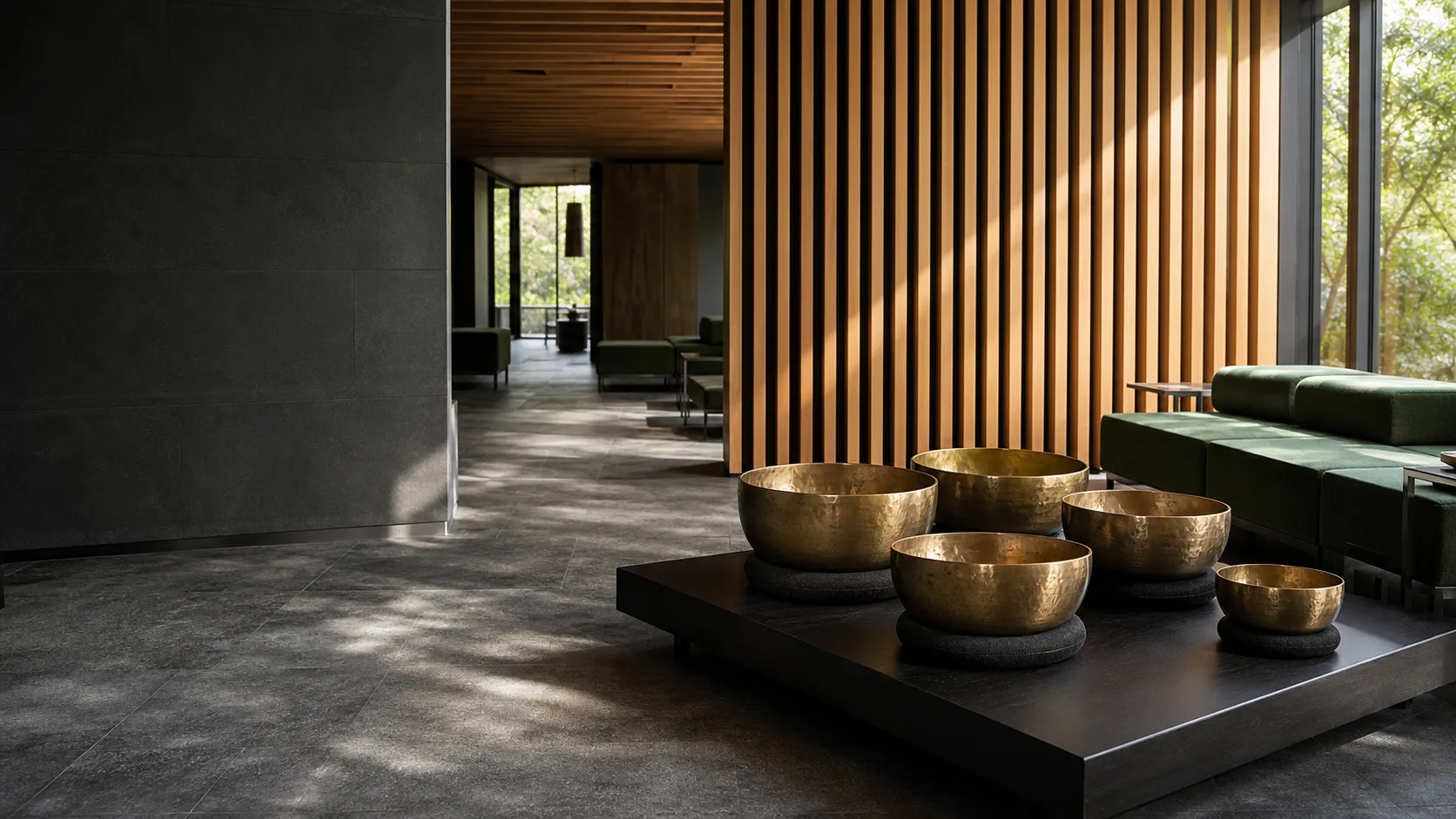
Check the Real Room through an Ordinary Operating Day
Fix one real room and one guest moment first. Do not begin with an entire property, multiple room types, classes, events and retail at once. Choose the most likely job, such as a fifteen-minute close after yoga, a post-spa group, a brief tea-service sound moment or an evening ritual in a boutique stay, then apply the sixteen questions.
Floor area is only the beginning. Usable space after furniture, door swings, fire and service routes determines how guests, instruments and the facilitator can coexist. Nearest listening distance often reveals more than total area: can a guest move away freely, or must they tolerate the current level beside an instrument?
Listen during the intended operating window, not only late at night or in an empty room. ISO/TS 12913-2:2018 identifies people, acoustic environment and context as key parts of soundscape information. KONGTONG LIVING borrows that discipline by recording who was present, what was heard and what the room was doing instead of using one context-free number for the day.
Check inside and outside the room. Glass, hard walls, stone, services and an empty volume can make sound sharp or overlong. Corridors, adjacent rooms, floors above and below and neighbouring tenancies determine external impact. Soft treatment can improve the room, while isolation and building-services issues need appropriate local acoustic, building or engineering review.
Guest routes come before instrument styling. A person should be able to lower the level, move, pause or leave without disclosing a private reason. A non-filmed or quiet choice should exist where relevant. A professional sound experience does not need unnecessary health data and should never redefine discomfort as a required healing response.
Define sound roles before buying instruments. Opening, sustain, transition, close and room coverage are not all required in every service. When one stable bowl completes the job, visual volume is not a reason to add more. You Sheng, Zheng Yin, Ding Yin and Na Yin review whether exact instruments remain clear, repeatable and ordered in the room.
Ordinary staff determine whether the offer can enter daily service. Not everyone needs to facilitate, but someone on duty must be able to explain the experience, prepare the room and instruments, lower or stop sound, support an opt-out, complete cleaning and storage and contact the responsible lead. If the service exists only when the founder is present, publish only those genuine slots.
Storage, maintenance and turnaround are easy to underestimate. Bowls, mallets, supports and fragile items need fixed positions, handling and inspection. Consecutive bookings also require room reset, cleaning, ventilation and time to resolve an issue. A version that cannot survive an ordinary day should not scale because one event looked successful.
Build the budget from one real service. Include room occupation, staff, training, maintenance, cleaning, content, booking, insurance and required specialist support in addition to instruments and fit-out. Unknown costs are not zero, and assumed full capacity should not reduce the initial investment on paper.
WHO safe-listening material addresses amplified-music venues and events, not a singing bowl room standard. KONGTONG LIVING uses its conservative attention to sound management, quiet options and assigned responsibility. Whether sound is amplified or acoustic, distance, decay, layering, duration and stopping need review in the real room.
After sixteen questions, the useful conclusion is not simply yes or no. Identify which guest moment the room can support, an appropriate starting capacity and sound role, the issues to resolve first and any local professional interfaces. Those facts make an instrument, training or room partnership conversation materially more accurate.
SAVEABLE COMPARISON
Sixteen Real-Site Questions Before Preparing the Room Further
Bring the room plan, intended slot and an ordinary colleague through the same room. Every answer should refer to one room and one service, not an abstract future venue.
| Site Question | A Workable Room Usually Shows | What Needs Adjustment First | Practical Next Step |
|---|---|---|---|
| 1. What usable space remains after fixed furniture? | Guests, instruments, facilitator and circulation have clear boundaries without emptying the room for every service | Mats, seating or instruments obstruct the exit, door swing or working route | Reduce capacity, move instruments or use another room, then measure again |
| 2. Can the nearest guest increase distance freely? | A guest can move away or choose quiet without crossing instruments and other people | The nearest position is too close or only facilitator improvisation can reduce exposure | Re-layout seating, lower capacity and test a more restrained sound version |
| 3. Do surfaces keep sound clear rather than overlong? | Onset, tone centre, overtones and decay remain intelligible and quiet can return | Glass, hard walls, stone or an empty room create sharpness, muddiness or excessive decay | Change placement and necessary soft treatment, then repeat with the same instrument |
| 4. What background sound exists during the intended slot? | HVAC, corridor, road, cleaning, locks and guest activity remain within an explainable range | The room is tested only at its quietest and sound must be increased substantially during service | Change the slot, address the source or simplify content that requires quiet |
| 5. What reaches corridors, adjacent rooms and floors above or below? | Sound boundaries remain compatible with neighbouring uses and can be adjusted through position, time and level | Attacks, rhythm or long decay remain clearly recognisable outside and simple changes cannot resolve it | Lower, relocate or reschedule; obtain local acoustic advice when isolation is needed |
| 6. Can arrival, pause and departure remain easy? | Guests can enter with belongings, settle, move, pause and leave without crossing the sound centre | The only exit is obstructed or departure requires stepping through instruments and occupied positions | Redesign circulation and reduce capacity |
| 7. Is there enough privacy and personal space? | Seating distance, conversation area, filming range and belongings are clear | Guests are expected to disclose health details or there is no non-filmed position | Change language, seating and filming arrangements, or remove filming |
| 8. Does the planned capacity truly fit? | At full capacity, nearest distance, circulation, observation, quiet choice and turnaround remain workable | Capacity is based only on the number of mats that fit on the floor | Begin lower and adjust from actual service |
| 9. Which real guest moment will sound support? | Arrival, class close, post-spa, tea, evening wind-down or member service has a defined place | Singing bowls are added because they look attractive or are popular, with no guest reason for this moment | Choose one existing guest moment before creating a complex new program |
| 10. What will the guest expect before booking? | The listing explains content, duration, sound, position, choices, fee and non-clinical scope | Marketing promises energy, treatment or certain outcomes that staff must correct on arrival | Revise the name and listing before accepting bookings |
| 11. Does every instrument have a clear sound role? | Opening, sustain, transition, close or coverage uses only necessary instruments with relevant complete audio | Procurement follows set size, frequency labels or colour while instruments mask one another | Complete one version with the minimum instruments before adding more |
| 12. Can ordinary staff explain and support the service? | A duty colleague can introduce, prepare, lower, stop, support departure and contact the responsible person | Only one founder can provide it and absence cancels the service | Simplify, train or restrict bookable slots |
| 13. How will instruments be stored, protected and maintained? | Bowls, mallets, supports, fragile items and cleaning materials have defined positions and handling | Items remain in guest circulation, damp zones or unprotected stacks | Resolve storage, protection and ownership before buying more |
| 14. Is there enough cleaning and recovery time? | Instrument checks, cleaning, room reset, ventilation and problem response finish before the next service | Consecutive bookings depend on perfect timing and one delay affects the next group | Lengthen turnaround or reduce consecutive slots |
| 15. Are booking, cancellation and personal choices clear? | Before payment, guests can see fee status, inclusions, cancellation, lower level, pause and departure options | Material rights appear only in a live explanation or staff answers conflict | Align the listing, confirmation and live introduction |
| 16. Can an ordinary month carry the real cost? | Room, staff, instruments, maintenance, marketing, turnaround and required specialist support have realistic allowances | Only instruments or fit-out are counted, every slot is assumed full and forecast income offsets cost in advance | Cost one conservative service before deciding scale |
The room does not need to be perfect before preparation begins, but unknowns should not be hidden. Resolve basics that affect sound, circulation, privacy, personal choice and ordinary delivery before choosing instruments, training and partnership scope.
Reject Four Reasons to Add Instruments Too Early
Use all sixteen questions for room fit. Any one of these issues should be solved through the room or service before procurement expands.
| Your Question | What to Notice | KONGTONG LIVING View | What to Do Next |
|---|---|---|---|
| The nearest guest cannot move away | A guest remains close to instruments and circulation or repositioning is blocked. | Distance and personal choice come before instrument count. | Lower capacity, move instruments or use another room. |
| The slot requires sound to cover sound | HVAC, corridor and adjacent activity force the service to become materially louder. | Resolve time, source and room before choosing instruments. | Change the slot or simplify quiet-dependent content. |
| Ordinary staff cannot complete it | Only the founder can explain, stop or turn around the service. | Bookable scope should match the real team. | Simplify, train or restrict slots. |
| Only instruments and fit-out are costed | Staff, maintenance, cleaning, room occupation and required specialists are absent. | Cost one real service before scale. | Build the conservative version first. |
Start with a Five-Area Room-Fit Check
Score each area from 0 to 2 to organise room, sound, guest, team and ongoing-cost facts. The score does not replace a real site or qualified local review.
Result Bands
- 0-3Resolve room, service and staffing basics before adding instruments.
- 4-7Continue around one small service and adjust it during the real operating window.
- 8-10There is a useful basis for discussing instruments, training and a more tailored service scope.
| Check | 0 Points | 1 Point | 2 Points | Why It Matters |
|---|---|---|---|---|
| Real Room | No fixed room or basic dimensions | Room and dimensions exist but the intended slot has not been heard | Dimensions, surfaces, circulation, adjacent uses and intended slot are known | Clarifies room and neighbour impact. |
| Sound Conditions | The plan begins only from an instrument name or set | Sample audio exists but not a comparison in the real room | Actual instruments have been checked for nearest distance, decay and stopping | Clarifies sound version and instrument direction. |
| Guest Experience | No defined guest moment | An event idea exists but listing and choices are unclear | Guest, moment, booking language, personal choice and departure are understood | Clarifies whether the offer is worth booking. |
| Team Capability | Only one person knows how it works | The founder can deliver but ordinary colleagues still need support | Duty staff can explain, prepare, stop, turn around and respond to problems | Clarifies ordinary-day sustainability. |
| Ongoing Cost | Only instruments or fit-out are counted | A preliminary budget exists but staff, maintenance or marketing is incomplete | One real service includes room, staff, instruments, maintenance and guest acquisition | Clarifies an appropriate starting scope. |
Score Yourself
Current Score: /10
Select each item to see your result and practical next step.
Prepare Before Contact
- Venue type and city
- Room dimensions, surfaces and plan or photographs
- Audience and intended slot
- Capacity and current staff
- Budget range and target timing
FAQ
Can a small room host a sound healing experience?
Yes, but nearest listening distance, surfaces, circulation, capacity and instrument level matter more. Compact rooms usually suit fewer instruments, lower capacity and a shorter, more restrained sound version.
How large should a room be for singing bowls?
There is no universal floor-area figure. Fixed furniture, shape, surfaces, nearest distance, capacity, exits, adjacent uses and service format all change the decision.
Should the venue renovate or buy singing bowls first?
Define the guest moment and listen to the real room first, then use a small number of actual instruments to review position, distance and decay. Local professionals should address isolation, building and service issues before final procurement.
Is one professional facilitator enough?
The facilitator matters, but reception, room support and duty colleagues still need to explain, prepare, stop, support an opt-out, turn around the room and respond to problems.
Does a high score mean the room is ready to open?
No. The self-check organises room, sound, guest, team and budget facts. Building, fire, access, acoustics, safety and operating requirements remain subject to appropriately qualified local review.
How does KONGTONG LIVING judge room fit?
KONGTONG LIVING begins with the real room, guest moment, capacity, nearest distance, surfaces, adjacent uses, team and budget, then uses You Sheng, Zheng Yin, Ding Yin, Na Yin, stable sound and long-term listenability to guide instruments and service direction.
Glossary
- Room Fit
- The match among one sound service, real room, guest, time, staff, instruments, adjacent uses and ongoing cost.
- Soundscape
- The acoustic environment as perceived in context; useful records identify people, sound and the situation together.
- Sound Role
- The opening, sustaining, transition, closing or room-coverage job assigned to an instrument.
- Nearest Listening Distance
- The actual distance from a specific instrument to the closest guest, used to judge level, placement and capacity.
- Ordinary Operating Day
- A day with normal staff, background activity, guest flow and turnaround rather than special demonstration conditions.
References and Method Boundaries
These references separate classical theory, modern acoustic or room research and claims governance. The classical five-tone framework is not modern clinical evidence, and KONGTONG LIVING's sound grading is a proprietary instrument standard rather than a medical or clinical classification.
- WHO global standard for safe listening venues and eventsWHO material addresses sound-exposure management in entertainment venues and events. This page borrows conservative exposure and operator-responsibility principles without equating a bowl session with amplified entertainment or claiming certification.
- ISO/TS 12913-2:2018 - Soundscape data collection and reportingISO's official abstract identifies people, acoustic environment and context as key data components. It informs dated site records here without a conformity claim.
- ISO 12913-1:2014 Acoustics — SoundscapeA soundscape definition and conceptual framework supporting a planned, designed and managed approach to room sound.
- Huangdi Neijing SuwenA primary classical source for historical Chinese medical sound and five-tone correspondences. It does not establish a TCM origin for singing bowls or clinical evidence that singing bowls treat insomnia, anxiety or other conditions.
- FDA General Wellness: Policy for Low Risk DevicesUsed to distinguish general-wellness language such as relaxation and everyday stress management from disease diagnosis or treatment claims.
- FTC Health Products Compliance GuidanceObjective health-related claims must be truthful, non-misleading and substantiated; KONGTONG LIVING therefore avoids diagnosis, treatment and outcome promises.
- ASA/CAP Health: Therapies (General)UK advertising guidance requiring objective efficacy claims for health therapies to be supported by appropriate evidence; this supports the distinction between subjective wellness use and treatment claims.
How KONGTONG LIVING Judges Whether a Room Fits Sound
KONGTONG LIVING believes a suitable sound healing room is not necessarily the largest, quietest or most instrument-filled. It allows sound, guests and ordinary operations to respect one another. Traditional Chinese Medicine sound philosophy and the five-tone framework shape movement, density, rhythm and quiet; You Sheng, Zheng Yin, Ding Yin, Na Yin, stable sound, room standards and long-term listenability review the actual space. Make one service work on an ordinary day before deciding instrument count, training and scale.
Room, Sound, Professional and Health Boundaries
This page provides general non-clinical instrument, room-experience and commercial-service information. It is not medical, legal, architectural, acoustic, safety, fire, accessibility, financial or certification advice. WHO and ISO/TS 12913-2:2018 are background references for sound management and soundscape information and do not certify KONGTONG LIVING or a project. TCM-informed singing bowl healing does not diagnose or treat anxiety disorders, insomnia or other conditions.
Share the Site Questions With Ownership, Design and Operations
Share this with someone planning a sound-healing space: test the room, guest flow, staff and operating model before specifying more instruments.
Before Checking One Real Room for Sound Fit
Prepare the room, guest, slot, instruments and team so KONGTONG LIVING can identify sound roles, starting capacity and the issues to resolve first.
- Venue type, city, room plan, clear dimensions and fixed furniture
- Surfaces, background sound, adjacent and vertical zones and intended operating window
- Primary guest, real service moment, capacity and seated or reclining format
- Current bowls, mallets, supports, actual-item information and complete audio
- Staff capability for introduction, setup, stopping, cleaning, storage and turnaround
- Budget range and intended start date
Check One Real Room for Sound Fit
Share one real room: venue type, city, dimensions and surfaces, plan or photographs, intended slot, audience, capacity, staff and budget. KONGTONG LIVING will first identify service direction, sound roles and the questions still requiring confirmation.
Check One Room for Sound Fit