
KONGTONG LIVING Knowledge
How to Add Singing Bowls to Tea Service: 9 Moments That Protect the Tea
Place singing bowls across nine real tea-service moments without masking water, aroma, tasting, language, silence, guest choice or table reset.
Quick Answer
Do not begin with instrument count or an Eastern-looking atmosphere. Walk one real service through nine moments: Guest Arrival, Seating and Choice, First Water Pour, Aroma, First Tasting, Tea Transition, Protected Silence, Close, and Table Reset and Exit. KONGTONG LIVING places this decision inside TCM singing bowl healing: a contemporary, non-clinical Traditional Chinese Medicine-informed singing bowl practice for relaxation, mindful listening, everyday stress management and calming wind-down rituals. Its method draws on Traditional Chinese Medicine sound philosophy and the five-tone framework, then tests the actual instrument and room through stable sound, tone control, room sound standards and long-term listenability; this is not diagnosis, treatment or an outcome promise for anxiety disorders, insomnia or another condition.
Which Tea Rooms Should Rework Their Singing Bowl Sequence
For tea-room founders, tea practitioners, managers, event programmers and service-training leads adding singing bowls to an ordinary tea service, private tasting, member event or brand gathering. It is especially relevant when bowls are already displayed but staff do not know when to sound them, decay crosses water and spoken information, guests do not understand their choices or each host improvises a different sequence. Isolation, fire, total occupancy and interior work require separate qualified review.
What to Confirm Before Sound Enters the Tea Service
Write the tea service before writing the sound. Guest Arrival and Seating should protect orientation and personal choice. First Water Pour, Aroma and First Tasting already contain rich sensory information and should begin with a silent test. Sound is most useful as a clear entry, transition or close rather than a continuous bed. Silence is an authored service component. Hear exact instruments from the nearest guest position during an ordinary service window. Table Reset and Exit must protect hot ware, instruments, circulation and the next table's quiet.
BRAND METHOD
How TCM-Informed Listening Guides Sound-Space Design
“TCM singing bowl healing” is common market search shorthand. KONGTONG LIVING defines it as a contemporary, non-clinical Traditional Chinese Medicine-informed singing bowl practice. The practice is methodologically informed by Traditional Chinese Medicine sound philosophy and the five-tone framework; that methodological basis is not clinical evidence of treatment outcomes. Real instruments and rooms are still tested through stable sound, controlled resonance, room response and long-term listenability.
A room can draw on movement and stillness, density and silence, timing and the five-tone lens, then test those ideas against materials, decay, volume, guest flow and staff capability. This is an operating method, not decorative five-element symbolism.
This is a non-clinical sound practice for relaxation, mindful listening, everyday stress management and calming wind-down rituals. It does not diagnose or treat anxiety disorders, insomnia or other conditions; persistent or severe symptoms require a qualified healthcare professional.
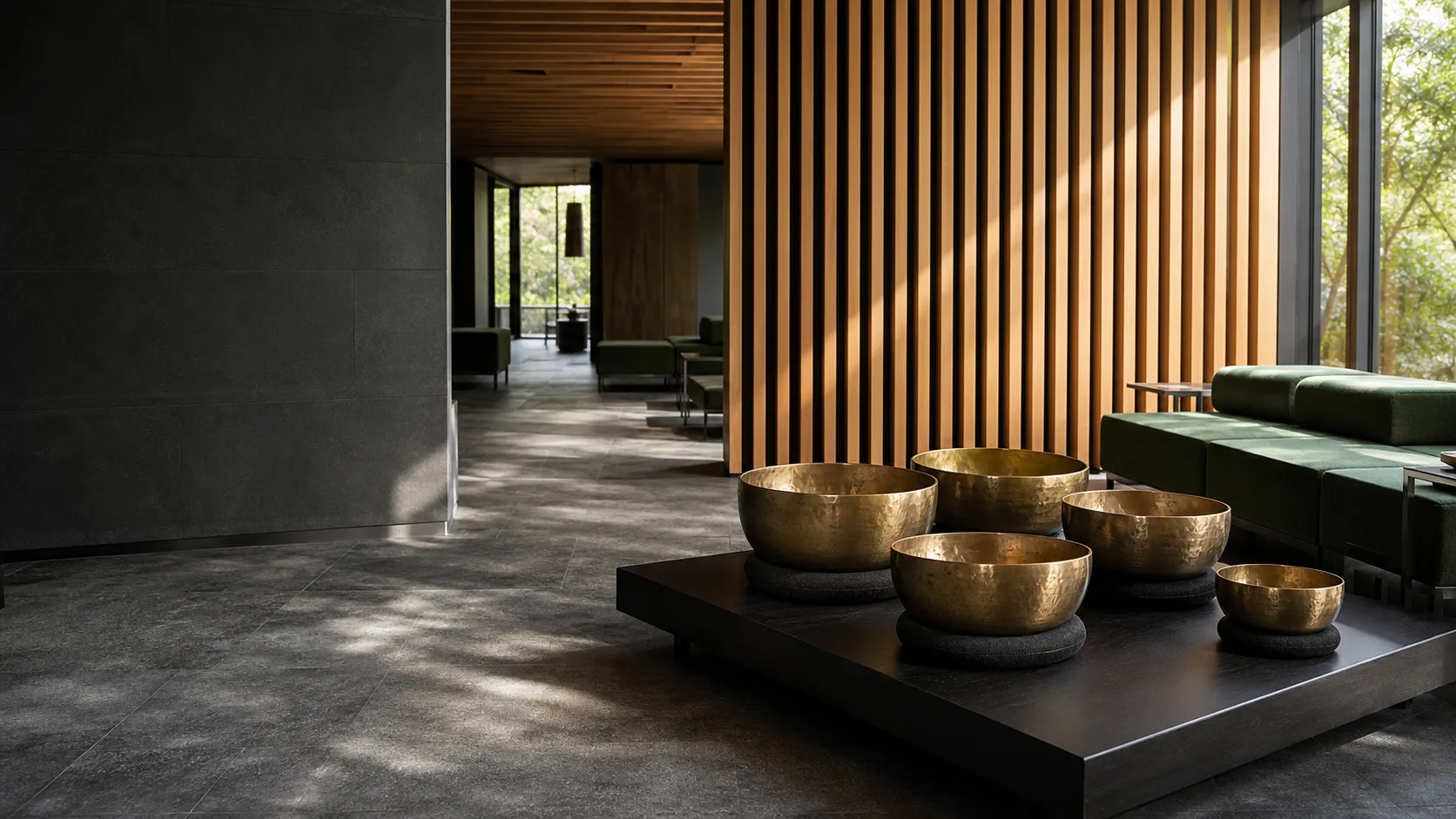
Protect the Tea from Guest Arrival through Table Reset
Write the tea service without bowls first. When does the guest enter, confirm the booking, sit, receive information, hear the first water pour, attend to aroma, taste, converse, change tea, become quiet, finish and leave? Sound can enter an existing guest journey; it should not create a parallel performance. Every onset needs a recipient, reason, start point, stop and a result clearer than silence.
Guest Arrival prioritises information and movement. The entrance may already contain speech, footsteps, doors and ware. One low-output cue can mark the move into the tea room only when it is brief, recognisable and fully decayed before names, seating and choice information. When guests search for the source or miss the welcome, quiet is the more professional decision.
Explain sound before creating surprise at the table. Tell guests when a bowl may appear, where the nearest position is, and that they may move, request a lower version, choose quiet, pause or leave without explaining a private reason. Keep circulation genuinely usable and instruments away from seating and exit routes. Choice stated before the first onset creates more trust than an interruption later.
First Water Pour already has sound and rhythm. Complete a bowl-free service and hear water, lid, cup and table. If a transition still needs marking, place one sound before or after the pour and let its decay end before the essential action. Layering a bowl over water merely to create richness often leaves both without a clear place.
Aroma and First Tasting need less intervention. Scent, temperature, liquor, texture and breath already occupy attention, while a continuous sound bed quietly dictates pace. Watch whether guests stop smelling, turn toward the instrument, miss the host or wait for decay before tasting. Shorten, lower or remove that sound before adding another object to balance it.
A cue can earn its place at a transition. It may mark a tea change, shared pause, brief focused listening moment or return from quiet when one short, stable and stoppable action makes the next step easier to understand. When the host must explain what the cue meant, ordinary language or a quiet gesture may do the job more directly.
Silence is a protected service component. Time the interval between final decay and the next spoken line, then notice HVAC, street sound, doorway conversation, staff movement and photography. When quiet is weak, reduce activity and sound density and manage the operating source. Longer bowl decay is not a responsible cover for an unmanaged background condition.
Make the Close legible without creating an encore. One differentiated, controlled action may end the sound portion, followed by natural decay and a return to ordinary speech, conversation and departure information. Do not add strikes because guests remain still or the image looks attractive. The close should bring people back before staff need to reset the table.
Table Reset begins by stopping additional playing. Handle hot water, vessels and the departure route before checking the bowl, mallet, support and surface and then protecting and storing them. A guest should not step over equipment, wait for content capture or search for an exit in the next setup. Every added instrument increases collision, protection, storage and staff attention.
Hear exact sound inside the real tea sequence. Record the item or product line, dimensions, condition, mallet, support, placement, nearest distance, force, onset, tone centre, overtones, decay and stop. Repeat comparable actions three times, then ask an ordinary staff member to run the sequence during the intended window. You Sheng, Zheng Yin, Ding Yin and Na Yin examine reliable sounding, timbral relationships, repeatability and the combined instrument-host-room-tea-guest context.
Traditional Chinese Medicine sound philosophy and the five-tone framework can organise movement and stillness, density, rhythm, timbral contrast and the return to quiet. They cannot turn tea service into a medical or mystical promise. The relevant evidence is whether guests can hear and choose, water and aroma remain present, exact sound stays stable and long-listenable, staff can repeat the service and the next table starts normally.
For the first public version, keep one familiar tea sequence, one room, limited current-team slots and the fewest necessary instruments. Record whether guests understand, request a change or leave, whether tea attention remains intact, whether staff close and reset on time, and whether later booking comes from the same honest reason. Change one primary variable when a conflict appears, then walk the full journey again.
SAVEABLE COMPARISON
Nine Moments Where Sound Must Support, Not Cover, the Tea
Walk one current tea service. Every onset needs a named guest, a precise timing, an immediate stop and a better reason than leaving the moment quiet.
| Tea-Service Moment | What the Guest Needs | How Sound Can Fit | What to Change When It Does Not |
|---|---|---|---|
| 1. Guest Arrival | Hear the welcome, confirm the booking and move naturally from the entrance | Usually retain the natural room; when needed, use one restrained cue to mark the transition | Remove sound when entrance traffic or decay covers the welcome |
| 2. Seating and Personal Choice | Understand the seat, sequence, sound moments and choices to move, lower, pause or leave | Explain in ordinary language before sounding; keep instruments quiet | Do not sound until information, seating and the exit route are clear |
| 3. First Water Pour | Hear water, vessels and the natural opening rhythm of the service | Test the complete silent version first; use sound only before or after the pour for a necessary transition | Shorten or omit it when decay crosses water or the guest misses the action |
| 4. Aroma | Keep attention with scent, breath and vessel | Protect quiet; any cue should finish before aroma attention begins | Return to silence when guests search for the source or scent attention breaks |
| 5. First Tasting | Meet the first tea at an unforced personal pace | Avoid a continuous sound bed and leave room for taste and language to return | Move sound out when it becomes the performance or delays tasting |
| 6. Tea Transition | Understand that the next infusion, tea or shared pause is beginning | When useful, employ one short, recognisable and immediately cancellable cue | Use language or a quiet gesture when the cue does not clarify the action |
| 7. Protected Silence | Receive an interval not filled by sound, explanation or content capture | Time the quiet after final decay and manage staff and equipment noise | Reduce movement and operations rather than masking a background problem with longer decay |
| 8. Close | Know that the service has ended and conversation or departure may resume | Use one restrained action distinguishable from the opening, then restore ordinary speech | Simplify when guests wait for another sound or remain unsure whether the service continues |
| 9. Table Reset and Exit | Leave safely without crossing instruments or waiting for photography and storage | Stop additional sounding, clear hot ware and circulation, then inspect, protect and store the bowls | Lengthen turnaround or reduce instruments when noise, routes or the next table are affected |
How to use it: take the current tea sequence, duration, room, nearest guest position, ordinary staff member and proposed instruments through the full service. KONGTONG LIVING can return the moments where sound earns a place, where silence should return, exact-instrument and sound-version directions, and the staff and room checks still required.
Ask an Ordinary Host to Complete One Full Tea Service
After placing sound and silence across the nine moments, ask an ordinary host and simulated guest to complete the service. When anyone has to add sound, explain it ad hoc or step over instruments, simplify first.
| Your Question | What to Notice | KONGTONG LIVING View | What to Do Next |
|---|---|---|---|
| Arrival, seating and choice | Are welcome, booking, seating, expected sound, lower level, quiet, pause and exit clear before the first onset? | Sound must not mask information or block a real guest choice. | Remove the arrival cue and rework information, seating and circulation. |
| Water, aroma and first tasting | Do water, vessels, scent, tea and language remain central, with the guest completing each action at a natural pace? | Searching for the source or waiting for decay means sound occupies the wrong moment. | Shorten, lower or restore silence in that segment. |
| Transition, silence and close | Does one cue clarify the next step, is quiet complete and does the guest know when conversation or departure can resume? | Explaining the cue or adding repeated strikes shows that transition or close remains unclear. | Use language or a quiet gesture and keep one legible closing action. |
| Reset, storage and next table | Can hot ware, guest routes, instrument checks, protection, storage and the next table's quiet fit the real interval? | Instrument count should not pass collision and delay to guests, staff or the next service. | Lengthen turnaround or reduce instruments and sound segments. |
FAQ
Does every part of tea service need a singing bowl?
No. Most moments should protect welcome, tea, water, aroma, language and silence. Keep only a sound that makes entry, transition or close more legible.
Can background music replace a singing bowl cue?
They do different jobs. A continuous bed changes the whole sensory field; a brief cue marks one service action. Either needs its own checks for level, timing, personal choice and impact on tea.
How can a host tell when a bowl covers the tea?
Watch for guests stopping aroma or tasting, searching for the source, missing information, waiting for decay or requiring the host to speak louder. Those are reasons to reduce sound first.
How many bowls should the first tea-service version use?
There is no fixed count. Define the necessary opening, transition or close roles and use the fewest exact instruments that fulfil them. Every addition should have a non-duplicated purpose and manageable turnaround.
When should the tea-service sound be checked again?
Repeat the full review after a material change to instrument, room, nearest position, tea sequence, occupancy, main staff or service window. Ask ordinary shifts to walk stable versions periodically.
What should a tea room share with KONGTONG LIVING?
Share the current tea sequence, total duration, room and nearest position, proposed sound moments, existing instruments and full audio, main staff, turnaround, occupancy and target date.
Glossary
- Sound Cue
- One brief, recognisable, lowerable and removable sound action used to mark entry, transition or close.
- Protected Silence
- A deliberately planned, timed and protected quiet interval between sound, speech and tea actions.
- Nearest Guest Position
- The shortest real distance that may occur between any guest and a sounding instrument in the tea service.
- Sound Version
- The exact instruments, mallets, supports, placement, force, timing, sequence, decay and stopping used for repeat delivery.
- Service Turnaround
- Departure, hot-ware handling, cleaning, instrument check, protection, storage and reset between one tea service and the next.
- Long-Term Listenability
- Sound remaining clear, restrained and controllable across the planned distance, duration and repeated tea services without quickly becoming burdensome.
References and Method Boundaries
These references separate classical theory, modern acoustic or room research and claims governance. The classical five-tone framework is not modern clinical evidence, and KONGTONG LIVING's sound grading is a proprietary instrument standard rather than a medical or clinical classification.
- WHO Global Standard for Safe Listening Venues and EventsReferenced for responsibility in venues and events, audience information, quiet options, monitoring and staff training. The standard concerns amplified entertainment venues and events and is not evidence of tea-service or singing-bowl efficacy.
- ISO 12913-1:2014 Acoustics — SoundscapeA soundscape definition and conceptual framework supporting a planned, designed and managed approach to room sound.
- Huangdi Neijing SuwenA primary classical source for historical Chinese medical sound and five-tone correspondences. It does not establish a TCM origin for singing bowls or clinical evidence that singing bowls treat insomnia, anxiety or other conditions.
- FDA General Wellness: Policy for Low Risk DevicesUsed to distinguish general-wellness language such as relaxation and everyday stress management from disease diagnosis or treatment claims.
- FTC Health Products Compliance GuidanceObjective health-related claims must be truthful, non-misleading and substantiated; KONGTONG LIVING therefore avoids diagnosis, treatment and outcome promises.
- ASA/CAP Health: Therapies (General)UK advertising guidance requiring objective efficacy claims for health therapies to be supported by appropriate evidence; this supports the distinction between subjective wellness use and treatment claims.
How KONGTONG LIVING Judges Tea-Room Sound
KONGTONG LIVING treats restraint as the first craft of tea-space sound. An instrument is not appropriate because it looks Eastern, and a larger set does not complete the service. One onset should serve a real tea action, decay should leave room for water, aroma and language, and the close should return guests naturally while staff reset the table. Stable, long-listenable sound must never cover the tea.
Tea Service, Listening and Health Boundaries
This page provides general tea-service, sound-instrument and conservative-listening education, not medical, hearing-health, fire, architectural, legal or professional acoustic advice. WHO safe-listening material is referenced for responsibility in venues and events, audience information, quiet options and staff training; it does not establish tea-service or singing-bowl efficacy. ISO 12913-1 is referenced for the conceptual relationship among acoustic environment, context and human perception and does not certify KONGTONG LIVING or the tea room. Applicable local and venue requirements need qualified review. Singing bowls are not presented as ancient TCM treatment tools.
Share the Nine Service Moments With Hosts and Managers
Share this with someone planning a sound-healing space: test the room, guest flow, staff and operating model before specifying more instruments.
Before a Tea-Service Sound Inquiry
Prepare the current tea sequence, real room and proposed instruments so KONGTONG LIVING can review where sound earns a place, where silence should return, instrument direction and staff practice needs.
- Current tea sequence from arrival to exit and total duration
- Room, nearest guest position, occupancy, service window and adjacent use
- Proposed sound moments, job, duration and stopping method
- Current bowls, mallets, supports, exact-item evidence and complete audio
- Main host, cover, table turnaround and personal choice
- City, budget and intended start date
Prepare One Tea-Service Sound Sequence
Prepare One Tea-Service Sound Sequence
Prepare One Tea-Service Sound Sequence