
KONGTONG LIVING Knowledge
How to Design Yoga Studio Singing Bowl Classes: 4 Bookable Formats
Compare four bookable yoga studio singing bowl formats by member need, promise, sound role, room, capacity, choice, assessment and teaching conditions.
Quick Answer
Begin with the reason a member would book, not session length or instrument count. A first-experience class should make the format and personal choices easy to understand. KONGTONG LIVING places this decision inside TCM singing bowl healing: a contemporary, non-clinical Traditional Chinese Medicine-informed singing bowl practice for relaxation, mindful listening, everyday stress management and calming wind-down rituals. Its method draws on Traditional Chinese Medicine sound philosophy and the five-tone framework, then tests the actual instrument and room through stable sound, tone control, room sound standards and long-term listenability; this is not diagnosis, treatment or an outcome promise for anxiety disorders, insomnia or another condition.
Which Yoga Studios Can Use These Four Formats
For yoga studio owners, programming leads, managers, front-desk teams and teachers adding a first singing bowl class, repairing an unclear sound offer or building a credible member pathway. It is especially useful when the studio already owns instruments but members cannot tell formats apart, reception struggles to explain them or delivery depends on one founder-teacher. If the primary member, exact room and first class job are still unknown, do not design four formats at once.
What to Confirm Before Designing the First Class
Choose the first format from one real member need. Four formats may share instruments but should not share one vague promise. The listing, booking confirmation and live delivery must agree. Capacity follows listening distance, movement, observation, opt-out and turnaround. Exact instruments and complete audio outrank frequency, colour and set count. Satisfaction describes preference, not learning; an internal teacher-practice record is not automatically a professional credential.
BRAND METHOD
How TCM-Informed Listening Guides Sound-Space Design
“TCM singing bowl healing” is common market search shorthand. KONGTONG LIVING defines it as a contemporary, non-clinical Traditional Chinese Medicine-informed singing bowl practice. The practice is methodologically informed by Traditional Chinese Medicine sound philosophy and the five-tone framework; that methodological basis is not clinical evidence of treatment outcomes. Real instruments and rooms are still tested through stable sound, controlled resonance, room response and long-term listenability.
A room can draw on movement and stillness, density and silence, timing and the five-tone lens, then test those ideas against materials, decay, volume, guest flow and staff capability. This is an operating method, not decorative five-element symbolism.
This is a non-clinical sound practice for relaxation, mindful listening, everyday stress management and calming wind-down rituals. It does not diagnose or treat anxiety disorders, insomnia or other conditions; persistent or severe symptoms require a qualified healthcare professional.
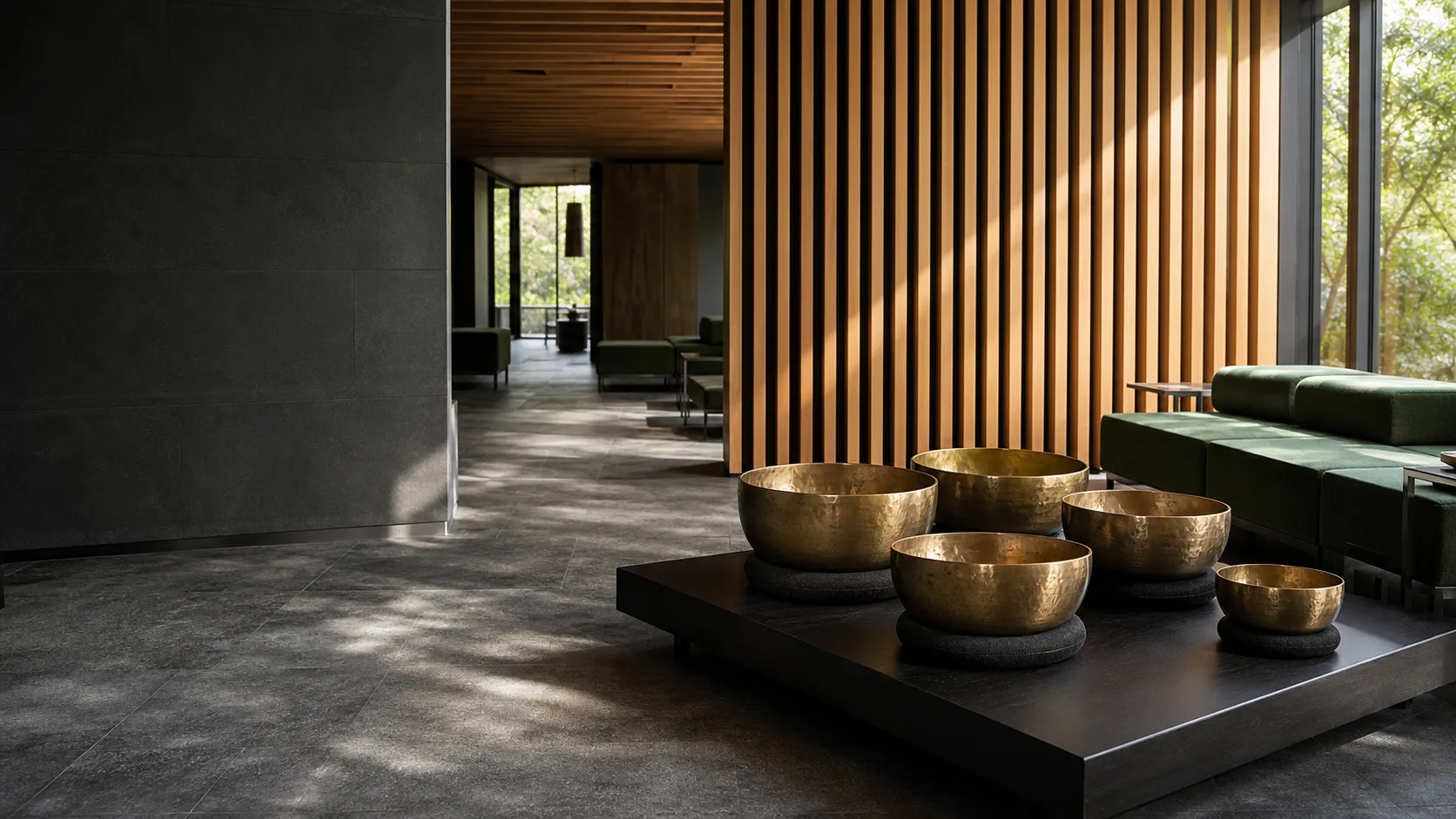
Design One Class From Member Need to the Real Timetable
A class earns a lasting place on the timetable when members can say why they would book it. One person wants a clear, choice-led first encounter in a trusted yoga studio. Another wants a regular listening and relaxation ritual. A learner may want hands-on control of an identified bowl. A teacher may need observed practice in reading the room, moderating level and stopping. These are different jobs. A longer duration and a higher price do not turn one generic sound sequence into a useful portfolio.
A first-experience class should reduce uncertainty rather than create mystique. Before booking, state total duration, actual sound time, seated or reclining format, likely changes in level, general purpose and personal choices. At the start, members should know they can move farther away, ask for lower intensity, use a quiet position, pause or leave without disclosing a personal reason. At the end, they should understand what happened, whether the format suits them and what a genuine next option would be.
A recurring member class needs an honest reason to return. It may be a stable listening and relaxation ritual, or it may teach basic attack, stopping, silence and instrument care. Both can be valuable, but the listing should distinguish them. A mostly reclined listening class should not imply skill progression. Where handling is taught, members need observable feedback, not a progress label based only on attendance.
An advanced workshop starts with entry conditions. Name the listening, onset, stopping, force, mallet, support, care or sequencing tasks participants should already perform, and show how the teacher will check them. A premium fee, longer class or larger instrument set does not create an advanced level. Real progression means a more demanding task, enough individual practice, observation, correction and another attempt.
Teacher practice is about facilitation behaviour, not the name on a certificate. Include a clear introduction, observation of the nearest listener, changes to distance and level, an immediate stop, a pressure-free exit route, issue recording and a boundary for qualified referral. Rotating facilitator, participant and observer roles reveals more than memorising a fixed script. The studio may preserve a supervised practice record, but should not turn it into a medical, mental-health or professional licensing claim.
Give every sound a job. A bowl may mark the opening, bridge movement and rest, support focused listening, become an instrument-practice task or close the class. If the job cannot be stated, the instrument does not need to appear for visual richness. Silence is a designed element. Every added object increases placement, matching, storage, turnover and teacher attention, so the first version should use the smallest setup that fulfils the member promise.
Return every sound role to an exact instrument. Reconcile the item or defined collection with images, dimensions, mass, condition, mallet, support and complete attack-to-natural-decay audio. Repeat restrained playing three times under comparable placement, then hear the teacher position, nearest member, typical member and doorway in the actual studio. Controllable onset, clear development, repeatability, natural closure and the ability to reduce or stop matter more than low pitch, loudness, long decay, frequency language or a seven-bowl set.
KONGTONG LIVING places the class inside a modern, non-clinical TCM-informed singing bowl method. Traditional Chinese Medicine sound philosophy and the five-tone framework organise movement and stillness, density, rhythm, timbral relationships and silence. You Sheng asks whether usable sound appears reliably; Zheng Yin checks a clear tone centre and overtone relationship; Ding Yin checks repeatability under comparable action; Na Yin considers instrument, teacher, room and listener together. The final checks remain real-room response, stable sound and long-term listenability, not a health inference from a tone, frequency or body label.
Capacity is not the number of mats that fit. It is constrained by the nearest listening distance, entrances, teacher observation, instrument rotation, personal choice, building services, adjacent classes, cleaning and the next changeover. Rehearse the planned occupancy from member arrival through departure and room reset. A headcount that works only with showcase staffing is not suitable for the ordinary timetable.
Front of house carries part of the trust. The class name, audience, inclusions and exclusions, total duration, actual sound time, capacity, current fee or membership status, cancellation, late arrival, language, personal choice and next step should agree across the webpage, confirmation, reception explanation and teacher opening. If a member must message one teacher privately to understand the offer, it is not yet a dependable studio product.
Assessment should match the promise. A first-experience class can check comprehension and choice. A member class can examine delivery consistency, a basic action or the real reason to return. An advanced workshop needs a scenario or performance task. Teacher practice needs live observation. Satisfaction, reach and photographs may support communication but do not prove learning, facilitation capacity or long-term fit. Recheck the promise after any material change to the room, instruments, flow or occupancy.
The first format does not need a full weekly schedule. Hold the teacher, room, instruments, explanation and flow steady across a small number of real slots. Observe whether members understand, book, arrive, complete, request adjustment or opt out, rebook, and whether staff can reset the room. Fix one material issue at a time, such as unclear information, an overly strong nearest position or excessive occupancy, instead of changing price, teacher, instruments and timetable together.
Once one class is understandable, bookable and repeatable, decide whether the next investment is a recurring member class, an advanced workshop or teacher development. KONGTONG LIVING can match sound roles and the exact room to current instrument directions and complete audio, identify teaching and handover needs, or move a proven class into a broader yoga studio sound-program plan.
SAVEABLE COMPARISON
Choose One Class Members Will Understand and Book
The four formats answer different member needs. Make the most important one work on the real timetable before adding another.
| Class Format | Why a Member Books | How It Works in the Room | Confirm Before Timetabling |
|---|---|---|---|
| 1. First-Experience Class | A first encounter with the format, sound and personal choices, without a competence or treatment promise | Short commitment and small group; explain expected sound, positions, lower-level and quiet options, and opt-out; use the minimum instruments for a clear arc | Reception can explain it; exact instruments and complete sound are checked; the nearest position is controlled; the next class can start on time |
| 2. Recurring Member Class | A dependable listening or relaxation ritual, or a clearly named basic handling practice worth repeating | Keep the service version, room, main instruments and rhythm consistent; record comparable delivery and member feedback without treating attendance as progress | The return value is clear; an ordinary teacher can deliver it; instruments, mallets, placement and level remain stable; member and cancellation terms are explicit |
| 3. Advanced Workshop | A more demanding listening, technique or sequencing task for people with defined prior experience | Publish prerequisites and allow enough individual practice and feedback; add complexity only when it serves the learning task | Entry skills are observable; capacity permits individual feedback; assessment matches the promise; a foundation route exists for people not yet ready |
| 4. Teacher Practice | Supervised practice in demonstration, observation, lowering level, stopping, opt-out response and scope communication | Rotate facilitator, participant and observer roles, preserving actual actions, feedback and the next practice focus | The observer and responsibility boundary are clear; practice is not sold as medical competence or a professional licence; local title, insurance and business requirements are checked separately |
How to use it: choose the format that fits the strongest current member need and the studio's real teaching capacity. Bring the timetable, room, teachers, instruments and booking information into the review. KONGTONG LIVING can return a first class structure, sound roles, exact-instrument directions, teaching gaps and room checks.
Compare Four Class Formats in a Real Member Journey
Use the format table to choose the class, then walk discovery, booking, arrival, participation, choice, departure and rebooking. When a step still needs private explanation, clarify that one class before adding another.
| Your Question | What to Notice | KONGTONG LIVING View | What to Do Next |
|---|---|---|---|
| Discovery and booking | Are the name, audience, total duration, actual sound time, fee or membership status, cancellation and personal choices visible before confirmation? | A member should not need a private message to one teacher to understand the class. | Narrow the promise and align the listing, reception and teacher. |
| Real room and nearest position | At planned occupancy, do listening distance, circulation, teacher observation, quiet position, lower level and opt-out work? | Mat count cannot substitute for sound and service capacity. | Reduce occupancy, move instruments or lower the sound version. |
| Exact instruments and teacher delivery | Can an ordinary teacher repeat the identified instruments, mallets, supports, complete sound, placement, force, stopping and essential actions? | Stable sound and useful feedback matter more than instrument quantity. | Obtain exact evidence, practise and complete a cover handover. |
| Close and next class | Can departure, instrument checks, cleaning, storage, feedback and setup for the next class fit the real interval? | The close should not pass delay or unchecked instruments to the next booking. | Lengthen turnaround or simplify the first class version. |
FAQ
Which singing bowl class should a yoga studio offer first?
Choose the format members can understand and the team can deliver consistently now. A small first-experience class often makes explanation, room sound and personal choice easier to test, but a recurring member class can be the right first offer when its return value is already clear.
Can all four formats use the same bowl or instrument set?
Yes. Shared instruments can create a useful baseline, but recheck the sound role, handling, capacity, room distance and assessment for each format. Shared equipment does not make the class promises identical.
Should singing bowls close every yoga class?
Do not make that the default. Test one class, teacher and real changeover first. Sound should not displace instruction, rest, member departure or setup for the next class, and members should know the arrangement and choices in advance.
Does strong member enjoyment prove the class works?
Enjoyment matters, but also examine whether the class is understood, reliably booked and delivered, controllable at the nearest position, genuinely optional, operationally sustainable and worth booking again.
Does an advanced class require more bowls?
No. Progression comes from clear prerequisites, a more demanding listening or handling task and useful feedback. Add an instrument only when it supports a distinct learning need.
Does teacher practice create a professional credential?
Not by itself. It is a supervised practice and feedback process. Certification, registration, insurance, professional titles and local requirements need separate verification.
What should a studio share with KONGTONG LIVING?
Share current members, the real timetable, room dimensions and adjacent uses, one proposed format, teacher experience, capacity, existing instruments, booking route, budget and target date. KONGTONG LIVING can return a class structure, sound roles, evidence gaps, teaching needs and room checks.
Glossary
- Class format
- A bookable class defined by audience, promise, duration, capacity, sound role, personal choice and assessment.
- Member promise
- The experience, learning or practice result a member can understand before booking and judge after the class.
- Sound role
- The specific job assigned to a bowl or silence at opening, transition, focused listening, participant practice or close.
- Exact instrument
- An item or defined collection that reconciles images, dimensions, mass, condition, mallet, support, complete audio and delivery terms.
- Personal choice
- The ability to choose distance, lower intensity, a quiet alternative, pause or exit without disclosing a private reason.
- Long-term listenability
- Sound that remains clear and controllable across the planned distance, duration and repeated classes without quickly becoming burdensome.
References and Method Boundaries
These references separate classical theory, modern acoustic or room research and claims governance. The classical five-tone framework is not modern clinical evidence, and KONGTONG LIVING's sound grading is a proprietary instrument standard rather than a medical or clinical classification.
- Yoga Alliance Ethical CommitmentUsed for yoga-teaching responsibility, scope, consent, inclusion and honest communication. It does not register, certify or endorse KONGTONG LIVING, a teacher or this class.
- WHO Global Standard for Safe Listening Venues and EventsUsed for conservative prompts on level responsibility, audience information, quiet options, monitoring and staff preparation. It is not a singing bowl efficacy standard.
- ISO 12913-1:2014 Acoustics — SoundscapeA soundscape definition and conceptual framework supporting a planned, designed and managed approach to room sound.
- Huangdi Neijing SuwenA primary classical source for historical Chinese medical sound and five-tone correspondences. It does not establish a TCM origin for singing bowls or clinical evidence that singing bowls treat insomnia, anxiety or other conditions.
- FDA General Wellness: Policy for Low Risk DevicesUsed to distinguish general-wellness language such as relaxation and everyday stress management from disease diagnosis or treatment claims.
- FTC Health Products Compliance GuidanceObjective health-related claims must be truthful, non-misleading and substantiated; KONGTONG LIVING therefore avoids diagnosis, treatment and outcome promises.
- ASA/CAP Health: Therapies (General)UK advertising guidance requiring objective efficacy claims for health therapies to be supported by appropriate evidence; this supports the distinction between subjective wellness use and treatment claims.
How KONGTONG LIVING Judges a Yoga Studio Singing Bowl Class
KONGTONG LIVING does not judge a yoga studio class by instrument count, mystical language or longer duration. Professional delivery means members understand why they would come, exact sound remains stable, restrained and listenable in the real room, teachers can observe and adjust, reception can explain the offer accurately and the ordinary timetable can fulfil the promise. Build one class worth rebooking before adding the next.
Class, Teacher and Health Boundaries
This guide provides general yoga studio class, sound-instrument and service-design education. It is not medical, psychological, legal, credentialing, insurance or certification advice. The Yoga Alliance Ethical Commitment is used only as a reference for teacher responsibility, scope, consent, inclusion and honest communication; it does not register, certify or endorse KONGTONG LIVING, a teacher or a class. WHO safe-listening materials provide conservative prompts on level responsibility, information, quiet choice and staff preparation, not evidence of singing bowl efficacy. Traditional Chinese Medicine sound philosophy and the five-tone framework inform KONGTONG LIVING's modern non-clinical method; no claim is made that singing bowls originated as ancient TCM treatment instruments.
Share the Four-Class Comparison With the Studio Team
Share this with someone planning a sound-healing space: test the room, guest flow, staff and operating model before specifying more instruments.
Before a Yoga Studio Singing Bowl Class Inquiry
Prepare the members, timetable, room, teachers and instrument information so KONGTONG LIVING can review the most useful class format, sound roles and training or room conditions still required.
- Current members and the one class need to address first
- Real timetable, room dimensions and finishes, adjacent uses and changeover
- First proposed format, duration, capacity, fee or membership status
- Teacher, cover and reception capability
- Current bowls, mallets, supports, actual-item evidence and complete audio
- Budget, city and intended opening date
Prepare One Yoga Studio Singing Bowl Class
Prepare One Yoga Studio Singing Bowl Class
Prepare One Yoga Studio Singing Bowl Class